HOME DESTINATIONS ISLANDS MAGAZINE BLOGS PHOTOS TRAVEL SPECIALS CONTESTS REQUEST INFO VILLA RENTALS CLASSIFIEDS
All the Way to Fancy
Exploring the road less traveled on St. Vincent's windward coast.
 Printer friendly page  Email to a friend

I prefer to arrive on a Caribbean island after dark. When the aircraft door opens, the sudden inrush of hot, moist, scented air brings the essence of the place to you in a single breath. The smells are sweet flowers and wood smoke, and more often than not there are puddles on the asphalt from the shower that ended five minutes before, and the continual background rustle of palm fronds in the trade winds.

Inside the terminal you blink your way through the standard gauntlet of wooden-faced customs and immigration officers. You and your luggage are somehow swept into a vehicle, and suddenly you're jouncing down an unlit, potholed road with only glimpses of houses and people and trees. No matter how hard you stare through the car windows, you see only swift fragments; you drift to sleep anticipating the morning.

I had wanted, after many years of traveling among the various Antilles, to see one of them - St. Vincent - from a different perspective than the usual resort or charter boat. The specific vantage point I had in mind was the seldom-visited windward side - the raw, jagged, unprotected coast onto which the Atlantic breakers are driven by the unending northeasterly trade winds.

Why? Partly, I suppose, because a rocky windward coast has the same scary fascination for a sailor like me that a rooftop ledge has for an acrophobe. And partly simple curiosity about what it would be like to live, however briefly, on the receiving end of the blustery trades, in a West Indian town that wasn't deluged with outsiders.

St. Vincent I knew from previous visits as an island of precipitous, verdant beauty, and not by any means overrun with tourists. Before independence came in 1979, its history followed the Caribbean pattern of flip-flop ownership by colonial powers. On St. Vincent, however, there was the added factor of 100 years of fierce resistance by the Caribs - whom the British didn't completely conquer until 1796, some 13 years after they had ejected the French.

St. Vincent's publicized attractions are mostly natural - like its superb botanic gardens, in operation since 1765, and Mesopotamia Valley, an enclave of unbelievable fertility surrounded by mountain ridges. The island's dependencies, the comet's tail called The Grenadines, are perhaps the most delightful cruising ground in all the Caribbean.

But St. Vincent's Atlantic shore I knew only from the map, which showed a bold and rocky coast with a thin scattering of villages. Georgetown, the largest of them, lay about 20 miles up the coastal road; more pertinent for me, it had the sole guest house on that side of the island.

The proprietor, Ferdie Toney, had volunteered to meet me at the airport, and locating him was even easier than I'd expected - he stood a full head taller than any of the cab drivers waiting outside - a solidly built man with a thick mustache, a broad smile, and a round gold plaque lettered ft hanging from a chain around his neck.

As he piloted his van up the swooping Windward Highway, he did his best to maintain a conversation, but I missed most of it. The van's radio, which was emitting an unbroken stream of good advice on everything from diet to municipal cleanliness, wasn't much help, but the principal distractions were Ferdie's grand prix driving style and the tantalizing glimpses of spectacular scenery.

At one point, as we rocketed around a succession of blind turns and narrow switchbacks, a long stretch of moonlit beach was spasmodically visible far below us. A few minutes later we passed a cluster of ruinous stone buildings that looked as if they'd been around since at least the 18th century. Then the van shot through a pleasant village, whose streets were mysteriously jammed with people, and hurled itself at a sheer hillside that suddenly opened to reveal a narrow tunnel - an "undermine" in local parlance - cut through 250 feet of solid rock.

Georgetown, when we finally arrived, was an arrow-straight empty street with darkened two-story buildings on each side. The ocean was invisible, but I could hear the breakers plainly, and not far away. Ferdie gave me a lightning tour of the premises.

The guest house, called Ferdie's Foot Steps, was a three-bedroom suite sharing (with the town's only restaurant) the second floor over the town's principal store, which offered everything from pencils to booze to chicken parts to a "tonic" from Trinidad that, I later learned, contained significant amounts of strychnine. My brain was reeling as Ferdie explained the vagaries of the plumbing, and I was asleep before I hit the bed.

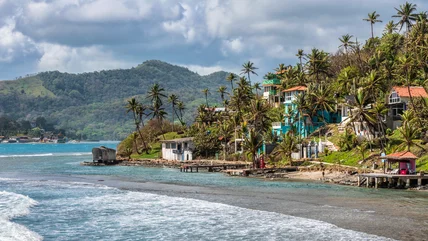
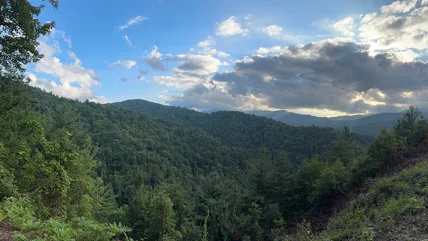
by daylight - and on foot - the Windward Highway was very different from the surreal roller coaster I'd ridden the night before. Most of the time it paralleled the shore, behind the inevitable row of palms edging the beach, with fields and fields of broad-leafed banana plants on either side. Here and there intransigent rock ridges ran down to the beach, and the road switchbacked its way up them, or cut inland to get across a streambed. Whenever the road managed to gain some altitude, the vistas opened up amazingly - to long lines of white surf breaking on the black sand; deep ravines edging streams that tumbled down from the dark green highlands; ancient- looking stone churches and plantation buildings that looked abandoned but probably weren't.

The clouds were moving fast from east to west, and as the sun was veiled or revealed, all the colors changed and then changed again. Almost every panorama contained tiny flecks of blue - pieces of the semitransparent plastic bagging that protects ripening stalks of bananas. Used and reused until it shreds, the plastic never really dies, and discarded bits footnote the windward-side landscape everywhere.

The highway, a two-lane asphalt strip, was getting a lot of play, most of it at high speed. Big, open trucks alternated with the brightly painted minivans that provide Vincentians with public transportation - and their owners with self-expression. Besides elaborate paint jobs and iridescent decals, the vans almost all carried hand-painted names. Some were obvious enough, like Man Sydney, Thunder, or God's Gift, but I did wonder what had impelled one owner to christen his Toyota Brave Worrier, or why another had hit upon Fairy Queen for his ancient, sturdy, open-sided bus, with its rows of wooden seats. Some owners, overwhelmed by inspiration, gave their vehicles different names front and rear; I saw one that was both Shaggy and Moon Raker as it approached and Doggie Fresh as it departed. Doggie Fresh? There are some things it is better not to know, and this, instinct told me, was one of them.

The few other pedestrians regarded me with what seemed like wary suspicion, and their greetings - the customary mumbled "OK" or "All right" - sounded even more reserved than was usual in ex-British islands. The penny didn't drop until a very young Vincentian, watching me trudge up the hill toward him, could no longer contain himself and demanded, "You preacher?" By coincidence both my bermuda shorts and polo shirt were navy blue, which must have suggested to him a uniform - clerical - as well as an explanation for the presence of a middle-aged white man, on foot, on the Windward Highway.

The calendar may also have had some effect on the boy's logic: Good Friday, part of the most important religious holiday of the year, was the next day. According to Ferdie, most Vincentians would spend at least three hours in church - and they would fast as well.

When I returned from my walk, my little upstairs room was filled with music. The restaurant radio across the hall was serving up rock interspersed with bursts of evangelical preaching, while across the street a soprano was apparently rehearsing her Good Friday solo, with occasional prompts by an off-key piano and a neighborhood dog. In the building behind me a group was singing hymns a cappella, accompanied by an eerily familiar rhythmic whockety-whock of metal on wood. I was in the shower before a childhood memory suddenly kicked in: spoons. The unseen percussionist was playing spoons, and they sounded just the way they used to on radio's Original Amateur Hour long ago.

The worshipers began to fill Georgetown's main street a little after sunrise, overflowing the sidewalk and gathering in clumps outside the town's several churches. The majority were women and children, much more formally dressed than churchgoers in the United States would be. As I munched hot cross buns in my second-story lookout, the ambience looked sociable as well as godly, and remarkably cheerful for people facing three hours of a tropical morning under a pressed tin roof.

Most of the buildings fronting the highway were, like Foot Steps, two stories, most also had second-story balconies, and most balconies, I could see, were occupied by male Good Friday shirkers like me. Well, I would make up my delinquency on Easter Sunday, but first there were other things to see, chief among them St. Vincent's most obtrusive natural attraction, the volcano of Soufri¿re, looming 4,000 feet over the north end of the island.

St. Vincent's soufri¿re shares its name (which in French means "sulfurous") with at least two other ill-tempered Caribbean peaks. Vincy's most devastating eruption, in 1902, killed 2,000 people, and it has erupted as recently as 1979, but timely warning ensured that no lives were lost then. Still, the potential for a shattering disaster remains very real, and the crater is monitored as carefully as any in the world.

The hike up Soufri¿re begins at the end of a two-mile branch off the Windward Highway, a side road that services some of the island's largest banana plantations. The trail has recently been rehabilitated, with a parking lot, shelters, and even latrines at the bottom. No wonder it has become a favorite weekend outing for the citizens of Kingstown. (And where, I wondered, were they all? Maybe their absence on this cloudy morning should have told me something.)

The first part of the trail was wide, flat, and almost ladylike in pitch.The surroundings were tropical rain forest - incredibly thick, incredibly green - with only occasional openings in the verdure, view points into steep-sided ravines that emphasize you're already several hundred feet above sea level.

At 1,350 feet the trail suddenly opened onto a stagelike expanse of smooth rock, through the middle of which a small stream had cut a trough and given the place its name - Riverbed. Here the ascent abruptly got down to serious business: The next mile or so was mostly stepped, with crosslogs to hold the cindery earth in place. The dripping rain forest closed in on either side, but every once in a while the trees opened up and I found myself looking straight down at the tops of other trees, a hundred feet or more below me.

Suddenly the trees above me seemed to have shrunk to shoulder-high shrubs. I was above the tree line, and shortly thereafter the manicured trail came to an end, at a spring called Jacob's Well, formed from a single hollowed-out rock. Along about here the drizzle, almost unnoticed before, turned to rain, gentle at first and then harder, until it was driving almost horizontally, in sheets that actually stung my skin. The trail seemed to have multiplied tenfold, but the apparent paths were just runoff ditches cut into the cinder surface by rain.

Two young Vincies came bounding down the hill - I saw them only dimly through the pelting rain, though they were no more than 50 yards away. "You're nearly at the top," they called out. "You're nearly there."

Heartened, I kept on trudging, head down, but the gully I was following soon flattened and disappeared. I looked up just in time to glimpse through the shifting gray curtain what appeared to be a handful of youngsters in Boy Scout uniform, traversing the steep slope at an angle. I hastened over and discovered a good track upward.

Just as I was congratulating myself, the rim of Soufri¿re's crater suddenly, unexpectedly, appeared at my very feet - a narrow ridge of soft, cindery earth beyond which was nothing at all. Cautiously I stretched out on the sodden ground for a peek over the edge. The inner side of the crater fell away vertically, and though I could see down only 20 feet or so, it was more unsettling than a clear view might have been.

I got to my feet and headed back down, long crunching strides over the wet path. For some reason the main trail was far easier to see in this direction, even with the wind and rain in my face. On the way I encountered three Americans - yachties, from their dress - toiling their way upward. "You're almost there," I cried, with the heartless cheeriness of the downbound. "Just a little farther."

It was a long, long walk back to Georgetown, especially the stretch through the banana plantations, where the sun came out and I began to parboil under it. A tremendous craving for bananas gradually crept over me, but I didn't quite have the nerve to help myself from a stalk. Most of those looked rather green anyway. Finally I came across a windfall lying by the side of the road. It was small and brown but delicious far beyond expectation - with a deep, rich, almost smoky flavor, quite unlike the Ecuadorian baseball bats I was used to from supermarkets at home.

Easter afternoon, I made up for Good Friday by going to a fund-raising concert in the Methodist church. My companion was Mary Burgess, a nurse from Winnipeg placed by the government in a small clinic a few miles up the coast.

Despite the formal setting and the presence of a lady from the Ministry of Education who served as emcee, it was immediately clear that the fund-raiser was essentially a family party, and every performer was greeted with enthusiastic and somehow knowing applause. Appropriate vocal numbers by a choir of half-a-dozen ladies alternated with old-fashioned declamations, in which a tightly wound teenage girl stepped before the audience, gave a quick, jerky bow, and launched into a memorized monologue, with gestures, on an uplifting subject ("Easter Evening Thoughts," "Footsteps in the Sand"). It was like being in a 19th-century time warp, and I couldn't help wondering if the ghost of Booth Tarkington was sitting in the back of the room taking notes.

Far and away the biggest hit was a costumed skit by four of the choir ladies. The first lady entered alone, and after a minute or two it became apparent that she was the Virgin Mary shortly after the Crucifixion, and understandably depressed by it. She was joined by two others in vaguely Middle Eastern veilings, one representing the satisfied recipient of a miracle, the other a messenger announcing the Resurrection. And finally - sensation! - the oldest and most spirited choir lady appeared as the risen Jesus, to provide the happiest ending of all.

It was hard to know who was having more fun, the performers or the onlookers, and the feelings of collective affection and pride fairly vibrated off the plain whitewashed walls. As the chattering, laughing crowd surged out into the street, we were enveloped by a sense of community that may not have been religious but was almost palpable.

Later, over drinks on Foot Steps' upstairs balcony, Mary told me of her work at the clinic in Overland village, and also of accompanying the government physician on his weekly rounds in the four-wheel-drive ambulance, all the way up the windward coast, past the road's end, to the tiny, isolated village of Fancy, on St. Vincent's northernmost tip.

"You've got to see Fancy," she told me several times. "It's absolutely out ofthis world."

I could ride in the ambulance, she added, when it went up on Tuesday. She would set it up.

The ambulance to Fancy that was supposed to leave a little after 8 finally pulled out just before 10, and from an entirely different departure point than the one advertised. Our complement consisted of a young resident doctor from the hospital in Kingstown (very much on his dignity), a lady pharmacist, and the driver, Lennox Ballantine, all in the front seat; and me, slipping and sliding on the single bench seat in back, where I shared space with a stretcher and two slightly overdressed young ladies who were also hitching a ride.

The first stop (except for a few more hitchhikers) was the cheerful village of Owia, where the doctor checked the action at the local clinic. By the time we arrived, school was in recess, and impromptu cricket matches were in progress anyplace there was room to plant a wicket - even the middle of the dusty road, where the wicket consisted of three dead palm fronds balanced to form a sort of tripod. Cricket is a national obsession on St. Vincent, as it is throughout the Caribbean, partly because almost anyone can afford the basic gear (a tennis ball and a hand-whittled bat), partly because it's the one sport in which the islanders have been able to meet the rest of the world on even terms.

The Windward Highway really ends at Owia, though it continues on a few optimistic maps. The mostly dirt track that edged around the north end of St. Vincent called for all Lennox's skill, and I could see why patients in the ambulance would need to remain strapped into the stretcher. What I couldn't see was how they'd survive the trip.

Around blind turns and up steep ridges we crept, past almost vertical hillsides painfully terraced to provide enough flat ground for a subsistence crop of peanuts, cassava, potatoes, breadfruit, pears, tomatoes. The houses were tiny, even simpler than those farther down the coast, but the formerly ubiquitous blue plastic was absent, and there was little of the squalor produced by masses of trash, because people up here had little or none to throw away.

Fancy sits well above the sea, a thin sprinkling of tiny houses on a wide shelf below pristine hillsides. It has two public buildings - a large, good-looking school and the clinic, which also contains the resident nurse's apartment. The clinic's massive foundation is an old arrowroot mill, and the huge, rusty mill wheel still looms over one end of the building, next to a modern phone booth.

A phone booth? Call it, rather, a political promise awaiting fulfillment, as it contained no telephone, and the phone line had stopped with the electrical line, not far past Georgetown. But I also saw three TV antennas, and Lennox told me that there were indeed sets connected to them, powered by automobile batteries.

While the doctor and the pharmacist dealt with the week's dozen or so patients, Lennox and I strolled through town, passing a couple of streams in which people were washing their clothes and themselves, more or less together. British reticence was much less in evidence here, and people stared openly at a white stranger.

We paused in one of Fancy's two shops, picking our sodas from an ice chest whose top was lashed down to keep the cool in. It was a tiny, dark, bare shack, with an old-fashioned scale - the kind with metal weights - on the wooden counter, and big sacks of rice and flour behind, under a couple of shelves that held the rest of the stock: cans of meat, some basic pharmaceuticals, a few bottles of rum.

We wandered down the dirt road to its end, a small beach fronting on a tiny harbor that nestles behind a semiprotecting bluff. A few home-built, outboard-powered boats were pulled up on the shore. I'd seen a couple of them fishing off Georgetown two days before, and Lennox told me they sometimes made the trip down the leeward side to Kingstown, more than 20 miles away, or even across to St. Lucia, though only very rarely. I was trying to imagine the skill and nerve required to take a 15-foot outboard across 25 miles of wind-whipped Caribbean, when my eye fell on a pair of raftlike craft pulled up on the rocky little beach off to one side. Each consisted of five roughly shaped logs held together with wooden pins. They were perhaps the most primitive artifacts I'd seen since I'd come to St. Vincent. In a way that nothing else could, those little boats brought home to me what it must be like to make one's life in Fancy.

Suddenly I knew that when Mary had called the village "out of this world," she was speaking the literal truth, at least as far as I was concerned. Fancy was out of my world, or beyond its farthest edge.

But the windward side had got into my system, as I realized next day, when 21 of us (one carrying a 19-inch TV) squeezed into a minivan for the hour-long trip to Kingstown. St. Vincent's capital is a sizable port and market town only by West Indies standards, but it seemed to me, after nearly a week in Georgetown, overwhelmingly metropolitan and bustling.

Sauntering down the crowded, narrow streets, pausing to stare into the shops (which were mostly larger versions of Ferdie's grocery cum everything else), I felt like the original hayseed country boy in the big city.

Kingstown doesn't extend itself for visitors. There's one large souvenir shop, whose air-conditioning is powerful enought to halt blood circulation, but the only other attractions inside the city proper are its open-air market and its three big churches. After a dutiful tour, I crammed myself into another minivan.

Twenty-five fellow riders, a downpour that forced us to keep most of the windows closed, and an earsplitting live broadcast of the West Indies vs. South Africa cricket match created a whole new definition of togetherness, but I didn't care. I was going back to the windward side.

  ISLANDS Twitter Updates more +

Reserve Your Free Trial Issue Today!

Simply fill out this form to receive a complimentary issue of ISLANDS! If you like it, pay just $14.97 for 7 more issues (8 in all) and receive a Free Travel Bag with your paid subscription. If ISLANDS is not for you, write "cancel" on the invoice, return it, and owe nothing!

The FREE trial issue is yours to keep - no obligation!

  Name:
  Address:
  City:
  State/Province:
  Zip/Postal Code:
  Email:
  Non-US Residents - Click Here
Digital Delivery Option - Click Here
Customer Service | Contact Us | Advertise | Site Map | Privacy Policy & Your Privacy Rights | Terms & Conditions | e-Newsletter Signup
Visit Our Sister Sites at Bonnier Corporation:


Copyright © 2008 Islands. All rights reserved. Reproduction in whole or in part without permission is prohibited.