Reader, if you be of those who have longed in vain for a glimpse of that tropic world - tales of whose beauty have charmed your childhood, and made stronger upon you that weird mesmerism of the sea which pulls at the heart of a boy - one who had longed like you, and who, chance-led, beheld at last the fulfillment of the wish, can swear to you that the magnificence of the reality far exceeds the imagination."
So wrote Lafcadio Hearn after returning from Martinique in 1889. Hearn, who authored Two Years in the French West Indies, was one of those travelers, rarely found now, who lingered in places that charmed him. He had intended to remain in Martinique for a few months; he stayed two years.
I didn't have the luxury of so much time, but I wanted very much to see for myself what could still be seen of his vivid world where handsome, superstitious Creoles lived on rugged mountains covered in fragrant blooms and primeval trees. And I wanted to wander on black-and-gray Caribbean beaches awash in birdsong and see the old colonial city of St.-Pierre, where Hearn had written of "shadows... reaching their longest, and sea and sky...turning lilac," of "palm-heads...trembling and masts swaying slowly against an enormous orange sunset."
Martinique, like all the French islands, is a matinal place - it is most energetic in the morning. On the day my wife, Laura, and I arrived, families embraced and wept just outside the customs area of Le Lamentin airport in Fort-de- France, and representatives of hotels and taxi companies stood holding signs listing the names of monsieurs and mesdames. It was the time of the French grand vacance, when tourists swarm, Martinicans from the mainland return, and children come to spend summer with grandma. The honking of taxis, the hubbub of greetings, and the bright tropical air were tonic.
We picked up our rental car and Laura took the wheel, maneuvering the little conveyance through the chaotic traffic. The highway into the city was a looping ribbon that climbed and fell between hills. The city revealed itself slowly. Clusters of houses hung precariously on the edges of cliffs. The ocean glimmered vastly around every curve, and tropical light fell with brilliant generosity on everything, including advertisements for cars and soft drinks. Driving through Fort-de-France was a challenge, but Laura rose to the occasion: As the road plunged beneath a river of traffic that had few discernible rules, she adjusted her attitude and began to go audibly native.
Once, pulling up to stop beside a lively park, something distressing happened: Laura couldn't find reverse. A few locals, mostly old men having their morning chat, gathered around us and tried to help - without success. At last, a young businessman, amused by our problem, laid his briefcase on top of the Renault and did the trick by pulling up on the stick shift. This otherwise trivial event was, to me, emblematic of a still-surviving island ethos: People will gather at the drop of a hat to assist, give directions, offer comments. In some ways Martinique is still like a village in which people make up their own entertainment.
The old downtown is home to a large park called La Savanne, where we gazed on a statue of the 19th-century hero Victor Schoelcher, who helped abolish slavery on the island. There was also a famous sculpture of native fille Josephine Bonaparte. Sadly, her head was gone. According to the story we heard, it would not be returned until the demands of an unnamed political group were met. A stripe of red paint ran down from her neck, recalling the red string that French aristocrats who had managed to survive the Terror wore around their necks. Josephine, the daughter of a Martinican planter, had come within days of losing her own head to the guillotine during the French Revolution, and her first husband, an aristocrat named Beauharnais, was in fact beheaded. Freed from prison, Josephine married a petty officer named Napoleon, who aspired to greater things.
Legend has it that, though spared brutality herself, she prevailed on her husband to maintain slavery on the island. That legend may have had something to do with the disappearance of the statue's head.
Just outside the city center, we entered a busy market by the river. The market was a cacophonous jumble of stalls offering everything from guavas to straw hats and sunglasses. An ancient woman with a deeply lined face squatted impassively, displaying several small limes spread on a red handkerchief at her feet. A young man held out a single breadfruit to passersby. (A breadfruit looks something like a cartoon bomb, fuse and all.) An enormous man at a makeshift table hacked a huge fish - a tuna or a dolphinfish, perhaps - with a machete. He held out red hunks of fish to shoppers who bought it as fast as he cut. Adjoining the street market was the covered market, a cornucopia of local spices and exotic fruit, where I bought a bag of dried bois d'Inde, a type of allspice.
Two restaurants in the market were doing a booming business serving people at long communal tables. As we approached one at Chez Hector, people happily moved over to make room for us. The waitress was trailed by her serious-looking ten-year-old daughter, who seemed intent on learning the business. The two of them bore patiently under my labored French and perfect ignorance of the menu and then brought us a broiled whole fish in a tangy mango sauce, accompanied by rice, baked sweet bananas, and slices of a boiled root I didn't recognize. A basket of fresh sourdough bread and butter completed that perfectly satisfying repast.
Aime Cesaire is one of the great writers of the 20th century - a world-renowned poet who is also the founder of modern Martinique. As a poet myself, I had long admired his writing, and I was gratified when the nonagerian man of letters - who for 45 years was mayor of Fort-de-France - consented to speak with me.
He received us in his office at the colonial-era Hôtel de Ville, the former seat of city government that is now home to the municipal theater. While waiting in the antechamber, whose walls were hung with photographs of the poet with world leaders, I read to Laura from Césaire's best-known poem, "Notebook of a Return to My Native Land."
And we are standing now, my country and I, hair in the wind, my hand puny in its enormous fist and now the strength is not in us but above us, in a voice that drills the night and the hearing like the penetrance of an apocalyptic wasp, and the voice proclaims that for centuries Europe has force-fed us with lies and bloated us with pestilence....
While those lines express a militant view, Césaire's relationship with Europe was fraught with ambiguity. The poet studied in France in his youth and became an important member of the Surrealist movement. Later, he was a leader in the Afrocentric cultural and political movement known as "Negritude," which condemned the French colonizers, changed race politics throughout the Caribbean, and affected the black-power movement in the United States. But after World War II, when Martinique was at a crossroads and had to decide between independence and autonomy within France, Césaire agreed to stay with France.
As I thought about this, Césaire appeared suddenly in the doorway of his office, smiled, and waved us in. He was tall and distinguished, his handshake was firm and warm, and he looked at Laura with an unmistakable sparkle in his eyes. We sat in a semicircle of three comfortable chairs and talked. That is, I asked a couple of questions and Césaire talked. He had indefatigable energy.
He talked about the history of Martinique and his role in it - his defection from the French communist party in 1956 and the founding of his own political organization, the Progressive Party of Martinique. He talked about the legacy of slavery, the beauty of the island's landscape. He complained about younger writers who no longer remembered their African roots.
We'd been there for an hour and the poet showed no signs of fatigue. His secretary came in twice, but Césaire waved him away. Finally, I asked him to sign his book of poetry for me. In exchange I gave him one of my own. He wrote, "To Andrei and Laura, thank you for your interest in the fate of the Antilles."
When we left, I asked him how he managed to stay so young.
"The secret," he said, "is to never stop searching for yourself."
His answer, like his warm handshake, lingered for a long time.
The Carib Indians called Martinique "Madinina," or "island of the flowers." Even in Fort-de-France, a cubist jumble of layered buildings carved precariously into the cliffs, we encountered sudden bursts of vivid blooms. And the fanning palm known as "traveler's joy" surrounded the civic monuments and peeked from behind houses like the spread fingers of a hand.
We headed south out of the city to our next destination, the quaint seaside village of Le Diamant. Hearn had written that travel in the West Indies was "slow, irregular, and difficult." The days of car travel haven't rendered that observation obsolete. Even though the island is only 50 miles long and 22 miles wide, the mountainous terrain presented many obstacles. But the spectacular scenery made up for the effort. The brilliant sea appeared and disappeared as we rounded the steep hills, known as mornes. Scents from fragrant grasses and flowers burst through the open car windows.
When we arrived at the Hôtel Diamant-les-Bains, a small family-run establishment located on the narrow main street of LeDiamant, Madame An drieu, the charming manager, sized us up and declared us ready for a bienvenu, or welcome. We then had the first of many 'ti punches, the island's signature drink made with light rum, cane syrup, and lime juice. Our sun-dazed brains received a violent rush from the concoction, which proved an immediate road-blues cure.
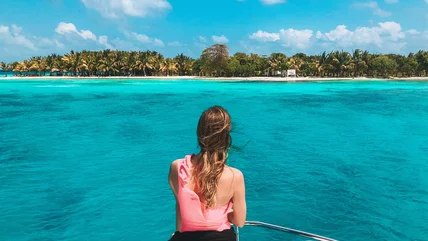
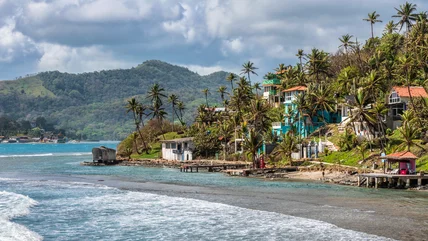
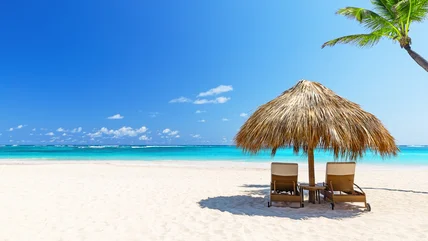
In our room - a modest bungalow with a small balcony - a sign behind the door warned, "Avoid staying under coconut trees, falling fruit could occasion unfortunate accident." As we took the flower-bordered path to the beach, I looked up now and then at the tall palms cradling clusters of big coconuts under their faraway tops. The sand was warm under my feet and the ocean stretched out before us. We entered the azure, bath-warm Caribbean like children abandoning themselves to a fairy tale.
Not far from the beach was the "diamant" itself, a black rock rising from the ocean like an ungainly growth on a perfect body. That so-called "diamond" had once been held by the British Empire, which positioned 100 or so unfortunate soldiers on it and baptized it the HMS Diamond Rock. When the men, drunk on rum that had been floated over in barrels by the French enemy, allowed their un-moving ship to be taken, they were court-martialed. None of that solemn past attached to the rock now as the evening settled over it and a special kind of Martinican cricket called "birds' pipe" or "kra-kra" filled the air with its melodious trills.
The main street of the old village of Diamant was dotted with ancient one-room Creole cottages, their shutters peeling brown and orange. Their roof tiles looked like red tongues. At the end of the street was the cemetery, overlooking the sea. Built of white or black tile and fitted with sliding shower doors, the crypts resembled small houses. Inside were altars festooned with framed portraits and porcelain flowers. Some of the names of the deceased were touchingly handwritten. We spent a quiet moment by the tomb of one Monsieur Justin Roc. There was something sweetly serene about the place, with its fragrance of seaweed and ginger, and the soft surf licking the beach below.
From a table at the Planète-Diamant café, just outside the cemetery, we watched some roosters pecking on the hillside. The steep, narrow street descending from the hill was named Rue Justin Roc, presumably after the man whose grave we had just visited. I thought it must be comforting to live one's life well in such a village, and then be buried with a view of the peaceful sea.
EARLY THE NEXT DAY WE took on the hairpin turns of route D37, rounding Morne Larcher to the other side of the "diamond." Driving that road was like riding a cobra, but Laura enjoyed it, and cried out "Weeee!" like a kid, every time we roller-coasted around a turn. We passed the fishing village of Les Anses-d'Arlet, as picturesque as Gauguin, who lived briefly on Martinique, might have painted it; then L'Anse-Caffar, where large birds rode in the sky above the mornes.
We stopped to investigate the Slave Memorial at Diamant, a grouping of 15 bigger-than-life statues - each over eight feet tall - looking out to sea. Erected in 1998 in celebration of the 150th anniversary of the abolition of slavery, the monument faced the spot where an anonymous brig carrying slaves had sunk. Eighty-six African captives were saved, mostly women and children. The fate of the survivors, however, was uncertain. The slave trade had been outlawed by the Congress of Vienna in 1815, but it was still legal to own slaves on Martinique. Rather than allow the victims of the wreck to remain with an undefined status on the island, we were told, the authorities shipped them off to French Guyana.
As we contemplated the monument and read the inscriptions, a group of children played hide-and-seek among the stone giants. A little girl in a bright yellow dress stood with her eyes closed against one of them, counting silently while her friends hid. The setting sun tinged the sky with extraordinary oranges, purples, and reds. The girl opened her eyes and took off in search of her friends, flitting like a butterfly between the tall, sullen, faceless men made of rock and sand.
Later that afternoon, we stopped at the Clement Distillery, a still-operating rum producer that has a fine display about the history of the liquor, as well. We visited the house of the original Creole master, which was still filled with hardwood colonial furniture and protected from the sun by a luxurious and well-trimmed canopy of flowering vines. Among the barrels of aging rum arranged in the deep coolness of the storehouses stood display cases containing miniature replicas of Columbus's Ni¿a, Pinta, and Santa Maria. On the walls were photographs of planters and traders - serious, bearded men who had moved the precious commodity across oceans. There was also a picture of slaves fighting the waves while pushing huge barrels of rum toward a ship waiting at some distance. Rum and slaves and suffering were inseparable.
Madame Yveline de Lucy de Fossarieu and her husband, Charles, were true békés, as descendants of Martinican planters are known. When we arrived at La Frégate Bleue, the inn the couple owns near the village of Le Fran¿ois, Madame was quite agitated. She welcomed us warmly but begged us to forgive the large sheets of plywood lying about. The night before, Hurricane Chantal had threatened the island. We happily disconnected voyagers had had no idea. The danger had passed, but there were other crises: Madame's four Parisian granddaughters were being prepared for their return home to France the next day, after having spent the summer with her in Martinique.
While Madame gracefully showed us to our light-filled room on the first floor, she invited us to dinner that evening, presented to us her pleasantly taciturn monsieur, and had the four granddaughters introduce themselves politely one by one. The girls were delightfully happy, tan, musical, curious - and lacking any desire to return to France. The catastrophe involved one teenager, who had left her shoes at a party the night before. They had to be retrieved urgently, before departure.
"Can you imagine," Madame asked with mock horror, "the scandal of returning the child to France barefoot?" Madame invited us to go along with them to retrieve the girl's shoes. Laura and I piled into the backseat of the car as Madame de Lucy, sitting up front with the barefoot Parisian gamine, sped between hilly banana groves lining the rough dirt roads. The intense green was broken now and then only by dazzlingly white mansions and glimpses of the sea.
The teenage girl had danced barefoot all night and left her shoes in the environs of a splendid villa. Verandas, gazebos, and a swimming pool with a waterfall dotted the vast lawn surrounding the mansion. A graceful French-woman who was renting the place from Madame de Lucy's first cousin pointed out a line of surf opposite the house. The sea between the reef and the land - known as "the baths of Josephine" because the future empress had supposedly bathed there, along with the daughters of the other Creole planters - was as smooth as a mirror.
Miraculously, the shoes were found.
Back in the spacious living room at La Frégate Bleue, Madame showed us a photo album of Martinique's most beautiful hotel, Leyritz Plantation, which she and her husband, Charles, had bought and restored. Leyritz had been the site of the 1974 summit between President Gerald Ford and Prime Minister Giscard d'Estaing. Ford, d'Estaing, and Henry Kissinger were photographed standing between neoclassical columns under an intensely blue sky.
Among the de Lucys' many other island relations were the Clements of Clement Plantation. Monsieur Charles revealed, after some prodding by Madame, that he traced his ancestry to Richard the Lionhearted. Compared with such lineage, Josephine Bonaparte's family, though noble, was just a bunch of Johnny-come-latelies.
Charles prepared dinner, serving what he referred to as "a simple repast" on the veranda extending from the cathedral-size living room. Two halves of a lobster accompanied by a homemade lemony mayonnaise were laid on each plate. Salad and cheese were served simultaneously, although Madame did not entirely approve. "Serving the salad and cheese together is a new thing; I'm not sure I like it," she said.
The granddaughters ate at their own table, flitting musically by to interrupt the grownups now and then. I remarked that French traditions seemed to be better kept on Martinique than in France, and that Madame's granddaughters must have been learning how to behave on the island. Madame de Lucy beamed proudly and confessed that she became quite melancholy when she pondered the manners of present-day France. Old families such as theirs had a duty to maintain the traditions.
We met Lucien, a tall, fierce-looking man, on the A waterfront at Le François. He putt-putted us in his motorboat to a small speck in the middle of the ocean, were we climbed a barnacled stair to a rickety dock. We were met there by Monsieur Bruno de Lussy, a middle-aged man with the wistful air of a beached adventurer. He led us to a shady bar in a mangrove, where he poured us 'ti punches. Although his name was spelled differently, he too was a relative of the de Lucys. Together with Madame Sylvie Loron, who waved from a kitchen window, he ran this exclusive island for the happiness of a few gourmands. The lunch that we were about to experience had been written about before, and true connoisseurs had known about it for years. We sat in sturdy chairs under a thatched palm roof on the edge of the sea, as the fabled dishes began arriving. First to appear was the traditional crab farcis with cucumber salad. I asked Bruno if he had used the same crabs we had seen scurrying over the dock. "The same kind," he replied, "not the same." They tasted rich and peppery, only lightly mixed with celery and bread crumbs. Then came dolphinfish baked in a shallot-cream sauce accompanied by a dish of grated green papaya that tasted for all the world like sweet cooked sauerkraut.
French bread and butter shored up these rich preludes to the formidable pièce-de-résistance: a regal monster lobster that must have been 100 years old. I had never seen its kind and felt an awe that almost prevented me from eating it, but after asking the creature's forgiveness, I proceeded - by brute force rather than refined instrumentation - tearing huge chunks of white meat from the red shell and dividing them between Laura and me. We dipped the sweet flesh occasionally into the piquant white mayonnaise that, Monsieur Bruno assured us, was a family recipe going back to Charlemagne. (It was entirely possible, I thought, that no French inhabitant of Martinique ever descended from anyone more recent.) Between our assaults on the monster, a couple of green salads came and went. I can't precisely recall their composition because the light white wine Monsieur served, combined with the 'ti punches and the royal lobster, created an indescribable headiness.
The dessert did not look like much at first: coconut flan floating in syrup. But just a touch of the custard to the tip of my tongue quickly produced a narcotic effect that reverberated through me as if my whole body were a breaking violin string. Monsieur de Lussy stood proudly by as we succumbed to the effect of the best flan in the world.
As we drove along the next day, Mount Pelée - which has, curiously, the same name as the Hawaiian goddess of volcanoes - rose quite suddenly from a bend in the steep road, its crest surrounded by clouds. Lafcadio Hearn had been in awe of the mountain, even before it erupted so spectacularly and with such devastating results at eight in the morning on May 8, 1902. The sudden eruption sent molten rock and ash raining down on the city and its harbor, killing 30,000 inhabitants and destroying all the ships in the harbor.
Everything in St.-Pierre looked burned, volcanic, stilled. We climbed into the ruins of the old theater, which had a view of the cloud-crowned volcano. From one of the blackened parapets, which still smelled faintly of fire, we looked down at what used to be the jail. There, a man named Cyparis, locked up for drunkenness on May 7, 1902, had spent the night; he was the only survivor of the eruption. After healing from his burns, Cyparis traveled the world with the Barnum & Bailey Circus, billed as "the sole survivor of St.-Pierre."
The magnitude of the tragedy escaped my attempts to understand it. I looked up at the mountain and when the clouds parted for a moment, Pelée showed her classically shaped cone. The volcano was still alive, but she was watched closely now. None of her moods would go unnoticed.
I took a small black stone from the surf to give to a poet friend who lives in New Orleans and loves volcanoes. The nearly translucent sea, the tall palms climbing the slopes, and the crown of clouds around the summit of Mount Pelée produced in me a certain melancholy. On Martinique, I thought, beauty comes at a price.
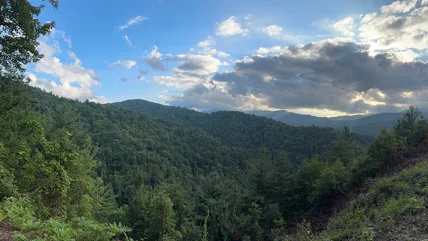
We drove through the island's interior. The surrealist layering of ferns, palms, and bamboo looked very much like the first woodcuts of the tropics I had ever seen, in books illustrated by the French master of the fantastic, Gustave Doré. The textured greens and the play of light and shadow through variegated foliage made it seem that we were half-floating in a watery dreamworld. Vertical rock walls covered with dense tropical foliage rose suddenly around dizzying curves. Waterfalls splashed from great heights to the dark forest floor, still carrying bits of sparkling light with them.
Parked at perilous angles here and there, locals filled plastic jugs with pure water from mountain springs. The villages of the interior, no more than narrow unpaved streets at times, were less colorful, cooler, and more mysterious than those on the seaside. They nestled in deep shades of green, aware of their stillness and difference.
The road climbed and climbed until we reached a hiking trail that led to the summit of Mount Pelée. The air was cool and misty; it had rained violently and briefly several times as we ascended. We parked and took the trail through the jungle and up the mountain, walking on rich volcanic ash.
"A vertiginous country," Laura said.
Precisely, and in all senses of the word: geographically, socially, historically - and poetically.