There she is, on the other side of the dance floor: Miss Jagger, clad in a dazzling white frock with a mile-wide smile and surrounded by supermodels, all of them grooving to an old-school reggae tune. On the super-hip Spanish island of Ibiza, resident Jade Jagger is the reigning queen of the night-life scene. She's even got her own Friday-night bash, called "Jezebel," held at the exclusive club Pacha in Eivissa (Ibiza Town). This is where I find myself well after midnight, sharing floor space with the hostess, nonchalantly slipping into her inner circle.
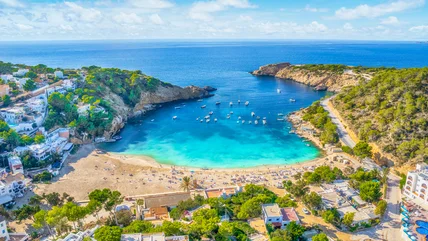
I count my lucky stars that I'm even here tonight, rubbing elbows with the glitterati on the mother of all party isles. Five days ago, fresh off the plane from California, I was at the bottom of the Ibiza food chain, a jet-set wannabe with only vague notions of how to get into Pacha, let alone dance with the stars. Having just passed a landmark birthday (one with a zero as the second digit), I got the idea that a week on Ibiza might be a great way if not to renew my wild youth at least to relive it for a couple of nights. Some guys pacify their midlife crises by buying fast cars, but I was satisfied with a simple trip into the hip: one last round of disco inferno before surrendering my soul to the AARP. And Ibiza seemed promising. For years I'd heard that this Balearic isle just off the east coast of Spain has the best night life in all of Europe, top dog in nearly everything by which night life is measured: the swankiest clubs, the most celebs, the biggest crowds. It's one endless party from June through September, when this island of approximately 111,000 people hosts nearly 2 million visitors.
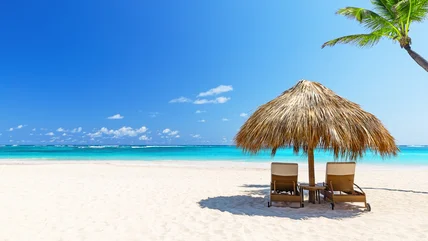
Over the last 30 years, many of the cornerstones of modern club life were developed or heavily refi ned on Ibiza, including electronic dance ("house") music and celebrity DJs. The island also has a reputation for the world's most debauched social scene sex and drugs of every persuasion set against a backdrop of sun-splashed beaches and warm Mediterranean nights. The scene has long drawn the rich and famous, some of them in passing (Bob Dylan, Bono and Penelope Cruz) and others for years at a time (Jade Jagger, Roman Polanski).
My quest in coming here beyond reliving my own glory days was to discern whether Ibiza really was the hippest scene in all of Eurodom and how it got to be that way. But given the fact that my face isn't instantly recognizable to the guardians of the velvet cordon, five days earlier that task had seemed easier said than done.
I'd packed my all-black clothes and planned to hit the ground running, jumping right into the club scene. Jet lag wouldn't be a factor, since my California bedtime is 8 a.m. Ibiza time, when people begin turning in. But as the sun set after 6 p.m. that fi rst day, I sat in my hotel room for the better part of an hour trying to muster my courage. The one thing I hadn't counted on was stage fright. Once upon a time, I wouldn't have thought twice about sharing a dance floor with hundreds (or even thousands) of sweaty revelers. But now I had the jitters, an almost paralytic inability to leave my hotel overlooking Playa d'en Bossa on the island's south coast, not far from the main city of Eivissa. I just didn't know how much mojo I had left, and there was this creeping paranoia that everyone would know from the moment I walked into the first club that I didn't have a hip bone in my body.
With the evening ticking away and the lines probably growing longer outside the island's seven huge "superclubs" (Space, Privilege, Amnesia, Eden, El Divino, Es Paradis and Pacha) scattered along the southern half of the island, I forged a temporary truce with my fear. Rather than diving in the fi rst night, I would glide slowly into the local vibe, starting with something I knew all too well from back home a rowdy beach bar.
I set out from my hotel room. Right up the shore was Bora Bora, a barefeet- and-bikinis joint thatched roof over a concrete slab that sold Corona and tequila shooters. The hard-core Balearic house music a lot of thump, thump, thump and not much in the way of lyrics was different from my usual California scene, but the club was not the least bit pretentious or threatening. Most of the patrons were twentysomething Brits or Scandinavians, many of them dancing on tabletops in various states of undress and intoxication. Having "been there, done that" in so many other places, I felt right at home.
Bora Bora lies beneath the airport landing path and, every time an airliner swooped down, the crowd erupted in a loud cheer, waving at the plane, hoisting bottles aloft and exposing certain parts of the anatomy to anyone who happened to be watching from above.
"I'm usually not like this back home," said a 30-year-old London lass clad in a thong bikini who sidled up next to me at the bar.
"You don't normally dance on tables?" I asked.
"Are you joking? I work for the British government. But coming down here brings something out in me. It makes me wanna be showy. You know what I mean?"
"Come on," she said, inviting me up on a table. But when I hesitated, another guy climbed up beside her. She looked at me as if to say, "You snooze, you lose." Which was exactly what I felt like doing. Worn out by the long fl ight, I didn't even make midnight that fi rst evening, but at least I'd stuck a tentative toe into the local night-life scene.
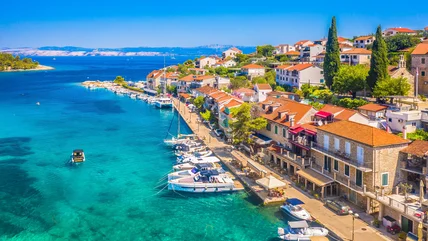
Refreshed by a good night's sleep and emboldened by half a dozen cups of Spanish coffee, I set out the following evening for Eivissa, about a 10-minute drive up the coast from Playa d'en Bossa. The town hugs the shore of a bay that bustles with yachts, ferries and the occasional cruise ship. Glitzy condo blocks and hotels dominate the north side of the bay, called the Marina district. The south shore is much older, a mishmash of just about every architectural style of the last 1,000 years gothic, baroque, art deco, you name it: a Mediterranean patchwork quilt replete with cobblestone squares, leafy promenades and outdoor cafes buzzing at sundown. In the fading light I sipped sangria in one of the plazas as a fl amenco guitarist strolled the ancient stones. There were lots of families about, and young couples mostly Spanishspeaking locals were engaged in romantic repartee.
My goal for this second evening was to wade a bit deeper into the night-life pond, although I still didn't feel ready for the major leagues. In fact, my journey into town was just another form of procrastination. Rather than booking a voluptuous escort like so many midlife males I would come across in Ibiza I had engaged the services of a freelance history guide. A drop-dead gorgeous female, mind you, but a historian all the same. Someone who would lead me on a walking tour around the old town rather than a prance around a dance floor.
She was Dominique LaCroix, a French woman who had married a Spaniard and settled on Ibiza. She whisked me into the Dalt Vila (High Town), the old walled quarter that dominates the heart of Eivissa. In a place so steeped in contemporary culture, it's easy to forget the island has a history that stretches back almost four millennia, embracing nearly all of the great Mediterranean civilizations. But over the next three hours, making our way through a maze of cobblestone streets, Dominique set me straight. "The Dalt Vila was founded 26 centuries ago by the Phoenicians," she explained. "And on this hill are the remains of all the civilizations that came after the Greeks and Romans, the Moors and the medieval Spanish. Fantastic, isn't it?"
Dalt Vila is fl ush with contrasts, from 16th-century townhouses that have been transformed into trendy eateries and boutiques to ramshackle old homes with wrought-iron balconies where gypsies still dwell. At the very top of the hill we came to the hulking cathedral, its ancient ocher stones bathed in fl oodlights. The church bells rang 10 times to mark the hour, but afterward you could have heard a cat pad across the plaza that fronts the church. From our vantage sitting on a stone bench on the city walls, we looked down on the whole of Eivissa, its dazzling harbor and the twinkling lights of Formentera, the smallest of the Balearic Islands, about 14 miles offshore.
Dominique and I talked about the island's more recent history and what had conspired to make it so glam. A hundred years ago, she explained, Ibiza was about as far off the map as you could get in Spain. The island was a poverty-stricken backwater that relied on fi shing, farming and salt for its meager livelihood. But after the Spanish Civil War of the 1930s, Spanish artists and writers began moving to Ibiza to escape the repression of mainland Spain. The island was so poor and secluded that Spanish general Francisco Franco let them be.
By the 1960s, Ibiza had evolved into an oasis of bohemian life. This, in turn, attracted a good number of hippies, many of them American, searching for another way station on a psychedelic trail that already included Katmandu and California. Some of these fl ower-power advocates were of the trust-fund variety, kids who could afford to outfi t their own villas and throw lavish parties that sometimes lasted for days. These parties inevitably attracted many young music and movie stars, setting the framework for Ibiza's transformation into a music hub and jet-set oasis.
"Some of the hippies are still around," Dominique happened to mention. "They have a big party at Las Dalias every Wednesday night. If you hurry, you can catch them."
So rather than slinking back to my room as planned, I found myself driving along country roads in the pitch dark, searching for some sort of hippie compound near the island's largely undeveloped northeastern end. About halfway between Santa Eulalia and San Carlos, I came across folks with shoulder-length locks and tie-dyed shirts milling in front of a sprawling old brick-and-adobe structure surrounded by olive trees. This had to be the spot. I drove around back to park.
As modern, capitalistic hippies (apparently not a contradiction in terms), the owners of Las Dalias impose a 25-euro cover ($32) for entrance into their magical mystery world. But it was money well spent, a trip down memory lane for those of us who are old enough to remember love-ins. Beyond the front gate I found myself at the weekly party known as Namaste, a lively night market where everything from cut-rate beads and bongs to expensive silk lingerie is available for purchase. Beyond that, a vegetarian restaurant is nestled beneath a vine-covered trellis. But the heart of the compound all part of the Las Dalias experience is a huge outdoor garden strung with twinkling lights and muslin, where hundreds of people recline on plush Oriental rugs and colorful Indian cushions, smoking weed and sipping wine.
Much of the crowd was "nouvelle hippie" not yet born when flower power bit the dust. But there were also vintage longhairs, such as the geriatric dudes lounging next to me and sharing a fat spliff.
Creaky joints didn't prevent either of them from dancing later in the evening. The world-beat-heavy entertainment included a duet playing didgeridoos and a dark-haired Spanish lass who warmed up the crowd with a blend of tantric chants and Mongolian folk tunes. The main act was a drum troupe that worked the crowd into a frenzy that had all of us on our feet, leaping and thrashing in front of the stage and howling at the moon like wild dogs, limbs akimbo, as we lost ourselves in the unrestrained freedom of the moment.
Whatever inhibitions I may have harbored upon arrival in Ibiza vanished in Las Dalias, felled by cheap wine, secondhand smoke and the magic of the moment. I hadn't just gotten my feet wet; the hippies had pulled me in over my head. Superclubs here I come.
With the weekend approaching, I figured it was time I got around to organizing my descent into the disco inferno. Collectively, Ibiza's seven superclubs have a total capacity of around 30,000 people, which means that on most nights there are plenty of tickets up for grabs. But as I considered my options for breaking into the ranks of the superhip (and rich), I had to consider the fact that the end-of-season parties on my to-do list are the most popular gigs, often sold out months in advance.
Several things like a royal bloodline or an eight-figure trust fund would have gotten me straight into any of the clubs. But seeing as I had none of these, my only option was a "fixer," someone who could help me overcome my social shortcomings. My would-be savior was Serena Cook, an English woman and longtime Ibiza resident who runs a company called Deliciously Sorted. She organizes and orchestrates island life for those who can afford not to lift their own fingers.
Meeting Serena over drinks in Eivissa's Plaza del Parque, I explained my night-life plight and asked her for suggestions.
"If this were August," she said, "I could probably get you into a private house party. Those are all the rage these days. But now the focus is very much on season-closing parties at the big clubs like Amnesia or Space. But the one you really want is Pacha. It has an older, more sophisticated crowd than the others. For VIPs of a certain age and style, Pacha will be their token club night. It's very glam, quite European."
Neither of which would describe me. But Serena didn't bat an eye when I inquired about the possibility of a commoner such as myself gaining access to the throne room.
She laughed and looked me up and down. "I don't know you look pretty dodgy."
"I can do basic black."
"Say no more!" she joked back.
No promises, but Serena would make a few calls, see what she could do. The conversation turned to other things, her friends drifting up to our table and Serena introducing me as if I were any other client. Nobody seemed to suspect that I was a night-life neophyte. It occurred to me for the fi rst time in my life that hip is largely in the mind of the beholder. Serena was cool, and she was hanging with me; hence, I was hip by association. Just like that, my doubts vanished.
The following afternoon I awoke to the sound of someone sliding a note beneath my door. A message from Serena Cook: She had scored VIP access to not one but two superclubs Privilege and Pacha.
By the time I got to Privilege on the outskirts of the village of San Rafael in the middle of the island at around 1 a.m., there were already thousands of people milling outside, waiting to enter. Privilege is the epitome of what sets Ibiza's night life apart from the rest of the globe's: size. A cavernous space, literally big enough to hold a jumbo jet, the club fl aunts more than 8,000 square feet of dance floor around a massive indoor swimming pool that (much like many a celebrity) doesn't seem to have a function beyond good looks. Privilege is also in the Guinness World Records as the world's largest nightclub (total capacity: 10,000). By the looks of things people elbow to elbow before the music had even started we'd reach that number tonight.
I was escorted to a VIP area with a private bar and a most excellent view of the seething mass of humanity everyone grooving to the music, working themselves into a dance-hall trance. Looking down from my balcony perch, I could feel the palpable sense of anticipation, people waiting for the start of the stage show Manumission, which would comprise a good deal of the entertainment. Most of those on the main floor were under 30. But I was far from being the senior patron of the VIP section. There was a guy in a caftan, his long gray locks secured by a Native American headband. If I hadn't known that Timothy Leary was dead, I would have sworn it was he. There was also an older, outgoing Italian who had clearly come to Ibiza looking for action.
"There is this crisis in Europe," he told me. I figured I was about to get an earful about high taxes. "Most of the guys younger than I am have been emasculated by feminism to the point where they now act like females. They go to the hair salon, they get their nails done. Can you believe it? But now the women of that generation decide they don't like these girly men so much, which makes it much easier for someone like me."
I wanted to ask him why he was talking to me instead of one of the nearby females, but the show was about to begin. And when Manumission starts, nothing else matters. Few of the big Ibiza clubs organize their own parties; they rent their space to independent promoters and share the profi ts. The events can range from simple gimmicks like the foam parties at Amnesia to extravaganzas like the La Troya drag queen review at Space. Manumission's forte, which now unfolded before my eyes, is a risqué version of Cirque du Soleil: scantily clad acrobats and topless tumblers, dancing dwarfs and flaming hoops and a mock game show that featured simulated sex between cast members and eager volunteers from the audience. Dante's Inferno come to life.
I left the club and cruised down the hill into Eivissa, reaching Pacha in the Marina district at 3 a.m. I had to park blocks away and then run a gantlet in front of the club that ended with a doorman who was the spitting image of Riff Raff, the alien vampire in The Rocky Horror Picture Show.
Ambling up the ramp into the club, I wondered if I were going to be disappointed after the raunchy spectacle of Manumission. While Pacha was definitely a few notches down on the debauchery scale, it felt much more glamorous from the get-go. The clientele was a bit older and much better clad than at the other clubs, and the space was posh with candlelit tables and classy bars rather than a huge soulless warehouse that stinks of stale beer.
Wading into the crowd, I slithered down into the dance pit, awash in frenzied movement and whirling flesh the music, the lights, the musky aroma made a full-scale attack on my senses. Celebrity DJ Pete Tong, one of the pioneers of the Balearic house sound, was spinning vinyl in an airborne booth as people took his picture with their cell phones and literally passed the shirts off their backs for autographs. The Pacha house dancers wearing fluffy, Marie Antoinette-style frocks and futuristic fly-eye headgear were freak-dancing on platforms.
Clustered around a main hall are side rooms and stairways that lead to a breezy rooftop garden bar. It was at the Jezebel party in one of these side rooms where I wound up spending most of the night, first and foremost because the music was more familiar to me and also because I dug the vibe warm and friendly.
It was Jade's idea to create this alternative club within a club, an intimate place that spins rock and hip-hop rather than techno and house. Plush sofas and carpet-covered benches invite you to lounge and listen rather than fl it about. And that's exactly what I did bought myself a drink and pulled up a seat, dancing as the mood and the music took me.
Everything came full circle around 5 a.m., when Jezebel's DJ played "Start Me Up." A quarter-century ago when the tune first came out, I was at Candlestick Park when the Rolling Stones did this number. And now here I was, grooving to the song on the same dance floor as Mick's kid. I wasn't just reliving my past, I was doing it one better. Amazing what you can do in just five days on Ibiza.