HOME DESTINATIONS ISLANDS MAGAZINE BLOGS PHOTOS TRAVEL SPECIALS CONTESTS REQUEST INFO VILLA RENTALS CLASSIFIEDS
Potluck in the Cook Islands
 Printer friendly page  Email to a friend

One morning on Aitutaki, in the Cook Islands, I was down at the harbor, watching a line of people - mostly old women - fishing along the seawall. Another American man, also watching, asked one of the women to pose for a photograph with the fish she had caught. The woman happily complied and, egged on by her companions, started clowning for the camera.

Something one of the women said, in Cook Islands Maori, caused a great deal of cackling laughter, so I asked an islander standing nearby for a translation. With only slight hesitation, he answered, "One of the mamas is telling the other, don't look at the camera, look between his legs."

Humor, sometimes earthy, is an attribute of Pacific islanders that visitors are often unaware of - particularly when a joke is made at their expense. Cook Islanders, too, I discovered, not only have this trait but also have adopted as their own some of the "pulling your leg" kind of humor common in New Zealand, with whom they have close ties.

I hadn't gone to Aitutaki looking for humor. I had gone because I had heard that it was the Bora-Bora of the Cooks: a classic South Seas atoll, with a bit of volcanic island in the lagoon. But first I went to Rarotonga (the Cooks' Tahiti) because you have to go to Rarotonga first. The day I arrived, I was sitting on the veranda of a waterfront restaurant, reading a local paper, when I came across a couple of puzzling sentences in an article on tourism: "Europe showed a consistent decline in numbers throughout the year following the loss of 747 services from Air New Zealand. That's a pity, because the soft light and cool temperatures of Europe lends the European a delicate, while still intriguing flavour."

After several readings of the passage, I turned to a man sitting at a table near mine and, showing it to him, asked if the text seemed to be saying what I thought it was. After reading it two or three times himself, the man, who was Polynesian, said: "No cannibalism on Rarotonga. Only Aitutaki."

A few days later, on Aitutaki, I was sitting with Queen Manarangi Tutai, on the front porch of one of the guest cottages she and her family had recently built themselves.

"What about cannibalism?" I asked the queen, a stately, gray-haired woman who is one of the island's several ariki, or high chiefs. "Did it ever happen on this island?"

"Oh, no," she assured me. "Only on Rarotonga."

There was the incident, she admitted, when her village forced all the inhabitants of another village into an oven and cooked them alive. But that was in retaliation for a wrong allegedly done to the chief's daughter and had nothing to do with anything as barbaric as cannibalism.

I never did get to the bottom of the eating habits of the ancestors of the present-day Cook Islanders. Nor was I ever quite sure if the queen, whose E-mail address is queen@aitutaki.net.ck, was pulling my leg. (My own attempt at humor, asking her if the incident explains where the name "Cook Islands" came from, got an even more lukewarm response than most of my jokes do. Of course, I already knew that they were named for the famous British explorer, Capt. James Cook.) I did conclude, though, that on Aitutaki, even more than on Rarotonga, humor is one of the essential qualities of life.

"It is true," said Emile Kairua, a large, amply tattooed fellow who had been showing me around the island for a couple of days. "Among Cook Islanders, the Aitutaki people are known as the jokesters. Islanders are often shy, but on Aitutaki that is a word they don't know."

The humor might show up - and be entirely for the benefit of the performer - during a lagoon tour, when the driver might introduce himself with a made-up Polynesian name that would translate as "Rotten Mango" or "Sour Fruit." Or some pale-skinned tourist will be told that the new tattoo he's so proud of literally means "He who always pays too much."

Or it might occur when the Aitutakians are among themselves, doing the very difficult work of fishing with handlines for tuna, in small boats outside the reef - work that becomes even more difficult when the fisherman discovers, after a mighty struggle, that what he imagined was a tuna big enough to buy an airline ticket to New Zealand, is, in fact, an old anchor (thanks to the shenanigans of a fellow fisherman who was allegedly untangling everybody's lines).

Apparently, such joking is only one facet of the islanders' tendency toward a larger-than-life attitude.

"Aitutakians are very jovial, very straightforward, and love to talk," Kairua said. "All the great speakers and all the prime ministers of the Cook Islands, except the present one, are from here."

The reason for their outgoingness seems to be that it is one of the ways Aitutakians deal with the big island-small island rivalry: Rarotonga, with a population of some 11,000, is the New York City of the Cooks (a New York City whose police blotter contains such items as "A resident reported that a cow was wandering about"). Aitutaki, with 2,400 people, is the Chicago, or, more realistically, the Peoria. The residents have a second-city complex, and they have compensated by finding ways to make their presence felt.

Not that Aitutakians have any reason to feel shortchanged by what they have. The Cooks are made up of 15 major islands, roughly divided into a northern and a southern group, all lying a bit to the west of French Polynesia and east of Tonga.

The northern group consists mostly of isolated atolls having little of general interest, except for Manihiki, which you would know if you trafficked in black pearls, as the island is a major producer; and Suwarrow, which you would know if you had ever seriously contemplated living on a desert island. (In which case you would own a dog-eared copy of Tom Neale's autobiography, An Island to Oneself, in which the author recounts his solitary years on that otherwise unremarkable bit of coral.)

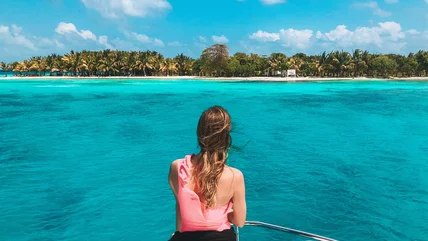
In the southern group are the two main islands, Rarotonga and Aitutaki, which I would submit is one of the most stunning atolls in the South Pacific. It has all the elements of reef and surf and palm-covered islets, but its most eye-catching feature is its lagoon, which from the air makes you think the color turquoise ought to belong to a food group.

"It was one of the largest and most beautiful lagoons I had seen," wrote author Paul Theroux in The Happy Isles of Oceania, the story of his sea-kayaking adventures through the Pacific. Aitutaki was an ideal island, he said: "Its people were friendly and gentle, its food was plentiful; it had no telephones, no cars, no dogs."

I know he was wrong about the cars, I have to wonder about the telephones, and as for the lack of dogs - they were all eaten, some claim - that would be of importance only if, as he was, you were surreptitiously camping out on islands where camping was not allowed. But the fact remains that for someone not known for heaping praise, he seemed quite taken with the place.

Paradise is seldom perfect, of course, and Aitutaki is no exception. For one thing, as is happening on many other Pacific islands, its population is abandoning it. In the past three decades about 15 percent of Aitutaki's inhabitants have left, and more continue to go. Combined with a similar exodus from Rarotonga, more Cook Islanders now live in New Zealand (whose political ties with the Cooks allow islanders the status of citizens), than at home. The reasons for the departures are classic: lack of economic opportunity and the imagined pleasures of life in a "First World" nation.

For another, the world is closing in on Aitutaki in a way that makes many who have chosen to stay feel besieged. An example, said Queen Manarangi, has been Air Rarotonga's efforts, for the convenience of tourists, to bring flights to the island on Sundays - an effort it suspended when locals dumped rubbish on the airstrip and threatened worse on the Saturday night before what was to have been the inaugural flight.

"Being a Christian country, we believe Sunday is our day of rest," the queen said. "And we would like to keep that tradition. Also, people pay a lot of money to come see us, and I think they want to see us for what we are."

Going to church on Sunday, in fact, is something almost all visitors do, in part because almost nothing else is going on. Even most restaurants are closed. The Sunday I went - to the Cook Islands Christian Church, in Arutanga - the singing was impressive, but for my taste the service dragged a bit long, which is why I know that 47 women in the congregation were wearing hats.

After the service I was standing in the churchyard with other congregants, talking with locals about the island's past, when one of them told me that the biggest danger to Aitutaki was that people were losing their ability to remember their own history.

"In the old days, every time you wanted to stand up in a public gathering and talk, you had to begin by explaining who you were, where you came from, and why you had the right to speak," he said. "It could take hours, but that's how we remembered our genealogy. But nowadays, long speeches aren't very cool, so if we aren't careful, we will forget who we are."

Yet despite these under-lying problems, I have no doubt that most visitors would agree with Theroux that Aitutaki is an ideal island. Nor do I doubt that the impression it made on its first European visitors played a role in history that, as far as I can tell, has been overlooked.

Those first visitors were the crew of HMS Bounty, and Aitutaki was the second-to-last place they visited before they staged their famous mutiny. It was very likely the beauty of the island and the friendliness of the people that tipped the scales toward their performing an act that every sailor on board knew would make them outlaws for the rest of their lives.

Oddly, on Aitutaki I ran into a descendant of Fletcher Christian, the most famous of the mutineers. I didn't have the courage to ask Steve Christian if he thought his famous ancestor or Captain Bligh was the bad guy. And anyway, he was more interested in telling me the history of Aitutaki before the Europeans arrived, because the site of the beachfront resort he managed apparently figured prominently in it.

Aitutaki's human history begins with the time of legends, when the great canoe migrations were traversing the Pacific. Coming from somewhere to the north was the "first canoe," commanded by a great chief named Ru. The story gets a little hazy for me here, because Christian told it over a bottle or two of wine in the resort's restaurant, not far from the spot where Ru's canoe (try to say that after a few drinks) allegedly landed. But the tale involved Ru's four wives, his four brothers, twenty beautiful maidens, and all the trouble you can imagine such a combination could cause. (Some of the most heinous hanky-panky, Christian said, occurred right where bungalow two now stands.)

Eventually, some of the clan were among those who sailed on, via Rarotonga, to discover New Zealand and become the people now known as the Maori. That's why the native language of the Cooks is basically the same as that which the New Zealand Maori speak.

The wandering spirit of those early voyagers seems never to have left the Cook Islanders.

"We've always been travelers," somebody else at the table with Christian that evening said to me. "That's how we got here. The Cooks were just the last transit lounge on the journey to New Zealand. And I don't think that voyaging thing ever left us. But now, instead of jumping into canoes and sailing off into the sunset, we jump into aircraft and fly off into the sunset."

Some of Ru's clan did stay behind, however, and apparently wasted no time developing their skills as pranksters. For instance, the reason the mountain dominating Rarotonga is flat on top is that during a raid they stole the peak, transported it back to Aitutaki by canoe, and plopped it down in the lagoon to form the island I was now on. Nor did they waste any time in developing the attitude that anything Rarotongans do they can do better. Their language is one example. Aitutakians feel that their dialect of Maori is so superior to that of Rarotonga that they don't like their children speaking the Rarotongan version.

To the visitor, however, a more obvious example is their dance.

Of all the arts, the one that people throughout Polynesia seem to excel at is dancing. More than anything else about Polynesian culture, the swaying hips of maidens and the athletic movements of men have mesmerized outsiders and made them fantasize that their next ticket will be one-way. By anyone's measure, Cook Islands dancing, which is faster and more suggestive than even Tahitian dancing, is considered to be among the best in the Pacific. And, at least to hear them tell it, Aitutakians are among the best practitioners in the Cooks.

"The Aitutaki men, they more lively the show, and the Aitutaki girls, they more beautify the show," the leader of one of Aitutaki's dance groups told me. "The girls, they are like flowers; the men, they are like warriors."

The secret, he said, besides the fact that islanders hear the drumbeat from the time they are still inside their mothers, is the aggressiveness of the men's movements and the side-to-side motion of the women's hips, unlike those of the Tahitians, and, even worse, he shivered, the Hawaiians, whose hip motion "is like washing machine."

If I wanted to see for myself, he told me, I should come that evening to the "Island Night" show at the Crusher Bar, a place that, I'd already discovered, had a much milder demeanor than its name might suggest. But he would apologize ahead of time, he said, because one of his best warriors was down. He had a cold.

The evening would be lively, no doubt. But I imagined that my day might be even livelier, because I planned to try my hand at fishing for tuna. I had arranged to go out with a fisherman named Long Tuiravakai, because I wanted to experience handline fishing for myself. I wanted to know what it felt like - using basically the same technique I did as a kid to wind in a kite - to catch a fish that could weigh up to 60 pounds.

So it was unfortunate that only after we had roared out of the pass in Tuiravakai's high-powered outboard did I realize that I was with one of the island's more progressive fishermen. Assisted by his wife and a young helper, he trolled for the tuna, using standard game-fishing tackle and big artificial lures.

I was mumbling to myself about how this was sissy fishing when the first tuna hit one of the two lines we were trailing behind the boat. As the line screamed out astern and everyone began shouting, it suddenly dawned that they were shouting for me to strap on the leather belt that the butt of the rod sits in and get to work.

Talk about work! Within two minutes I was gasping for breath; within ten, as the helper poured seawater over the reel to keep the line from melting, the muscles in my arms had contracted into knots I doubted would ever come untied; and, finally, after 15 minutes, a shimmer of silver, which grows in size every time I imagine it, broke the surface just long enough to spit the lure at me and disappear back into the depths.

With Tuiravakai and his crew doing most of the reeling in, we had better luck after that, and ended up with four and a half big tuna that would bring about 90 cents per pound in the local market. The half of a fish was the result of an attack by a six-foot-long shark, which clamped on and didn't let go until the top half of the unfortunate tuna was almost aboard.

How, I asked my host, could anyone possibly catch fish that big on a handline? The secret, he said, was not to be pulled out of the boat.

That night, during dinner at the Crusher Bar before the show, it occurred to me that I was very likely paying for tuna I had caught myself. The dancing, despite the absence of the downed warrior, was excellent. The men were lively, the women were beautiful, and those of us who were dragged up onto the dance floor were apparently very funny.

Funny, too, or so I gathered from the laughter of the locals, was a speech to the audience of mostly tourists that one of the warriors made in Maori.

I asked Kairua for a translation: "If you had been here before the missionaries came, we would really be having you for dinner."

It gave a whole new meaning to potluck. But seemed a small enough price to pay to visit paradise.

  ISLANDS Twitter Updates more +

Reserve Your Free Trial Issue Today!

Simply fill out this form to receive a complimentary issue of ISLANDS! If you like it, pay just $14.97 for 7 more issues (8 in all) and receive a Free Travel Bag with your paid subscription. If ISLANDS is not for you, write "cancel" on the invoice, return it, and owe nothing!

The FREE trial issue is yours to keep - no obligation!

  Name:
  Address:
  City:
  State/Province:
  Zip/Postal Code:
  Email:
  Non-US Residents - Click Here
Digital Delivery Option - Click Here
Customer Service | Contact Us | Advertise | Site Map | Privacy Policy & Your Privacy Rights | Terms & Conditions | e-Newsletter Signup
Visit Our Sister Sites at Bonnier Corporation:


Copyright © 2008 Islands. All rights reserved. Reproduction in whole or in part without permission is prohibited.