HOME DESTINATIONS ISLANDS MAGAZINE BLOGS PHOTOS TRAVEL SPECIALS CONTESTS REQUEST INFO VILLA RENTALS CLASSIFIEDS
The Enduring Allure of Polynesia
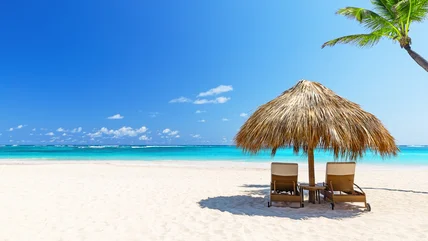
Who could resist the palm-covered beaches and perfect blue lagoons of Moorea and Tetiaroa? Why would anyone want to?
 Printer friendly page  Email to a friend

On Tetiaroa, a coral atoll 26 miles north of Tahiti owned by actor Marlon Brando, I am walking barefoot in the sand by moonlight and wondering if there could be anything more romantic. What complicates the question is that I am alone.

Originally the question had been, "What is it about French Polynesia's islands - Tahiti, Moorea, Bora-Bora, and all the others - that makes them, in our fantasies at least, the most romantic of all? Is it their physical beauty? Their tropical climate? Or, as one writer has characterized it, "the erotic mist that hangs over these islands"?

I had intended to find out the answer by journeying here from New York with the woman I will soon marry. We would begin with a brief stay on Tahiti, where an early European visitor, the French navigator Louis-Antoine de Bougainville (for whom the bougain-villea is named) described his first landing as being "transported into the Garden of Eden." Then we would go to spectacularly green Moorea, which half a dozen visits have led me to think of as one of the Pacific's most beautiful

islands. And finally we would end up on Tetiaroa, because we hoped to discover what it was about the tiny atoll that had so captured Brando's imagination that he attempted to turn it into his own private paradise.

Hand in hand, we would climb mist-shrouded paths to hidden waterfalls, watch the moonlight shining on banana leaves and palm fronds, listen to the rain falling on a thatch-roofed hut, and, of course, test the powers of that fabled erotic mist.

But then her work schedule wouldn't allow her to go, and mine demanded it. So¿

Since I was suddenly solo, my visit to Tahiti this trip was extremely brief - just long enough to collect my bag; walk through the crowd of ukulele players, flower presenters, and family and friends of returning locals (whose animation, at six in the morning, never ceases to amaze me); and make my way, along with the French and American couples wearing shiny new wedding bands, to the Air Moorea terminal. But the moment I stepped outside and felt the moist warmth of dawn, smelled flowers and burning copra, and heard the giggles of unseen women, I was reminded that, despite the often-chronicled growing pains of French Polynesia's largest community, I was once again back in paradise.

When I got to Moorea, whose precipitous mountains fold back and forth on one another like bunched curtains, I felt I was not only back in paradise but also back among old friends.

After taking a moment to marvel again at Cook's Bay, which, with its backdrop of high-rising peaks, is undoubtedly one of the world's most beautiful yacht anchorages, I caught up with artist Aad van der Heyde; he was still talking about the screenplay he has been writing ever since I first met him. Tour operator Hiro Kelley was still getting in the amount of surfing he felt his quality of life demanded. And journalist and guidebook writer Jan Prince was still celebrating the full moon by pulling the chairs from her house out into the yard and inviting friends to watch the heavens and have a barbecue.

There were new friends, too. Over lunch one day, after a morning of walking through the lushly agricultural Opunohu Valley, which sits like a bowl of pineapples in the in-terior of the island, I met a honeymooning couple from Georgia who invited me to their bungalow on Dream

Island. A place I'd never heard of, it turned out to be one of two small palm-covered motus on which Kolka Muller, a well-known hotelier in French Polynesia, had built a five-bungalow compound for himself, his wife, and their children. But these days the children were away, and since he was, after all, a hotelier, he had started renting out the empty bungalows.

"It is the dream of everyone to live on an island," Muller said to me as we watched my new friends from Georgia trying, with only moderate success, to master the art of paddling an outrigger canoe. "And to do it with somebody you love, of course, is better."

The problem is, he said, that although everyone says, immediately upon arriving on an undeveloped island, "I wish I could stay here forever," most of them, within two hours, want to go back to somewhere they can get a cold drink. Muller's solution is to offer a desert island with creature comforts - and a five-minute boat ride back to civilization.

"I think we are getting it," said the happy Georgia couple, in water so transparent as to be nearly invisible, as they ricocheted from one coral head to another.

"Yes, wonderful," called back Muller, adding, hotelier that he is, "and it is a skill you can pass on to your children, when you bring them back."

olivier briac is another entrepreneur with a desert-island dream. The Frenchman was a successful dancer and choreographer, but he gave up that life 19 years ago because he wanted to live on a South Seas island.

"In my old life I fly three days a week for business - Berlin, Madrid, Cairo, Hong Kong," he told me, as we sat on the shaded back deck of the houseboat where he now lives. "But I love my children. I want to speak with them, have breakfast with them. So one day I said I will go buy a small, deserted motu. It will be far away from business. Far from the fax. Far from the telephone. Right away I change my mind. Why? The first reason is that it costs one million dollars. The second is that I learn it is very selfish to live with children in such an out-of-the-way place. They have no friends. No nothing."

Briac was visiting Moorea, choreographing a show for an annual arts festival, when he realized that he'd found a paradise where sunrise filtered through palm trees and people said good morning to him in his own language. It also dawned on him that the fabulous Polynesian production would last only two days. But what if the show ran all year? He could help. And that is how the Tiki Village Theatre came about. On the west side of Moorea, in what was once a coconut field, Briac and a troupe of some 70 dancers, sculptors, tattoo artists, and craftsmen illustrate the traditional Polynesian way of life.

At the village - if you are willing to go through myriad formalities insisted upon by the French, or don't mind that the union won't be considered legal anywhere else - you can even be married in a traditional Tahitian ceremony, as some 20 couples a month do, including, about eight years ago, Dustin Hoffman and his wife.

"If you really love islands and really love her, what better way to show it than by marrying her againhere?" Briac asked, as we sat on the shaded deck of a houseboat that often serves as a wedding-night abode.

Jan Prince has lived in French Polynesia for more than 25 years, and her stories go well with a glass of merlot out on the patio of the Bali Hai at sunset. (The hotel may not have the social cachet it once did, but its history is as legendary as ever: The place was co-founded by Hugh Kelley - Hiro's father, who died last year. The elder Kelley was one of the Bali Hai Boys, who came out from California in the '60s and, with his friends Muk and Jay, started the hotel that became famous not only for its party-throwing hosts but also for its over-water bungalows - the first in the South Pacific.)

"What's romantic? Where to start?" asked Prince, who's working on a new book about playboys of Tahiti (a kind of how-to for women who want to live out their fantasies in the tropics). "What we are looking at right now, that's romantic," she said, waving her hand out toward an outrigger canoe moving slowly across calm water turned pink by the disappearing sun. "That's absolutely gorgeous," she said. "Especially when you take your glasses off and it's all sort of blurry.

"Sitting on the balcony of an over-water bungalow and looking at the stars at three in the morning. Standing at the edge of the sea when the full moon first comes over the horizon. Seeing a double rainbow. Sailing to one of the islands you haven't visited before. That's the romance of the South Seas. That's what I really love."

And what about places, I asked, thinking of Moorea - its reef, its mountains, its flowers, but mostly remembering an indelible image of a woman I once saw sitting alone on an upturned outrigger, playing a ukulele.

"There's Bora-Bora, when the sun is setting over Maupiti," Prince went on. "Rangiroa, at sunrise. But I still think the most beautiful place is Tahiti. Once, I lived for a while on the other side of the island from Papeete, in a place that was so natural, so beautiful, so romantic - so Polynesian. Every morning the old man next door would put on his straw hat, paddle out in his outrigger canoe, and go fishing. There was no motor on that boat. He would just sit out there very quietly and fish. Then two Tahitian ladies would come from the other end of the beach with a net to catch baitfish - no tops, pareus around their heads to put on if it got too hot later. That, to me, was the South Seas kind of romance."

Romance, she said, is not so much about a place - not even a place like Moorea, where the ukulele always seems to be strummed to a softer beat than on other islands - but about a frame of mind.

And having a person who can share that frame of mind, she said, is crucial. "I remember one day," she lamented, "walking on the beach with a Tahitian boyfriend and saying, ¿Oh, look at that sunset.' But he was looking for fish. Tahitians don't see beauty the way we do. They are looking at practical things.

"But then, once, I was on a bus, sitting in the seat next to the driver. When we stopped at a red light just outside Papeete, I looked out the window at a Tahitian girl on a Vespa. I saw an exchange of glances between her and the bus driver that woke me up. It was incredible how much they said with their eyes."

She sighed. Twilight was gone, and out beyond the reef a big moon was rising out of the water.

"There was one young man on the Aranui," she said, referring to the interisland freighter that carries both cargo and passengers. "He still calls me: He says, ¿I looked at the moon last night, and I thought about you.' I haven't seen him in over a year. But somebody who says he thinks about you when he looks at the moon - that's romantic."

And could a place be romantic if you were there without the person you wanted to be there with? A fianc¿e back in New York, for instance? I'd find the answer to that, Prince said, when I got to Tetiaroa.

The island was probably first visited by europeans when the HMS Bounty's infamous Captain Bligh came there looking for three deserters who would later be part of the crew that mutinied against him, but Tetiaroa had long been a kind of getaway for Tahitian royalty. In 1904 Tahiti's ruling family, the Pomares, gave the atoll to a Canadian dentist, Walter Williams, to pay off what must have been a considerable dental bill. Williams's daughter, who hadn't really altered the island, sold it to Brando in 1966.

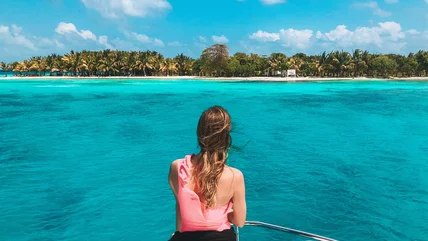
What he owned, I realized, as the chartered flight started descending toward what is alleged to be one of the shortest landing strips in French Polynesia, was a South Seas classic. A dazzling spot of white-fringed turquoise surrounded by dark blue ocean, Tetiaroa consists of a circular reef enclosing a dozen motus, with white-sand beaches, jungle green interiors, and a lagoon so many shades of blue that I, a committed Manhattanite, caught myself wondering, Why would anyone want to live in New York?

The landing strip - simply a swath cleared through the trees from one side of the narrow island to the other - was just steps from the hotel, which is not so much a hotel as a collection of less than a dozen thatched-roof bungalows. They were scattered among a grove of palm and casuarina trees alongside the lagoon, which, through the unscreened opening of my bungalow, lost none of the beauty it possessed from the air. I had a toilet and a shower and reassurances from the islander who showed me to my room that the electricity would be on for a few hours in the morning and evening.

Aside from that brief introduction - and except for meals served in the common area - the staff, who are the atoll's only full-time inhabitants, pretty much left me and the other eight guests alone. (The rest of the visitors included three couples and two French sailors who, I realized later, seemed to be a couple, too.)

Wanting to be left alone is undoubtedly one of the things that brought Marlon Brando to Tetiaroa. Of course, he had long been in love with the South Pacific. In his autobiography, Songs My Mother Taught Me, he says Tahiti had exerted a force over him ever since he was a teenager, when he began to thumb through old copies of National Geographic.

The image became real when he traveled to Tahiti in 1960 to star alongside Trevor Howard and a Polynesian actress named Tarita in the second of the three well-known movie versions of Mutiny on the Bounty. (The first, released in 1935 and starring Charles Laughton and Clark Gable, is noted for its best-picture Oscar; the third, released in 1984, with Anthony Hopkins and Mel Gibson, is known for its nudity.)

"From the moment I saw it, reality surpassed even my fantasies about Tahiti," Brando wrote, "and I had some of the best times of my life making Mutiny on the Bounty."

He had two children with his co-star, Tarita, and for years spent much of his time with them on Tetiaroa. "If I've ever come close to finding genuine peace, it was on my island," he said in his autobiography. Peace proved elusive, however, and after a series of family tragedies he stopped coming to the atoll and has not visited in almost a decade.

But on my walks around the island, I could see the beauty that had drawn him, and I came to admire him much more for recognizing it than for his role as the Bounty's Fletcher Christian, who, in the movie, has what must be the strangest British accent ever heard in all the Seven Seas.

There was beauty when I walked the beach at sunrise (not a particularly difficult hour to be up when the electricity goes off at nine at night) and watched the sand turn from pink to gold. There was beauty as I waded out to a sandbar, where the cries of birds mixed with the booming surf. And there was beauty when I sat in the shade of a palm tree, one with no coconuts directly above, and noticed a couple splashing in the water (who turned out to be the French sailors).

One afternoon, feeling the need to be even more solitary than I already was, I launched a leaky outrigger from the beach and paddled to a smaller, uninhabited island that had been beckoning from across the lagoon ever since I arrived. It has always been a dream of mine to live on just such an island, in the style of Robinson Crusoe, except that I'd want to arrive with a toolbox, a big roll of mosquito netting, and - a recent addition to the list - my fianc¿e. Since Brando already had his desert island, I could easily imagine that he would let this one be ours.

Our island, shaped something like a watermelon seed, had a shallow reef on the leeward side that would undoubtedly provide the fish that would go so nicely with our coconut bread, coconut salad, coconut cake, and coconut cocktails. It was blessed with a white-sand beach, nesting seabirds, and - because we would need some source of income and recycling is as good as any - just enough drifted-ashore soft drink containers to allow us to turn a profit. Best of all was a breeze-washed point, invisible to our neighbors over on Brando's island, that would make the perfect building site for the thatched-roof, screened-in hut where we could live in bliss - till cyclone season.

It was enjoyable work, planning a coconut kingdom. Still, I had lots of time to think, and I thought a lot about the question I had brought with me.

And my answer? Yes, a place or a moment can be romantic even if you are alone. Perhaps even more so than if you are with the person you love. Because yearning for what you don't have is much more intensely emotional than appreciating what you do. I realized this not on my desert island but - because there is, after all, something about the moon - on my final night on Tetiaroa. I walked alone along the beach, beneath the soft rustling of palm leaves, looked up at the full moon, and could think of nothing, honey, but you.

  ISLANDS Twitter Updates more +

Reserve Your Free Trial Issue Today!

Simply fill out this form to receive a complimentary issue of ISLANDS! If you like it, pay just $14.97 for 7 more issues (8 in all) and receive a Free Travel Bag with your paid subscription. If ISLANDS is not for you, write "cancel" on the invoice, return it, and owe nothing!

The FREE trial issue is yours to keep - no obligation!

  Name:
  Address:
  City:
  State/Province:
  Zip/Postal Code:
  Email:
  Non-US Residents - Click Here
Digital Delivery Option - Click Here
Customer Service | Contact Us | Advertise | Site Map | Privacy Policy & Your Privacy Rights | Terms & Conditions | e-Newsletter Signup
Visit Our Sister Sites at Bonnier Corporation:


Copyright © 2008 Islands. All rights reserved. Reproduction in whole or in part without permission is prohibited.