I am here to find some trace of Eibhl¿s O'Sullivan, whom I know only through the letters she wrote a half century ago from this island. This is her family's house; its walls are still intact. The home she shared with her husband is among those ruined stone cottages huddled against the slope like sheep in a storm. The door of this surviving house isn't locked. It opens to a room littered with fishermen's junk: a scrap of net, a couple of floats, hanks of line hanging from the rafters.
"My dear there is no place like home," Eibhl¿s wrote to a friend in 1931, when she was a 20-year-old beauty with wild black curls and a flashing smile. "The very day I'll have to leave it won't be a pleasant day for me. I think my dear heart will break that day."
I wonder, did she visit the Great Blasket later, after the islanders all left?
After a week of fog, wind, and rain, this island off Ireland's southwest coast is green under the morning sun. The dirt path I've climbed from the boat landing is slippery, and so steep I had to stop not even halfway to catch my breath. But up here at the top of the abandoned village, I'm among landmarks that were familiar before I ever laid eyes on them.
There, for instance, is the house that Tom¿s O'Crohan, Eibhl¿s's father-in-law, built with his own hands. "It isn't a large house," he wrote in his book The Islandman, "but, all the same, if King George were to spend a month's holiday in it, it isn't from the ugliness of the house that he would take his death."
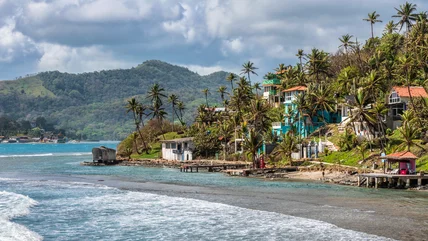
His house was roofed with felt, Tom¿s wrote. Now his house is roofed with nothing but the sky above, and green grass is its floor. Beyond its tumbling stone walls, I can see the White Strand, the long, lovely beach where the women gathered fresh sand to spread on their floors.
Today the Blasket islanders, their children, and grandchildren are themselves scattered like grains of sand, from Irish mainland villages to American cities. Their island is home only to flocks of storm petrels, guillemots, and razorbills - and Manx shearwaters that come screeching in at about one in the morning, a fisherman has told me, making a hair-lifting sound like a coven of witches cackling.
I slide to a seat on the damp grass and watch a pair of rabbits, the inheritors of the land, bouncing through a patch of eyebright and self-heal. The mainland at Dunquin is three miles to the east. I'm perched on the western edge of Europe, on ground important to Ireland's history.
Thirty-six years after the last few families left the Great Blasket, the Irish Parliament passed legislation to make the island a national historic park. Issues concerning land purchase have been in the courts for years, however, and this year, the Irish High Court ruled in favor of a group of private owners resisting purchase by eminent domain. But no matter what the future of the park, a spokesman for those owners told me, visitors will continue to be welcome on the island.
In good weather, ferries cross from Dunquin several times a day, leaving passengers time to explore the home of a remarkable brood who, as the poet David Quin wrote, "kept their boats high on the waves and their roofs low to the ground / and were grateful for seals when God withheld pigs."
The prettiest town in all of county Kerry, Dingle is built around a busy fishing harbor. It is nohardship to stay here for a few days, waiting for the skies to clear and for the water to calm enough to cross to the Great Blasket.
One morning I travel through fog that has overrun the coast road from Dingle to Dunquin. Gray stone walls have gone a damp lavender, and water drips steadily from the wild roadside fuchsia blossoms the Irish call "God's tears." The whiteout erases the sea below and camouflages the perils of cliff-hanger shoulders and tight switchbacks ahead.
The "Open" sign at Máir¿n Daly's Dunquin Pottery offers relief from the road. Shopkeepers here often have more than one string to their bow; Miss Daly's pottery shares a roof with her bookstore and coffee shop. The women in the kitchen are speaking Irish, but the boss slips into English as she offers me a choice of empty tables.
"Not many tourists out today, and who can blame them?" she asks. "Jesus, Mary, and Joseph, who can blame them? It's not likely you'll have much company today."
But Daly herself is fine company. She serves me fragrant chowder and thick-cut brown bread, then points out a gallery of photographs. "There's Robert Mitchum, that one's Trevor Howard, and she's Sarah Miles, of course." The photos are film stills from Ryan's Daughter, which was shot here in 1969.
Along another wall, Daly has displayed a personal collection of books. The titles are familiar: These are the books that have brought me to the Kerry coast. Here are first editions of Peig, the autobiography of Peig Sayers, and her later book, An Old Woman's Reflections. Two books are by Tomás O'Crohan. Others include Maurice O'Sullivan's Twenty Years A-Growing, M¿cheál O'Guiheen's A Pity Youth Does Not Last, Seán O'Crohan's A Day in Our Life. And I find my favorite, Letters from the Great Blasket. That modest book includes selections from the letters that Eibhl¿s O'Sullivan wrote to a Londoner named George Chambers, beginning in 1931, soon after Chambers visited the Great Blasket, and ending 20 years later.
Altogether, almost 40 published books have come from the Great Blasket, whose population never rose above 176, and there are memoirs and diaries still in manuscript form, as well as recorded oral histories. Many of the books were written by the islanders, but some were written by scholars and other outsiders, John Millington Synge and Dylan Thomas among them, who were attracted to the folklore and the pure Irish language. The result is a unique body of literature about life in a turn-of-the-century Irish fishing village.
"Have you been to the Blasket Centre yet?" Daly asks, after I say a reluctant no to rhubarb pie. "It's just along the road."
In fact, the Blasket Centre is the reason I'm out in the morning fog. And a few minutes after leaving Dunquin Pottery, I'm there.
The interpretive center, built with some of the money that has been poured into Ireland since the country joined the European Union, opened in 1993. It's a low, starkly modern building of stone and glass that fits snugly into a field overlooking Blasket Sound and the island. Inside are offices and a research library, exhibition wings, a restaurant, and a small theater, where a video includes the islanders' story in their own words.
Early fears that the center would bring to the area only "coachloads of befuddled grannies," with no idea of what the Blaskets were all about, have been assuaged, says Miche¿l de M¿rdha, the director. Most of the center's visitors know the Blasket story, for Peig was assigned reading for Irish schoolchildren for many years.
The history books note that the Great Blasket is the largest of the group of seven islands, and the only one that was continuously inhabited into the 20th century. There's written record that people were living there in 1597, but it's unlikely they were the first. The remains of an Iron Age fort encrust the northwest end of the island. And because excavations on the nearby Irish mainland have revealed a settlement predating 6000 b.c., it could be that the Great Blasket, with its defensible position and freshwater springs, was settled about the same time.
I look out the windows of the center and see the rough bulk of the Great Blasket looming through a scrim of fog. Old Tom¿s O'Crohan, born on the island in 1856, saw it as "a crag in the midst of the great sea." As for spells of bad weather, he wrote, "Again and again, the blown surf drives right over [the crag] before the violence of the wind, so that you daren't put your head out any more than a rabbit that crouches in his burrow.¿"
For many years fast-changing weather and rough water isolated the island from the passage of time. It was almost a medieval existence there, I'm told, the island needing to be almost entirely self-sufficient. There were no police, and there was no crime, but there was an island "king." The Great Blasket had no hospital, no doctor or nurse, no resident priest, no church, and in the final years, no school.
The islanders raised their own food, gathered seaweed to fertilize their fields, and, until none was left, cut turf to warm their cottages. They shared their labor and its rewards, fishing for mackerel and lobster from naomh¿ga, the buoyant and biddable three- and four-man boats they built of lattice covered with tarred canvas.
It all ended in 1953, when the government sent boats to evacuate the islands.
We had to leave," Sean Guiheen says. "it had gone down so much. All that was left was old people and the crews of two naomhóga."
Seán and his brother, Muiris, are among the last half-dozen surviving Blasket islanders. These old men are national treasures (even if the government has yet to dub them that), carrying old knowledge into the new high-tech, fast-track Ireland of the EU.
The bachelor brothers occupy their usual chairs, pulled up to their frugal fire of peat briquettes. Both are as lean as a poor mackerel season; they wear flat tweed caps and woolen sweaters against the damp of their cottage. Se¿n, who is 86, sits at the left, a Silk Cut cigarette held rather elegantly between fingers roughened by hard work and salt water. Muiris, who has played the role of younger brother for 80 years, is at the right.
Muiris defers to Seán, never disagrees but occasionally interjects a piece of information. Micheál de Mórdha, who is a neighbor and has known the Guiheens all his life, translates their low, rhythmic Irish speech.
Seán and Muiris have lived alone since the death, at age 88, of their mother, whose father was king of the island. (He was, the brothers agree, "just like anybody else. You'd never know to meet him that he was the king.")
Forty-five years on, Seán and Muiris have clear memories of the evacuation of the Great Blasket. On November 17, 1953, "a boat was sent out from Dingle with two people from the Irish Land Commission," Seán recalls. The name of the boat was the Lawrence O'Toole; a man named Dan O'Brien was there to collect the islanders' signatures accepting transfer to the mainland.
As he moves swiftly from Irish to English, de M¿rdha ticks off some of the factors that brought the end to island life: the replacement of barter by cash, the decline of fishing, and, most crucial, emigration of the young and the strong.
"It was the young girls, especially, who went first," de M¿rdha says. "There were few pros-pects for marriage on the island, and visitors brought stories of a better life across the Blasket Sound."
And like young people all over Ireland at the time, the youth of the Great Blasket were going to America. "One or two were leaving every house," Seán recalls.
(In 1942 Eibhl¿s O'Sullivan had written to Chambers: "Everyone is quite tired of the wind and rain and would prefer to be in any other place but here." She was by then married to Tomás O'Crohan's son, Seán, and the mother of a small child. "Visitors¿would never believe the misfortune on this Island no¿comfort, no road to success, no fishing.¿")
An event that occurred at the end of 1946 made the islanders face the inevitable. On Christmas Eve, Seán O Cearna, one of the island's last young men, was stricken with an agonizing headache. The island's radiotelephone wasn't working, and rough seas prevented the few able-bodied men from rowing to the mainland for help. The young man died; an autopsy showed the cause was meningitis.
"The death of Seán O Cearna was the straw that broke the camel's back," de Mórdha says, as Muiris stirs the peat fire. "The people said, ¿Oh, my God, you know we're not able to live here any more. We're not able to deal with a crisis, because there aren't enough men to row the boats.'"
Just months later the Great Blasket was again isolated by a storm that lasted for days. De Mórdha recounts the story: "This prompted the islanders to send a famous telegram to Eamon de Valera, then the prime minister." The message read: "de valera dublin = stormbound distress send food nothing to eat - blaskets."
De Valera sent a boatload of food, reportedly tucked in a few bottles of warming spirits, and appointed a commission to devise long-term help for the island.
"The government, after listening to the people themselves, decided that the only option was to resettle them on the mainland," de M¿rdha says.
Resettlement was a solution for other dwindling Irish islands, too. John Sayles's 1993 film, The Secret of Roan Inish, tells a story of one such island, abandoned but not forgotten. The story is fiction, but the life it depicts is not.
On the Great Blasket only 21 people remained by November 1953. Houses had been built or bought for them in Dunquin; the cottage beside the coast road was new when the Guiheens were handed its key. They have grown old here, living contentedly without electricity, plumbing, central heat, or a telephone.
Se¿n has been mulling one additional comfort, however. He says his bed feels cold as his bones grow older. "I think it might be good to have a woman," he says, his eyes taking my measurements as de M¿rdha translates. "To warm up the bed, you know."
It has been ten years since the old men set foot on the island, and they're not likely to go again.
"Do you miss it?" I ask.
"Everything was hard there," Seán says. "There was not comfort like here. The sun would not shine in the houses in the winter. From January to March was bad. Then the wives and mothers would worry when the men were out fishing on a cold, dark night. Sometimes we'd have to wait until the sea calmed before we could come in. The naomh¿ga, though, were very adept."
"Yes, they could go where no other boats could go," says Muiris.
"They were our horses and our carriages," Se¿n says. There were good things about that life, he concedes: "There were no rats and no foxes. You could leave the henhouse open, and there was no need ever to lock a door."
"The clean air, the water¿" Muiris looks up from where he sits, his hands folded in his lap. The room is quiet but for the somber tick of a clock.
"We were happy there," Se¿n says, "but, of course, we didn't know any other place then."
Still, doesn't he sometimes miss the island?
"Not at all. Whenever I want to, I can go right outside this house and look at it."
The Great Blasket lies beyond the Guiheens' field like a ship at anchor, like a piece of the past floating just out of reach.
On the shore of the Great Blasket a few days later, I climb the banks of gullies and walk to the fields beyond the village. Gray stone walls seam the slope, dividing the land into family patches. They had names for all the fields: the new field, the old field, the sandy field, the short field, the field between two paths. The lowest one, just above the long white beach, must be the strand's edge field.
In summer, Muiris had told me, there would be great dances just over the strand. The island's musicians would also gather beneath low cottage roofs on some of those long, dark winter nights. And always, there were stories told around the turf fires.
Peig Sayers was the most famous island storyteller. Her memory was stuffed full of stories - legends and myths and local tales, peopled with fairies, invisible fiddlers, priests and drunkards, heroes and strongmen. In Peig's stories, hands reached from the sea bottom to snatch unwary swimmers; letters from castaways floated ashore in bottles.
Secrets were told, and lost men found. To one collector alone, Peig passed on 375 tales and 40 songs.
"Big Peig," who was born on the mainland, entered into an arranged marriage at 18. She had never seen her husband, Peats, an islander, until they married, and had never been to the Great Blasket until he took her home.
"Isn't this a queer place?" she asked a neighbor woman soon after she arrived. "How is it that the cows don't fall over the edge of the cliff? Is the Island all as high as this? I'm shivering in my skin with dread when I look down on the blue sea running right underneath me."
Although her life there was tragic, Peig grew to love the island where she lived for 50 years and gave birth to ten children. Four died of illnesses before the age of nine. Another, Tom¿s, was killed as a young man when he fell from a cliff where he had been gathering fuel for the fire. ("The poor fellow was pulling a bush of heather when it gave way with him and he fell over the cliff top," Peig wrote. "He fell on his back pitching from rock to rock, each rock hundreds of feet above the sea until he crashed down at the bottom of the ravine. And may God save the hearers!")
The beauty of nature was her solace in sorrow. Peig wrote of walking the fields after the death of her fourth child: "I sat on the bank above the beach where I had a splendid view all around me." She watched the seabirds, then, "I turned my gaze to the south - towards Iveragh and Dingle Bay.¿The whole bay was as calm as new milk, with little silver spray shimmering on its surface.¿"
She let the calm envelop her until, "A sigh welled up from my heart and I said aloud: ¿God! isn't it an odd person indeed who would be troubled in mind with so much beauty around him and all of it the work of the Creator's hand?'"
Like Peig, I feel the island's calm wrapping me like a shawl. The shush of the waves over sand and rock, the cries of the seabirds, and the puttering of an unseen boat are the sounds I hear, but I can imagine another - the slow falling of stones. Stone by stone, the cottages are returning to earth.
One that's still standing firm is Peig's house at the top of the village. Slate-roofed with concrete walls, it was one of several new dwellings built in the early 1900s by the Congested Districts Board (a strange name for a body that created public works on a three-mile-plus island with 160 people).
In Dingle I had come across a scene from Peig Sayers's earlier life. Dingle can still be recognized as the remote rural town it was when Peig was a girl, especially in the old pubs like Foxy John Moriarty's or J. Curran's. Foxy John's is a combination pub and hardware store, whose windows display weed killer, bike locks, and bathroom scales. ("He'll sell you rat pizen on one side and a pint on the other," a cab driver said, "and I hope he never gets 'em mixed up.")
On the afternoon that I stepped into J. Curran's public house I felt that it had changed little since Peig worked there late in the last century. Sacks of Irish potatoes, cabbages, and carrots leaned against counters. "You can pick out your spuds and your lumps of coal while you drink your pint," explained a fellow who sported sideburns as gray and woolly as a Kerry sheep.
The bar runs down one side of the room, its stools occupied by men who seemed to know each other very well. I asked how long the pub had been there.
"Oh, a couple of hundred years at least," Mary Curran said as she pulled a slow pint. "There used to be more business in the days when the farmers came around back for sacks of feed. Now, of course, it's much slower. We don't suit the youth," Curran added. "Well, you have to take it as it comes, don't you?"
Out on the great blasket, surrounded by memories of people who took it as it came, I turn back toward the harbor. A heavy gale is on the way, and the boats must return to Dingle before it arrives. I'm lucky to have had this time on the island.
"The life would have been the same on almost any island along this coast," the boatman tells me. "What makes the Great Blasket different was the books they wrote."
Tomás O'Crohan would have been pleased. "One day there will be none left in the Blasket of all I have mentioned in this book," he wrote in The Islandman, "and none to remember them. I am thankful to God, who has given me the chance to preserve from forgetfulness those days that I have seen with my own eyes and¿when I am gone men will know what life was like in my time and the neighbours that lived with me."