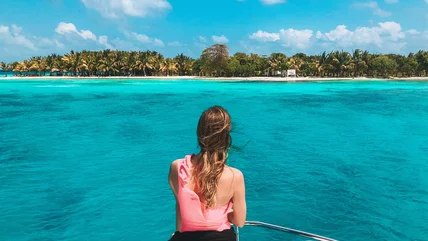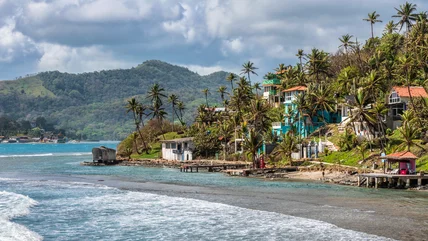
From this high perspective, the big swell is a majestic spectacle. Giant combers appear, groomed and orderly, marching in their sets of six or so, growing steeper as they approach the shore, shadows deepening, spray beginning to fountain from the curls. On the water, insignificant little dots, actually surfers with pounding hearts, paddle futilely out to sea as the first wave breaks, perfectly, right on top of them, silently spreading a wide lacy track of foam. A couple of seconds later the sound, like distant thunder, reaches me at the top of the hill.
An hour earlier, with a board strapped to the top of my car, I passed through the town of Rincón, past the renowned big-wave spot, Tres Palmas. Through the palms I could see enough foam on the reef to know it was "going off," as we surfers say, in a raggedy, windblown version of its badass self. I reached the top of Bummer Hill and stopped to take in the scene.
Under the guise of judiciously studying the swell, I am also, frankly, just plain stalling. It's been nearly ten years since my last surf session on the waters that break on these western Puerto Rico reefs, and I'm wondering how I'll hold up in the juice.
I'm on a pilgrimage back to Puerto Rico's legendary surf spots, the places that once pulled me from Florida to set up home here. I've wanted to see how it has all turned out, the cultural evolution of this coast¿both the farthest from San Juan, as well as the main island's most fertile ground for gentrification, or gringo-fication, owing to this world-class surf.
Rincón is where the whole expatriate thing began for American surfers, a kind of reverse West Side Story in which a bunch of barefooted tow-headed juvenile delinquents in board shorts were the Jets, and their counterparts, the Sharks, were proud young Rincóneros, clattering down the roads atop their high-stepping Paso Fino horses. You can imagine the culture clash. In the 1960s western Puerto Rico was a backwater, very rural¿all campesinos and pescadores¿and very traditional, very conservative, and very Catholic. A woman (she would have had to be a visiting gringa) in a one-piece bathing suit could cause a riot of disapprobation, que puta! Still, in 1968 the sport of surfing held its World Championship in rustic Rincón, and Surfer magazine published a picture of a bronzed hero dropping in on a glossy blue Tres Palmas bomber, triple overhead and perfectly shaped.
I was in high school when I saw that photo¿it looked like Hawai¿i, only a hell of a lot closer to Florida¿and it put a bug in my head that I filed away but never forgot. Meanwhile, most of the seriously talented surfers in my little beach town made the pilgrimage to Rincón where the water was always warm and the winter surf spectacular. They joined the first wave of alpha males, East Coast surfers from surf-starved Cocoa Beach to chilly Montauk, a daring and rowdy bunch that crashed in the tiny vacation cabins atop this "bummer" of a hill, drank mucho rum, flirted with the chiquitas, got in scuffles, and caught epic swells.
For surfers, the potential of the place was obvious. The westernmost tip of Puerto Rico, Punta Borinquen is a great anvil-shaped limestone plateau that thrusts into the immensely deep Puerto Rican trench. These depths preserve the potency of swells, while a series of smaller points to the north and the south shape them into perfect surfing waves. The pretty green foothills of the Cordillera Central, lush with mango, avocado, and brilliant flowering trees, weren't exactly underpopulated. But back then the locals didn't surf, and preferred to live in town or in convivial clusters of pastel-painted cement houses high in the cooler hills. The less-desirable oceanfront, selling at a buck a square yard, was an open frontier. That first jet set, a heady mix of trustafarians, Jimmy Buffet-style pirates, and just plain dedicated surfers, bought land here on the cheap and built their dream houses on the beach or up in the first tier of hills with an ocean view.
That's all surf legend now, of course; and even by the time my wife and I moved here in '95, the culture clash had become a more peaceable dance. American surf culture and Puerto Rican folklife were already engaged, so to speak. Rincón had taken to calling itself the Capital de Surf, and locals had adopted the surfboard, and the more affordable boogie board, in a big way. The multi-store mall (one in Aguadilla and one in Mayag¿ez) coexisted with the colmado (the traditional corner grocery); roadside pollo carbon with KFC.
I've seen enough from my perch on bummer Hill¿this swell is doable, I think. Survivable. But to be on the safe side I head for the smallest wave, at Little Malibu. The surf can be huge on the north side of Punta Borinquen¿at Jobos, Middles, Shacks¿and just as big or bigger on the south side¿at Domes, Marias, or the Tres Palmas deep-water reef. But Little Malibu, in front of the breakwater of Rincón's marina, is the end of the line, south of which, nada¿just fishing boats bobbing at anchor and then flat-water swimming beaches and sheltered bays along the southern coast.
At Little Malibu, the surf is never big, and the reef is always dangerously shallow, but the wave is perfectly shaped for hot-dogging. With today's big unruly swell, I'm expecting a crowd in the water and find one.
But this is something new! At the very end of the jetty is a little pup of a wave, and riding it is a pack of grommets¿wee little surfers, boys and girls, local and expat. Watching over them, wading in up to their knees to offer tips and encouragement, are surfer dads, just like soccer moms. The real-estate boom has yielded a surfer-baby boom as well. The competition on the real break looks so fierce that I'm tempted to steal a few mini-waves from the tykes. Instead, I mosey back across the dirt parking lot to check out Taino Divers, a dive shop. A couple of gringo old salts tell me the owner is out, but that he's probably right next door at a favorite local hangout, Club Nautico, having a beer with some buds. "Just ask for Carson."
Carson! He of the one name, like Prince or Madonna, known to all Rincón watermen. Of course he's still here. Greg (that's it!) Carson was a perfect match for the place: talented surfer, excellent free-diver, highly employable scuba divemaster. In those days, the Texan had long yellow locks and looked like a barrel-chested hippie Jesus, beatifically fit. He had a local girlfriend who tended bar at the Tamboo Tavern on Sandy Beach and she was about the prettiest girl in town. They'd had a baby, whom I'd last seen crawling across a beach blanket on the sand. Carson and I had been on a few scuba adventures together, to distant Mona Island and to the shoals of craggy Desecheo, 14 miles offshore, which haunts the Rincón horizon like Bali Ha¿i.
And here they are: Carson, shorn of his wild hair but still as fit as ever, and his kid¿Meshak, the name comes back to me¿a skinny reed, but looking just a few years shy of a GQ photo shoot, wheedling a few bucks from Dad.
"Things are great," Carson tells me. "I've got my shop now¿we must've opened right after you left¿got a couple of boats, a couple of captains. We dive Desecheo every day, except when it's rough like this. Then we surf." Carson grins like the cat that ate the canary.
I ask if he's gotten around to exploring some of those underwater caves we saw on Mona Island (not yet), and we reminisce about diving the Mona Channel. It's big, wild water out there in the passage between Hispaniola and Puerto Rico, very deep, full of megafauna like whale sharks, marlins and manta rays. Carson says he's into blue-water hunting now, the extreme form of deep-water, free-dive spearfishing and tow-in surfing, and he just got back from snowboarding in Chile. And nope, the growth of Rincón doesn't bother him a bit, nor the big resort hotel south of town, Rincón of the Seas, and all the new condos sprouting up. "It's just more business for us. This place, it's becoming like the Riviera of the Caribbean.
It's all good."
And he's dead right, so far as I can tell. The growth of Rincón doesn't bother me either, because when I give up on Little Malibu (I could never nab a wave from those tykes) and trek north up the beach on foot, the mile-long stretch to the lighthouse park, El Faro, is well-nigh deserted. The same ancient almond trees lean out gracefully over the sand, the same black-and-white cattle still graze in the palm-lined pastures.
This used to be my favorite beach for surfing, but also for just beachcombing. You never knew what you would find¿some smuggler's boat wrecked on the sand, whale bones, or just sea glass and shells (I came home to the States with cookie tins full). I found a Voodoo doll once, and a message in a bottle (a treacly love note from a hopeless romantic). But mostly I found peace of mind, knowing I was in a special place, keeping my appointment with the sea and surf of my boyhood dreams.
Today I have another date to keep before the sun goes down behind Desecheo. I finally steel my nerves and paddle out at a peak called Dogman's and have it to myself. It's big and spooky and lonely out there. I bag two grinders and get out before I get hurt.
While Rincón has its thriving expat community, and Aguadilla hosts Ramey Air Force Base and some big U.S. corporate plants, the smaller towns of the west remain Old Puerto Rican to their roots. That means family is everything, grandmothers rule the roost, English is spoken sparingly, and the whole town goes crazy on its patron saint's day. In little Isabela, a town on the north side of Punta Borinquen renowned for its artisans in lacework, narrow shop-lined streets climb steeply up to a spacious central plaza, then plunge just as steeply down the other side, affording precipitous sea views reminiscent of a mini-San Francisco. The plaza, where a few old-timers slap down dominoes, is flanked by the Colonial-era mayor's office and the imposing church, with a grammar school attached.
The school lunch bell has just rung when I poke my head in the front hall. A wall of sound greets me¿shrieks of laughter, the babble of a hundred voices speaking simultaneously in high-pitched, high-speed Spanish. The energy of these kids in their blue and white uniforms blows your hair back. A Catholic school veteran myself, I feel faint from d¿j¿ vu and the memory of piety and impious pranks. I wonder about the big mural of St. Anthony of Padua, the school patron, painted on the wall of the enclosed playground. The saint is quoted in foot-high letters, the gist of which is: "I don't want to waste my time with books while people are starving."
Now, as the motto for a school, this leaves much to be desired. But its blindness to irony seems a metaphor for Puerto Rico's long-term relationship with the church: always a great comfort, and a fine source of holidays; never much of an obstacle to a good time.
And speaking of good times, a couple of days later I'm speeding down Highway 2, the four-lane freeway, headed for the new Wal-Mart in Mayag¿ez, when I see a great commotion of cars spilling out of the Holiday Inn parking lot and clogging the service road. It is Saturday night after all, and I suppose my purchases (mainly duct tape for surfboard ding repair) can wait. I park and hike, and find the excitement inside the bar. There's a live band, with a hot horn section and three sexy singers in little black cocktail dresses, blasting out hot salsa dance music. And¿my god¿can this crowd dance!
One couple, in their late-30s, I think, but astonishingly supple, keep both pairs of hands clasped yet somehow twirl separately and simultaneously, first he, then she, then he and she, twisting themselves into pretzel shapes, M¿obius strips, and double helices¿and all gracefully, precisely. I'm wowed. Another couple, also of nimble middle age, explore nearly the same range of motion pressed tightly together the length of their torsos. Yet another, younger couple discourses on country matters¿he, the strutting gallo, approaching, arms back, chest out; she, the coy hembra, retreating, culas twitching, tossing come-hither looks over a bared shoulder.
Sigh! Can a gringo gent cut in? No effing way, sen¿or. Not here, not with this crowd. But I'm so entranced I think I see my future. I'm no great shakes as a surfer, and getting worse, truth be told. But what if I could learn to dance the salsa? Not only would I be a better, more stylish surfer, but I'd welcome the sunset as much as the dawn. In a way it would finally consummate my relationship with the island, giving me one foot in each culture: surfer by day, salsa king by night. But where to make a start?
I'm musing on that question the next day at Playa Brava, a combination surf shop and coffeehouse in Aguadilla. Come to think of it, this little shop is itself a perfect marriage of cultures, a place where you can get an iced latte or rent a surfboard; admire local art and eat vegetarian; check your e-mail with high-speed DSL Internet service, while you listen to Puerto Rican tunes. I'm chatting with the counter girl, a New Agey gringa, about salsa dancing when she suggests I talk to the owner, Tupi Cabrerra, who's a huge fan of the music.
Tupi, hirsute and elfin, and wearing a funky hat, is in the surf shop, looking at some canvasses with an artist. I browse, admiring the longboards and surf DVDs for sale, until I get a chance to spring my off-the-wall question.
"Yes, it's true," Tupi says, "I am an aficionado of salsa music¿especially what I call ¿fat' salsa, the old-school style." He rummages through some CDs behind the counter and pulls out Ray Baretto's Energy to Burn.
"I love to hear salsa before and after surfing, but then I'm the exception. More like rock and rap or reggae."
And what about dancing? Does he know anyone who teaches locally?
Tupi confers with a cute assistant, who shrugs, the question mildly preposterous, the potential field being so large. "All Puerto Ricans can salsa," she says. "It's in our blood." I leave Playa Brava well-caffeinated, with a couple of lender CDs to get a feel for the music, and with a number to call.
The next afternoon, my salsa instructor arrives at my efficiency apartment, Villa Montana on Shacks beach in a big Jeep Cherokee. She looks 17, but says she's 24. Suheily Rivera is petite, curvaceous, vivacious, and kindhearted, I believe, with a grin that crinkles her nose. The sense of humor and the kindness are most important, for this is the woman with whom I'm about to embarrass myself.
She's brought along a few CDs¿Tito Puente, for soft and slow, and Gilberto Santa Rosa for hot and fast¿and a boom box that we set up on the deck facing the beach. There's a wild wind blowing, and the sea is a raging glory. It's the perfect setting for a dance, only give me a couple of years to rise to the occasion. The learning curve is painfully steep.
"Try to move your hips a little more," Suheily gently suggests.
Easy for her to say. She seems to have several joints where I only have one. There are pause steps, transition steps¿the dos and the quattro between the uno and the tres¿in which she manages about a dozen subtle shimmies. Eventually the expression "two left feet" slips from her lips. Finally, exasperated by my bungling, she says, "No! No! Con sabor!"
Feeling hopeless as dancer I decide to distract her with questions. She's not a professional salsa dance instructor, but a senior in marketing at the university, already working part-time in her field. "I'll probably go on to grad school," she says. "A B.A. is nothing anymore. And real estate here is so expensive these days, you really need to focus on your career if you expect to buy a house."
Suheily tells me she's a surfer herself, in fact, treasurer of the local International Association de Mujeres Surfing, which is about to hold its first contest in Aguadilla. She has an American boyfriend, a surfer named Cory, who is living here now, but they don't know yet, this Tony and Maria, if they will live here or up there, or in both places.
Somehow, this surfer girl, concerned about spiraling real-estate prices, tells me that the dance between cultures has come full circle¿round one, anyway. And my own faltering steps to know both cultures have crossed an important threshold, too. Do I take this island to be my favorite surfing destination, in flat spells and in swells?
I do.
Puerto Rico's Mild West
WATCH THE SUNSET from an antique armchair at The Hotel Horned Dorset Primavera, a stunning Relais & Châteaux property in Rincón with a top restaurant, 800-633-1857; www.horneddorset.com. In Isabela, on the beach Villa Montaña has hotel rooms and villas, 888-780-9195, www.villamontana.com. For an inexpensive guest house with surf views, try Rincon Surf and Board (787-823-0610, www.surfandboard.com); surf lessons extra.
SURF THE COAST with lessons or rentals from West Coast Surf Shop, 787-823-3935; www.westcoastsurf.com; or Playa Brava in Aguadilla, 787-890-2189.
DIVE THE CHANNEL Just off Rincon is spectacular diving. In Rincón, try Taino Divers: 787-823-6429, www.tainodivers.com; or, in Aguadilla, Aquatica Underwater Adventures, 787-890-6017.
GET THERE Continental and JetBlue fly direct to Aguadilla from Newark and JFK and Pan Am from Orlando, FL. Or connect via San Juan. Visit www.rinconpr.com.