
Swim With Giants In Tonga
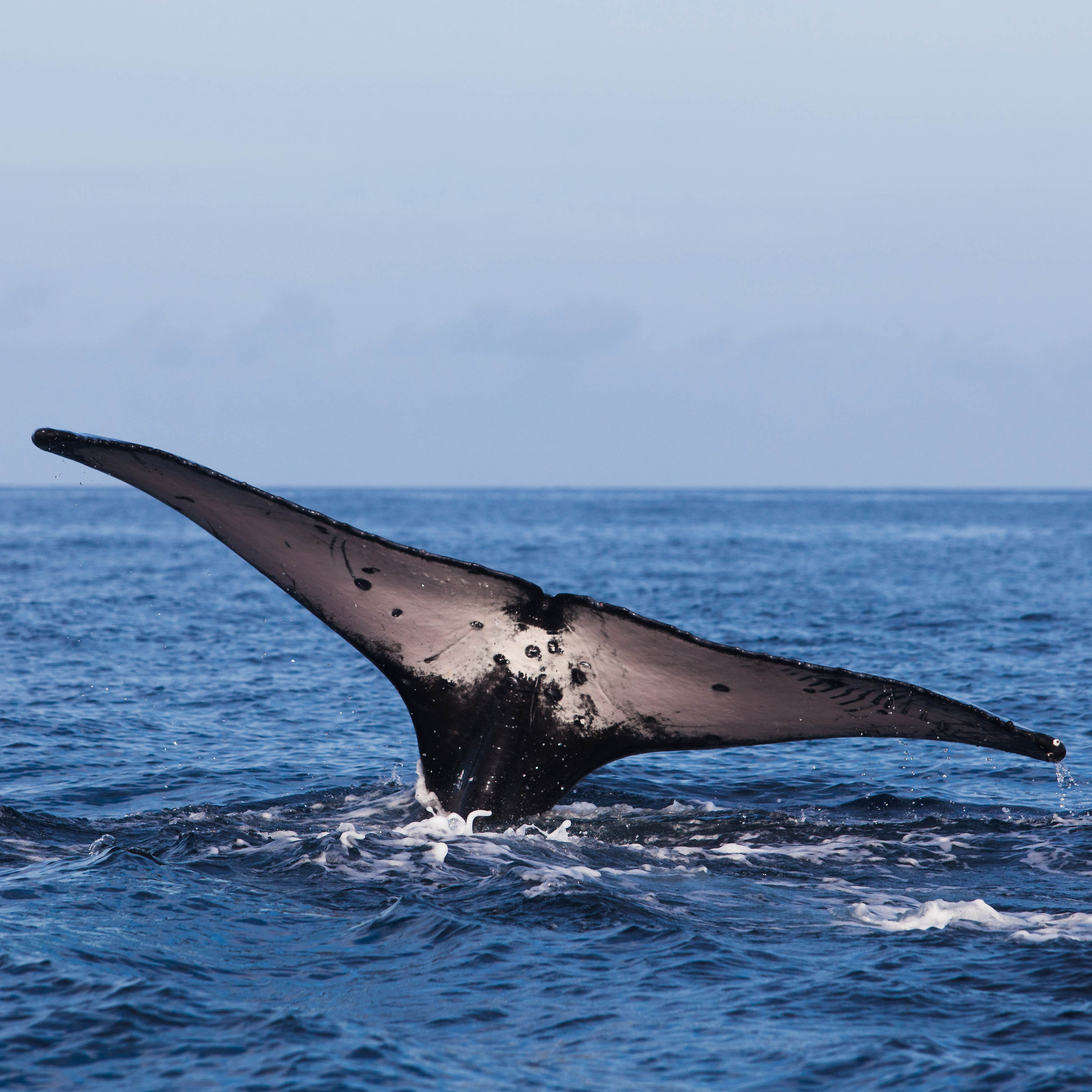
I'll call her Anna.
She had a long and slender face and a pear-shaped figure, and she moved gracefully through the water, ballerina-like, gently undulating and occasionally performing pirouettes. I stopped cold when I first spotted her. My heartbeat quickened, and as she drifted slowly past I reached out my hand and waved. This probably sounds silly—waving at an animal—but at the time it seemed like an entirely appropriate reaction. For what we were having, this creature and I, could only be described as a moment—a chance encounter sustained by mutual curiosity. As Anna came to within six feet from my face, and checked me out, I looked directly into her eye. She was the prettiest whale I'd ever seen.
There is whale "watching"—you spend three hours on the deck of a boat glued to binoculars, and consider yourself lucky if you see a whale breach the water, but you'll settle for fluke sightings—and then there's swimming with these gentle giants, an experience of true contact that approaches something spiritual. There are only three countries in the world were such intimate encounters are allowed, including the Kingdom of Tonga, a remote archipelago in the South Pacific Ocean. Tonga's deputy prime minister, whom I met in the sleepy capital town, Nuku'alofa, explained that this was a direct result of his own clever lobbying in the mid-90s. "I said to the IWC"—the International Whaling Commission—"there's two choices: we can either eat the whales, or we can swim with them," he told me, chuckling at the memory. "I was only joking. But it worked."
Most Tongan whale tour operators run day trips out of the northern Vava'u group of islands, but our boat, the Fiji-based NAI'A, is the area's only liveaboard, and leads 10-day sojourns around the relatively empty Ha'apai Island group during the whale's winter breeding season. Humpback whales spend a few months a year around Tonga birthing, mating, competing, sleeping and socializing—everything but eating, which they do the rest of the time in Antarctica. We would witness up close the full range of whale behaviors: breaching, singing, fin slapping, and lollygagging, an unscientific term for the idle activity that our affable British guide Sam described as best for encounters. (Put another way: try to hold their interest when they seem to have nothing better to do.)
Anna demonstrated to us the tender ways of homeschooling—a mother's education in the ways of being a whale. This sublime moment, however, was abruptly disturbed by another fact of life. As the two circled closely around me, a lone male suddenly emerged from the depths below. Such was his brash arrival that I quickly branded him a rogue, and I scrambled away to avoid a possible collision. Clearly, Anna felt the same way: she flicked the hopeful mate off with a mighty tail strike, and took off with her calf, disappearing quickly into the oblivion. The male slinked off, out of sight.
The scene reverted to an empty blue space, and I looked down into the void. Twenty feet below, a solitary white-tip reef shark was swimming by.
Nearly three-quarters of all the animal extinctions recorded in the past 500 years have occurred on oceanic islands. Of the most recent extinctions, the greatest concentration have taken place in Hawaii, but islands throughout the world—most of which are high in endemic species not found elsewhere—all face the similar perils of human being rise, habitat demise, and invasive species. Island peoples are often faced with what they see as a choice between conserving their natural resources and providing for their own. This is often a false choice—but sometimes conservation does require a little incentive.
Seacology, a Berkeley, Calif.-based organization devoted to preserving island environments, steps in with that. They propose to island communities what they call "win-win" deals: the islanders receive a tangible benefit—something they say they're in need of—in exchange for a commitment to protect their local environment. The funds needed to build themselves a school, in exchange for establishing a 30,000-acre forest reserve, say. A power generator for a marine protected area. On Hainan Island in China, Seacology funded the education of children in four villages in exchange for protecting the habitat of the highly endangered Hainan gibbon. In a village in the Philippines, they supported the construction of guardhouses, conservation area patrol boats, equipment, buoys and signage, and also purchased cashew production equipment to encourage an alternative economic lifestyle; the community in turn established large marine and mangrove-protected areas for 25 years.
The investments are relatively small–$25,000 here, $15,000 there—and the results are measurable and immediate: Seacology projects are currently protecting nearly two million acres of coral reef and island terrestrial habitat worldwide.
Swimming with whales was what you might call our incentive for the main purpose of this trip, which was to visit a new Seacology project in Tonga. A few times a year Seacology organizes such expeditions, which are open to anyone and combine scuba diving, snorkeling, hiking or kayaking with a visit to an island community that has received Seacology support. The community visits amount to only a brief part of the trip, but the cultural immersion is unique and not the conventional reception—the songs, the dances, the jaded locals—that typically greets an island tourist. At least this is how I felt during our visit to Felemea.
Around 200 people live in Felemea, one of two villages on 'Uiha Island in central Tonga. It's subsistence living: pigs, fish, bananas, taro. In 2008 the Tongan government, with funding from Australia, established six marine protected areas in the Ha'apai Island group, including a 4,000-acre zone around Felemea. The waters off shore contain clams, sea slugs, seaweeds, crab, lobster and reef fish—resources of high commercial value that have been threatened by overfishing. The designation of the "special management area" around Felemea prohibited outsiders from fishing there, and mandated that the villagers themselves use it sustainably. But local management of the marine reserve lacked focus. Seacology offered the villagers some encouragement: $25,003 to refurbish Felemea's existing community hall—tiling, repainting, electrical repairs, a plastic water tank, etc.—for their engagement in protecting 368 acres of marine habitat over ten years.
"The Ministry of Fisheries in Tonga had been there for years, but tying the [reserve] to something that so immediately benefits them has really brought it home on another level," Duane Silverstein, Seacology's executive director, told me. "As does the mere fact that 15 of us came from the United States to a village that doesn't often receive people from outside just see what they are doing with conservation."
The villagers had prepared a grand ceremony for our arrival. A group of village women greeted us as we landed on the beach with hand-woven flower necklaces. The community hall, nearby, was a basic, low-lying white and blue structure; the cement veranda was ornamented with beautiful tapa cloths, the traditional painted fabrics that Tongan women make from the bark of a paper mulberry tree. Villagers milled about, sitting in the shade, sitting on chairs under a white tent that had been erected on the grass outside the hall. A two-man band—crooner, synthesizer—played tunes through a set of loud speakers.
The event—billed on a printed schedule as a "prayer program" to mark the hall's completion—was kicked off by a beautiful hymn that the men and women of Felemea sang in harmonies. This was followed by speeches.
"Before the completion of the hall, it was almost like nothing to us," the emcee, a Felemea man, delivered earnestly. "There were too many holes. It was dusty. But we are more than grateful for the kindness and the love that you have donated on us. In the new hall are the local products made by the poor hands of our people." After he said this, he paused to stop his tears. "I know for sure it won't be worth the great amount that you have helped us. But this is the best that we have. We've given it with all our hearts. And please do accept it, and take it to your home as a souvenir. As a remembrance of this poor island."
The band struck up a festive tune and after a ribbon cutting we were danced and twirled into the village hall by local women. On the tables inside were laid woven purses and hand fans and necklaces and trays, on which was painted: "Tonga Friendly Island." (This was the nickname Captain James Cook gave the islands after his warm reception in 1773; it was insincere—the islanders plotted to kill him—but it's not untrue, either, and out of it Tonga inherited a great marketing slogan.)
Outside the hall, the villagers had laid out enormous banquet. Mussels steamed in banana leaves and whole roasted pigs and taro and shredded beef and grilled fish. The emcee introduced a series of traditional dances, performed solo by teenage girls in tapa dresses, whose arms glistened from coconut oil that stuck the paper money that other villagers walked up to offer them. "Unlike the vigorous tamure of Tahiti and Cook Islands or the swaying hula of Hawaii," explained a dated pamphlet on Tongan dancing I'd picked up at the main airport, "dancing in Tonga is a dignified, graceful portrayal of the choreographer's art."
But what the Felemeans later presented was more like Tongan vaudeville. A large lady in a tapa skirt stepped out to the music adorned in a boa of red balloons and a necklace strung with aluminum soda cans. Her slow hand twirling mimicked traditional dance movements but the absurdity of her outfit had the locals in stitches. "Have you seen enough? Or do you have time for one more dance?" the emcee asked us. Cue the boxers: two women in plastic grass skirts emerged wearing red boxing gloves and proceeded to pretend spar with each other. One of them walked over to the audience, over to me, and poised her arm for a right uppercut. She faked the punch, and I threw my head back. She landed another. On the third, I collapsed to the ground, feigning knockout. The villagers laughed approvingly, and my looming adversary—our group would later nickname her Tonga Tina—took her her plastic pearl necklace and offered it to me, as if to say: "Thank you for playing."
We had been sailing for about an hour when someone called out from the top deck: "Thar she blows! 11:00 off the bow!" After several days on the NAI'A, the mere sight of whales often provoked a tepid response. I grabbed my camera from the dining room, where two other guests sat playing gin rummy.
"There's a whale out there!" I told them. "Yeah, I heard. We only get up for two," one replied jokingly, nose in his cards.
It was true: we had all become a little jaded, or maybe, just spoiled. No less appreciative of the beauty of these animals; no less exhilarated by a majestic, out-of-water breach, or entertained by a pod of lollygaggers slapping their pectoral fins, or endeared by one poking its head up vertically to steal a glance above the surface ("spyhopping"), or marveled by the raw and rowdy energy of a group of males in hot pursuit of a female (a "heat run"). But we had all been touched more deeply, below the surface.
That afternoon we tracked a pod of pilot whales that had become curious about our boat, and we set out in the skiffs to follow them. Pilot whales are actually dolphins, and move swift and torpedo-like through the water. The boatman sped in front of the pod and turned off the motor. "Get in!" he said. I put on my snorkel and slid quietly into the water. Immediately, the pod surrounded us, whizzing by in all directions. They produced an overwhelming soundscape of high-pitched whistles that called to mind squealing pigs. I looked down as a dark body rapidly approached me from below, and it passed by four feet from my face. I stared straight into its right eye for a second—and then it was gone.
Her name was Princess Mele Siu'ilikutapu Kalaniuvalu Fotofili, but she said to just call her Mary. According to protocol, I addressed her as "Your Royal Highness," and it occurred to me, after I did, that I'd never said those words before, to anyone. Tonga is the only South Pacific island nation to have avoided formal colonization (although it became a British protectorate for a time, and recently became a constitutional monarchy). On our last day in Tonga, on the main island of Tongatapu, Seacology had arranged for our group to have an audience with the eccentric King of Tonga, George Tupou V, whose family dynasty traces back to 950 A.D. He was out of the country on official business; Mary, his niece, obliged. We visited her at her small estate, which sat on the edge of a tranquil bay at the now overgrown site of Tonga's original wharf.
Dressed in a white-and-black flowered dress, red shawl and pearl necklace, Mary had the dignified and elegant presence of a royal, and the unassuming warmth of a Pacific islander—a "friendly" islander. She is now in her 60s, and her English accent carried the 22 years she spent living in New Zealand. We chitchatted on the veranda for a half-hour, sitting in red velvet-backed chairs that bore the royal insignia ("GvT"). As we got up to leave, I asked Mary how she would explain Tonga to people she met living abroad, people who probably had never heard of the place—or, as what seemed to be the case with my friends before the trip, assumed it was in Africa.
The princess considered the question. "You're going to get something here that's lost," she replied. "We're still carrying on traditions that have been lost, a lifestyle that is not common. You'll see pomp—this is the last kingdom in the Pacific islands. We have something here that you won't get anywhere else."
Mary wasn't referring to the whales, but she may well have been.