
Between Albuquerque And Santa Fe Is A Loop Trail With Historic Art And Stunning Mountain Views
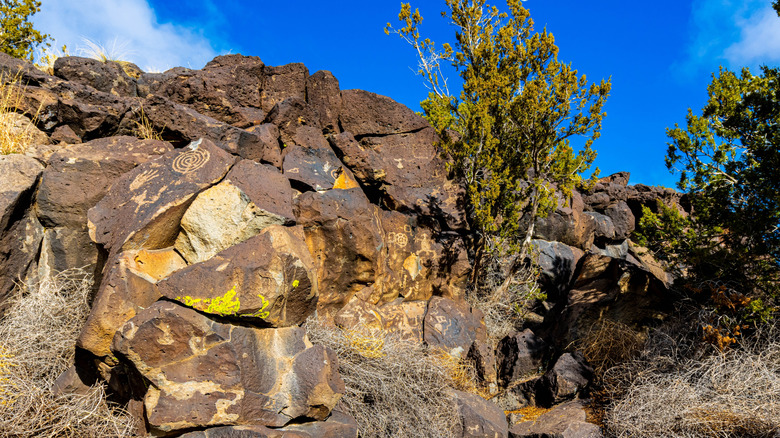
Long swaths of volcanic rocks and sagebrush fill the desert landscapes of the American Southwest, to the point that it's easy to feel like you're the first human to touch ground on these lands. That makes it all the more surprising when you come across a trace of human presence and remember that, indeed, people have been passing through here for millennia. They left behind etched art — petroglyphs — on the faces of darkened rocks that have survived through generations. Within a drivable distance from both Santa Fe and Albuquerque, overlooking a tributary of the Rio Grande, some remarkable examples of this ancient art gather densely at La Cieneguilla Petroglyphs Site.
You will have to climb a bit to get to the petroglyphs at La Cieneguilla, including a stretch that involves a somewhat scrappy rock scramble. If you're an adventurous type, though, the effort is worth it. You'll be walking in the tracks of the El Camino Real de Tierra Adentro, a 500-year-old trade route that once passed through here. The petroglyphs are far more ancient, though, some dating back to the Archaic period thousands of years ago. From the top of the mesa on which the petroglyphs are etched, you also get great views of the Sangre de Cristo mountains to the north.
The rocky hike up to La Cieneguilla Petroglyphs
At the trailhead to the La Cieneguilla Petroglyphs, a short distance from the parking lot, there's a sign with some basic information about the site. Starting from the parking lot, take the trail to the left of the sign that follows a fence line, and you'll begin the journey to the petroglyphs. In the beginning, the trail is fairly flat and easy to follow until it reaches an escarpment. Here, the rest of the way is a bit of a free-for-all, as the trail is no longer apparent once it reaches the jumbled rocks.
One Google Reviewer suggested that it's best to focus on finding the most straightforward way up the mesa to some larger boulders. It helps to download a map of the trail and use it to navigate from your phone. The good news is that the whole trek from the parking lot to the petroglyphs is less than 1 mile.
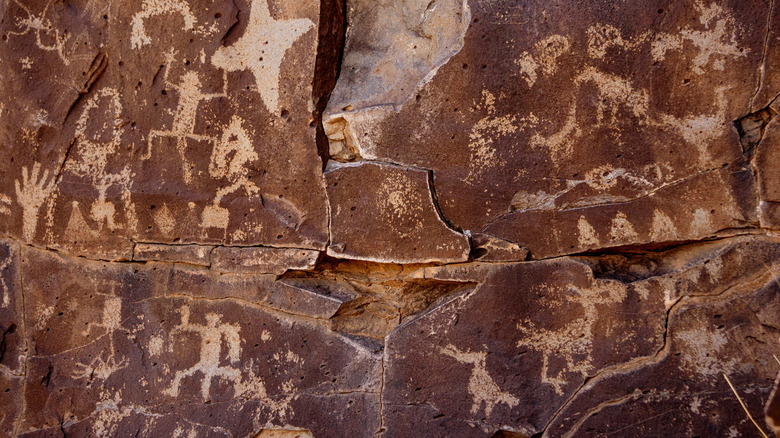
Once at the top, there are a ton of petroglyphs to see, many clustered along the escarpment rim. According to the site's National Register form, there are around 4,000 petroglyphs here in total, etched into the volcanic rock by Puebloan people. Most of the petroglyphs were etched during the Classic period, around 1300 to 1600 A.D., (the same era the stunning cliff dwellings of New Mexico's Bandelier National Monument were built). Some of the petroglyphs, though, are thought to be from the much older Archaic period, which goes back to 5,500 B.C. The site is believed to be a ceremonial site for an ancient Puebloan settlement nearby, with many depictions of kokopelli, a fertility deity among Southwestern tribes.
More to explore around the La Cieneguilla Petroglyph Site
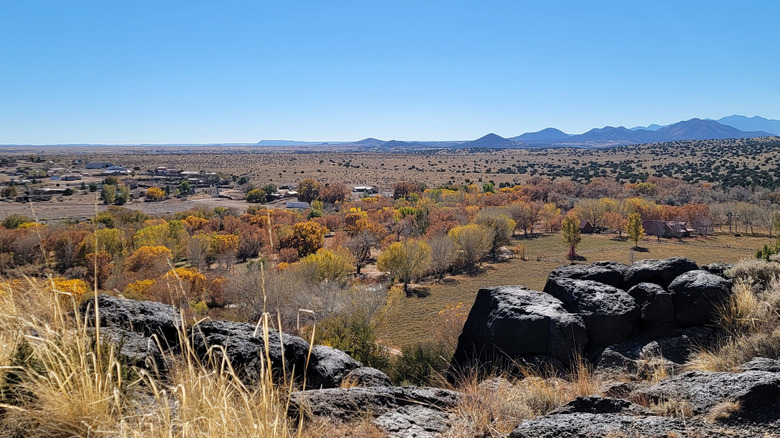
While the petroglyphs are a highlight of the La Cieneguilla site, the scenery of this area is impressive in its own right. The mesa looks out over a plain, with mountain peaks visible in the distance. You can extend your scenic hike by taking on one of the other short trails branching off from the petroglyph loop. Another loop trail, the North Mesa Loop, goes for 0.6 miles, while the South Mesa Loop is 1.2 miles, per the City of Aztec. While neither trail leads to petroglyphs of note, they afford sightlines over the valley, and the North Mesa Loop passes a small cave. Access to the entire site and its trails is free.
The closest major hub to the La Cieneguilla Petroglyph Site is Santa Fe — the city center is about a 20-minute drive away, while those flying into the Santa Fe Regional Airport can get there in about a 10-minute drive. Santa Fe is home to some wonderful hikes, too, including a stunning aspen forest trail with alpine vistas. If you're coming from Albuquerque, it's just under an hour by car. Albuquerque could be a good base for a petroglyph-focused trip, too, since the Petroglyph National Monument lies within Albuquerque's outskirts among an otherworldly range of volcanoes.