
Forget Central Park — New York City's Under-The-Radar Urban Landscape Is Intimate And Stunning

In New York, an iconic city full of iconic landmarks, Central Park reigns supreme, drawing joggers, dog-walkers, commuters, and out-of-towners into its 843 bucolic acres like a big, green magnet. But such popularity — 42 million visitors a year, according to the Central Park Conservancy — means it's difficult to find reprieve from the crowds, even in that vast space. For a more intimate Manhattan escape, consider Greenacre Park, a small patch of tranquility and rushing waters on East 51st Street. It may only be 6,000 square feet, but this pocket park is more richly layered than its diminutive size would suggest.
Unless you're a New Yorker, Greenacre might mean nothing to you. Then again, the competition is stiff. Central Park was America's number one tourist attraction for 2025 and is still the most-filmed location in the world, while New York suburban parks like Greenbelt in Staten Island and Flushing Meadows Corona Park in Queens are larger. Greenacre, the brainchild of Abby Rockefeller Mauzé, opened amid the high-rises of Manhattan's Midtown in 1971 at a time when pocket parks were challenging the conventional wisdom about what a park ought to be. And it remains a much-loved corner of green space five decades later.
Using buildings as walls and a tree canopy for the roof, the park is a stunning oasis cocooning visitors from New York's ceaseless hustle and bustle. Some people come to sit and chat while the 25-foot waterfall drowns out the noise of the city. Others come down on their lunch break, grabbing coffee and a sandwich from Carol's Cafe, a hole-in-the-wall inside the park. Best of all, there's no barrier to entry. Just walk straight in off the street, no questions asked, free of charge.
Visiting Greenacre Park
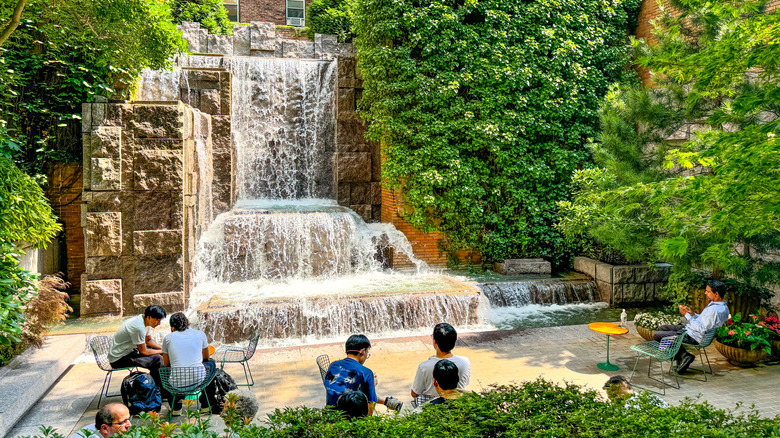
Greenacre's lead designer, Masao Kinoshita, was born in America and was inspired by the modernist movement — which placed emphasis on the user experience — and by architects like Eero Saarinen. But the park also expresses the design language of his ancestral country, Japan. Greenacre is an exercise in minimalism, combining an open viewing space with natural elements like water, plants, and stone. The cascading water feature draws the visitor's gaze and also acts as a sound barrier, while seating is scattered around the park, enabling the user to experience it from different viewpoints. This less-is-more approach is fundamental to Japanese design philosophy and allows the features that remain to take center stage.
Unless you're a sucker for landscape architecture, you may not go out of your way just to sit for an hour in Greenacre Park. But it can make a great addition to a broader New York itinerary. If you're visiting Rockefeller Center and its heart-pounding revolving platform with expansive city views, then Greenacre is just a 10-minute walk away. It's also a short stroll from the busy Diamond District, upscale Sutton Place, the shopping palaces of Midtown East — Bloomingdale's, Bergdorf Goodman, Madison Avenue — and attractions like the Chrysler Building and the Museum of Modern Art (MoMA). Or, if you're traveling by subway, it's only three minutes from the Lexington Avenue/53rd Street Station. Either way, chances are you'll be glad you came. After all, Greenacre is one of the few places of true respite in the city that never sleeps.