
5 Once-Thriving Island Resorts That Are Now Abandoned
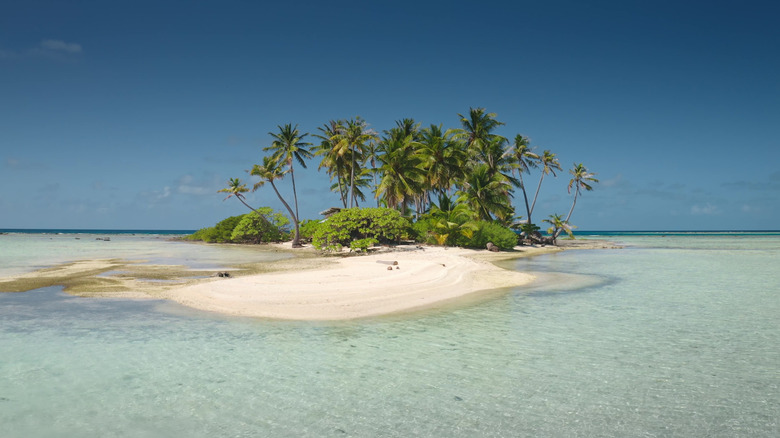
We can only imagine how five once-thriving island resorts ended up abandoned. Perhaps the scene unfolds like the opening minutes of a dystopian film. We're in a bustling tropical resort. Laughing guests in the latest resort fashion gather around a beach bar, sipping colorful umbrella drinks. Beach servers in shorts and T-shirts cater to guests lounging poolside. In the background, glasses clink against a soundtrack of rustling palms and the melodic rhythm of steel drums.
Then the time-lapse begins. Fewer guests. More empty lounge chairs. Algae blooms tint the once-crystal-clear swimming pool green. The pleasant tropical sounds fade to silence, and what was once a thriving island resort lies abandoned. Long-broken lounge chairs sit at the bottom of an empty swimming pool. Graffiti covers the walls. Local flora creeps forward in a steady march to reclaim the land.
Except we're not watching the opening minutes of a dystopian film. We're imagining the sequence of events that likely precipitated the demise of five once-thriving island resorts that now sit in ruins. Are they gone forever? It's hard to say. Occasionally, an investor comes along, recognizes the value of the location, and — in the best-case scenario — sets about returning the property to its former glory. The former Hotel Ponce InterContinental on the southern coast of Puerto Rico and Sugar Bay Beach Resort on St. Thomas in the U.S. Virgin Islands — once considered one of the territory's best beach resorts before Hurricane Irma — are examples of properties that have undergone redevelopment efforts. But not every resort gets a second act.
Caneel Bay Resort, St. John, U.S. Virgin Islands
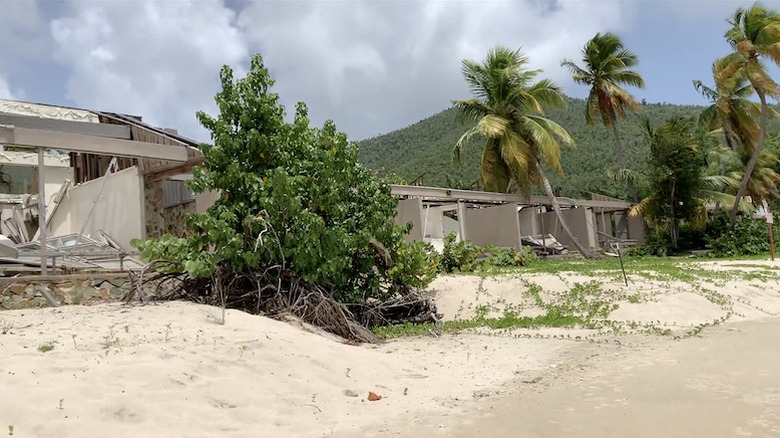
About 5 miles east of Sugar Bay Beach Resort, Caneel Bay Resort on St. John — a verdant paradise with one of the world's best beaches — has been languishing in a state of disrepair since Hurricane Irma struck in 2017.
Established by philanthropist Laurance S. Rockefeller in 1956, Caneel Bay was a one-time pinnacle of barefoot elegance. The 150-acre property sits within Virgin Islands National Park, part of roughly 5,000 acres Rockefeller donated to help establish the park. Designed to blend into its surroundings, the resort featured low-slung guest buildings painted in earth tones scattered across rolling terrain. Guest rooms were intentionally simple; there were no phones or televisions. While part of the landscape could have been cut for a golf course, it remained an untouched oasis throughout the property's run as a quietly elegant resort destination.
Today, the former exclusive enclave has become a shadow of its former self. It's now a tropical ghost town where crumbling stone walkways lead to guest rooms stripped open to the elements and littered with debris. Common areas, including the open-air lobby, are eerily quiet, and restaurant menus are stacked and ready for diners who may never return. Why is the former resort in limbo? It's complicated. When Rockefeller opened Caneel Bay Resort, it operated under a retained-use agreement that allowed private management until September 2023, when control of the buildings reverted to the National Park Service (NPS). With that deadline looming, few investors were willing to take a risk. In December 2025, travel company Explore STJ reported continued rumblings about proposals contingent on negotiations with the NPS, but details remain sketchy.
Moonhole, Bequia, Grenadines
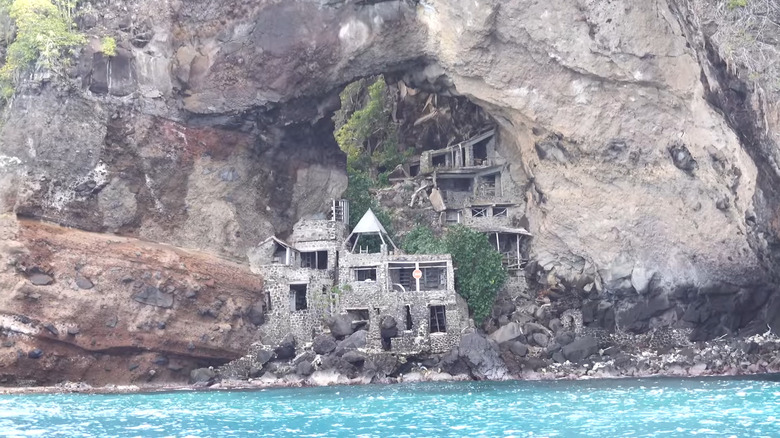
There's an interesting story behind the Moonhole. Located on the island of Bequia, a hidden Caribbean gem in St. Vincent & the Grenadines, the community began as a private vision rather than a traditional resort — the result of an unexpected confluence of circumstances and coincidences.
Retired New Yorkers Thomas and Gladys Johnston relocated to Bequia in the late 1950s to manage the Sunny Caribbee Hotel. While exploring, they discovered a natural arch opening carved into a rocky outcrop on the western side of the island. Perhaps drawn by the Robinson Crusoe-esque nature of the space, they picnicked at the site and mused about creating a rustic infrastructure where they could return time and again. One thing led to another, and what began as the trial-and-error construction of a simple campsite expanded into a fully functioning residence complete with a kitchen, dining room, and bedrooms, with enough creature comforts to prompt the Johnstons to relocate permanently.
Media coverage in outlets including The New York Times and National Geographic drew attention to the project and inspired others to build nearby. In 1964, the Johnstons established Moonhole Company Ltd. By the mid-1970s, the enclave had become a "people preserve" comprising 16 individual dwellings connected by a series of trails and bridges. Thomas Johnston's death in 2001 heralded the beginning of the end. Without its charismatic leader, the community began to fall apart, and lawsuits challenging the trust he had built to preserve Moonhole ensued. Today, nature is gradually reclaiming the property. The crumbling structure is still visible from the water, but exploring the ruins is both forbidden and dangerous. In an interesting twist, however, a few of the 16 original abodes have been restored and are currently listed as vacation rentals.
Four Seasons Barbados
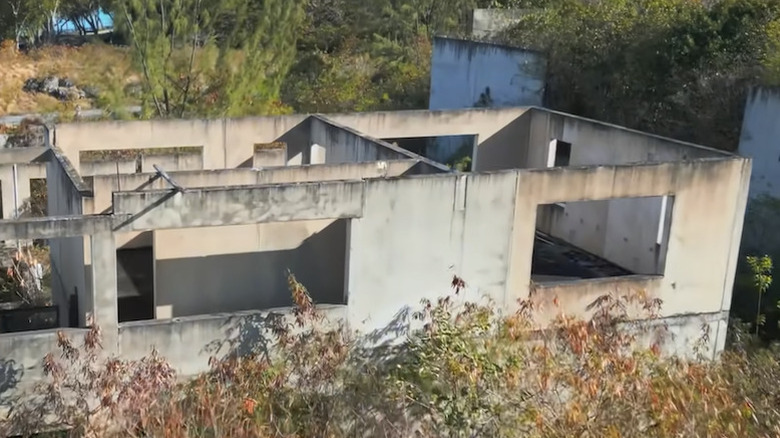
Sometimes, tropical resorts sink before they ever have a chance to swim. Such is the case with a once-heralded luxury resort development on the island of Barbados. With investors including entertainment mogul Simon Cowell, composer Andrew Lloyd Webber, and the late Formula 1 team owner Eddie Jordan, the 32-acre resort complex comprising a luxury hotel and private villas has been in limbo since the late aughts. Despite a promising start and its affiliation with Four Seasons Hotels and Resorts, the ill-fated project overlooking Paradise Beach fell victim to one challenge after another, including the 2008 financial crisis, before construction halted in 2009.
In 2018, a fire ripped through the aging maze of partially built structures. It's an interesting turn of events, given that Cunard's Paradise Beach Hotel had a successful decades-long run on the same site before Sandals Resorts bought it in the early 1990s. For myriad reasons, Sandals never got off the ground, but it looked like things were finally turning around in 2004 when the investors behind the Four Seasons Hotel & Resorts deal stepped up to the plate.
More than 20 years later, the foundations of the all-but-abandoned development loom over the beach in a scene Jake Williams of Bright Sun Films described as creepy and unsettling. Williams, a Canadian YouTuber who has built a brand focused on reporting about abandoned places, produced a video chronicling his experience touring the desolate ruins of the once-promising luxury resort. Describing the site as the "eerie bones of what would have been," Williams observed crumbling concrete frames giving way to the steady encroachment of local vegetation, scattered debris, and long-ago-abandoned construction materials that conjure haunting images of a post-apocalyptic world. But the long-abandoned property may be on the verge of resurrection. In November 2025, Gate Checked reported that CBL Developments SRL had acquired the property, although redevelopment plans remain vague.
La Belle Creole St. Martin
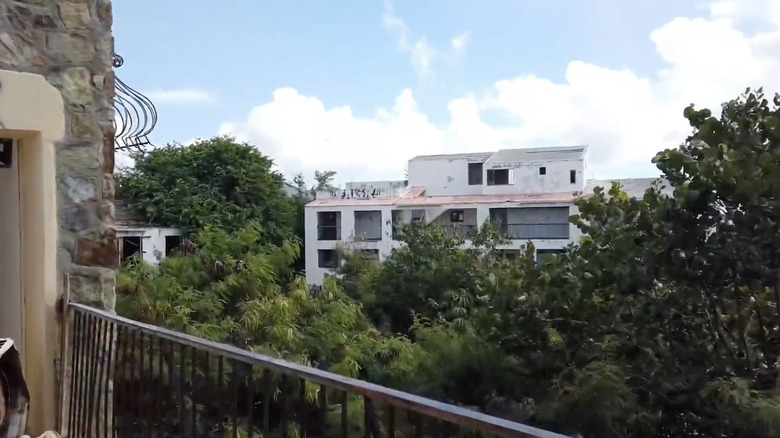
In its heyday, La Belle Creole was envisioned as an exclusive luxury resort on the French side of St. Martin. But getting to the point wasn't easy, and unfortunately, it doesn't have a happy ending. The project was the brainchild of Claudius Charles Philippe, a socially connected hotelier who served as the general manager of New York City's storied Waldorf-Astoria Hotel for close to three decades in the mid-20th century. In 1964, he and his business partner, Alexis Lichine, a well-regarded wine expert, purchased a 3,000-acre parcel of land on a promontory jutting out from the island's north coast. The partners hired a New York architectural firm to design the "village," centered on a striking pink tower that anchors a square lined with boutiques showcasing Parisian fashion. Guest rooms would feature Italian marble baths, walnut doors and accents, terra-cotta floors, and cast-iron balconies. Construction began in 1968, and by the following year, when the development was still in its early stages, Philippe and Lichine were out of money. Thus began a decades-long saga of starts and stops, broken deals, and dashed dreams.
La Belle Creole ultimately opened in 1989 — 11 years after Philippe's death in 1978 — but the 1995 one-two punch of Hurricane Luis followed closely by Hurricane Marilyn left the short-lived luxury resort in ruins. More than three decades later, despite ongoing rumors of new investors and potential resurrection, the once-elegant resort is a ghost town of crumbling ruins and remains officially off-limits to curiosity seekers.
Sand Castle Hotel, Dominican Republic
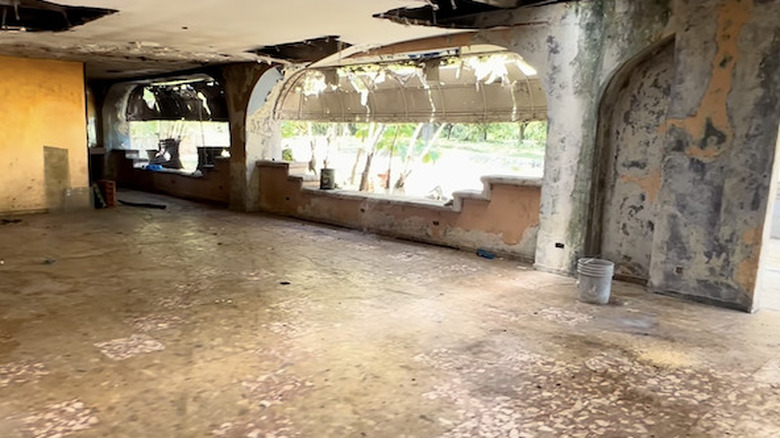
Long before gated all-inclusive resorts dominated the coastline of the Dominican Republic, the Sand Castle Hotel was an upscale resort in Sosúa on the island nation's north coast. It was the place to see and be seen. Today, observers describe the remains of the once-thriving resort destination as a ghostly presence on the horizon. "If you didn't know any better, you'd think it was a ruin left behind from some ancient Caribbean civilization," noted YouTuber Buying Dominican Republic in a 2025 video, reporting that the crumbling structure was conceived as an ambitious project. Back in the 1980s, Sosúa was a family vacation mecca — and families were the Sand Castle Hotel's target market. The expansive cliffside resort comprised hundreds of guest rooms, multiple swimming pools, a selection of restaurants and bars, and — for grown-up outings — a disco.
But times changed. Powered by the growing popularity of packaged-travel deals from the eastern United States in the 1990s, nearby Punta Cana emerged as a nightlife destination. That energy spilled over into Puerto Plata and, eventually, Sosúa, eclipsing the family travel market. But despite the evolving demographic, Sand Castle Hotel held steadfast to its reputation as a family-friendly resort. And that was the beginning of its end. Following a couple of last-ditch efforts to reposition itself, including a short-lived venture into the time-share market, Sand Castle Hotel closed for good in mid-2003. Today, the once-bustling resort is a ghost town of abandoned structures. The open-air lobby is eerily quiet while local flora and fauna steadily reclaim the property. The pool and its swim-up bar are littered with debris, and its pristine beach is deserted save for the occasional curiosity-seeker.