
The 5 Best RV Floorplans For Retired Couples, According To RV Owners

So, you've retired and decided to turn your travel dreams into reality by hitting the road in an RV. That's exciting. But now comes the hard part: Which RV should you choose? With so many brands and styles available, shopping for an RV can feel overwhelming, not to mention confusing. What's a fifth wheel? What's the difference between a trailer and a motorhome? And what about all those acronyms — TT, TV, SLX?
Before you start researching brands and models, it helps to first decide on a floor plan. You may already have your heart set on a nostalgic and groovy, retro-style RV or an affordable pop-up camper, but you may find yourself back at the drawing board when it comes time to decide where the kitchen should go or whether you want to avoid climbing stairs at night to reach the bathroom. You'll also want to understand your vehicle's towing capabilities. What can you tow, and do you want to tow at all? If you don't have — or don't plan to buy — a full-size or heavy-duty truck, you can rule out a fifth wheel and consider a travel trailer or motorhome instead. Fifth wheels require a special hitch installed in a truck bed.
This guide takes a closer look at five RV floor plans that retired couples say work well, including input from owners who are seniors themselves. The goal is to help you have a clear idea of what will work best for you and your partner long before it's time to set foot on the RV sales lot.
Fifth wheel, front living
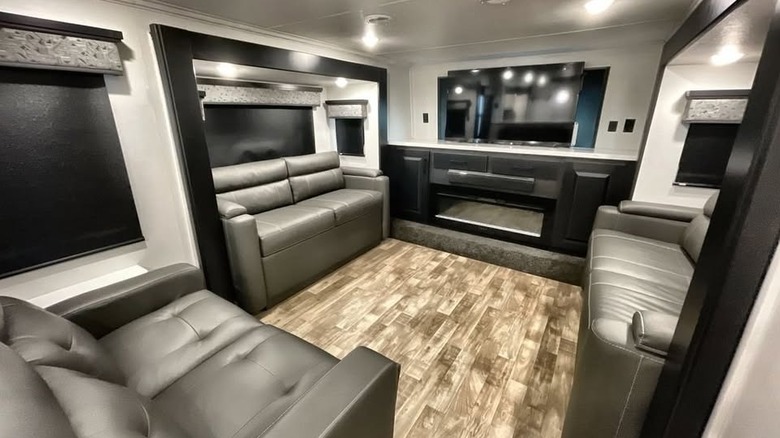
Among RV owners, floor plans that prioritize larger living areas remain popular — including front living (FL) layouts in fifth wheels. "Our favorite floor plan is the front living room on a fifth wheel," notes RV owner and retiree Judi DuGuay in the Full-time RV Living Community Facebook Group. "It has the most room to relax in and it actually feels like a home."
Owners often describe FL layouts as offering a "den-like" experience. The living area typically has space for one or two couches, often with pull-out beds, which can be a bonus for retired couples who expect to have the grandchildren or relatives accompany them on trips. Because the living room is separate from the rear bedroom, overnight guests have more privacy than they might in other layouts. It can also work well for couples with different sleep schedules. One person can stay up watching TV without disturbing a partner who has already gone to bed.
Rubirose Wingman, who has lived in an RV since retiring in 2020, recommends front-living or front-kitchen fifth wheels for couples who are comfortable with stairs. Still, she cautions against thinking that any single type of RV is "best," as it really depends on a couple's specific situation. "If stairs are an issue then a bumper pull would be best as there are only stairs going in," she says. "If they are not towing a little car than a Class A or Class C."
Fifth wheel, front kitchen
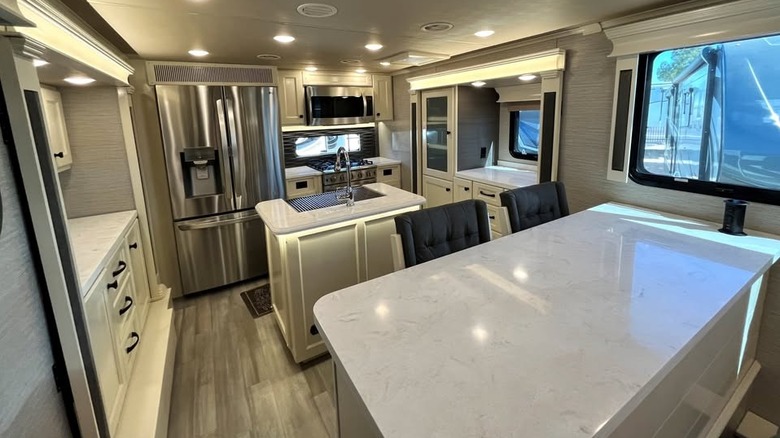
With a fifth wheel, terms like "front kitchen (FK)," "front living (FL)," or "front bath (FB)," mean that the designated space sits in the overhang above the truck bed, creating a dedicated "second floor" or upper-level area. Deciding what belongs in that space depends on your priorities.
Is a full-size refrigerator important to you? What about a large pantry? Whether you love to cook or just want more room for friends and family to gather around the table during meals, a front kitchen may be a strong fit. Owners recommend this layout for retired couples because of the added storage, countertop space, and room for booth-style seating. One RV owner on Reddit who had purchased a fifth wheel with a front kitchen prefers this layout because "the sink is in the island, full size micro, fridge, and stove. It has tons of cupboard space and a pantry. The kitchen is across from two reclining movie theatre chairs and a booth. There's a fireplace on the kitchen side." FK floor plans also often feature lower cabinets, which can reduce the need for step stools to reach pots and pans — a practical benefit for some retirees, especially those with mobility issues.
It's worth noting, however, that a front kitchen can add weight to the overhang, especially when fully stocked. You'll want to double-check your truck's payload capacity before purchase to be on the safe side.
Travel trailer, rear living
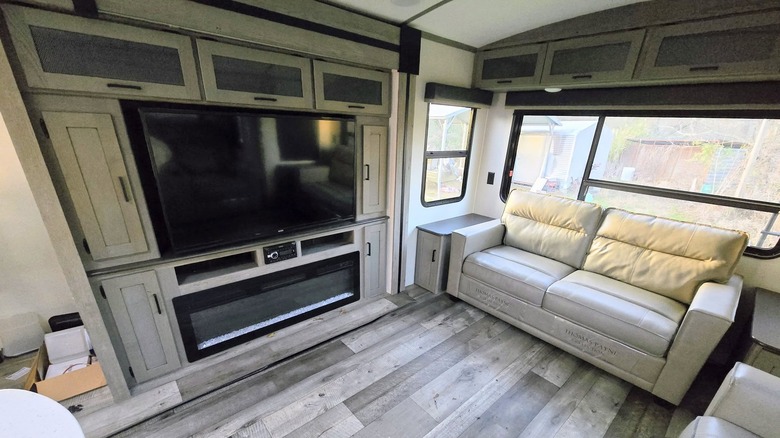
If you don't own a heavy-duty truck or want to avoid stairs, you may want to forgo a fifth wheel and consider a travel trailer instead. A travel trailer is a towable RV that typically connects to a rear hitch, and some models can be towed by SUVs. While generally smaller than fifth wheels, many offer similar amenities. "I would stay away from fifth wheels and anything with slides. Stick with 24 to 30 ft — those are easy to tow and maintain. Easy hookup and unhook," one Facebook commenter advised senior couples.
Similar to a front-living fifth wheel, a rear-living (RL) travel trailer prioritizes a larger living area. This means you have enough space to fit a couple of recliner chairs, so you can kick up your feet and read the paper or watch a movie. You can even customize it with large windows to enjoy the view, or install a widescreen TV and an entertainment unit. One retired RV owner on Facebook says RL layouts improve the viewing angle for watching TV without turning your head. Others on Reddit note that the large rear windows provide more natural light and better views, especially at scenic campsites.
Travel trailer rear bathroom
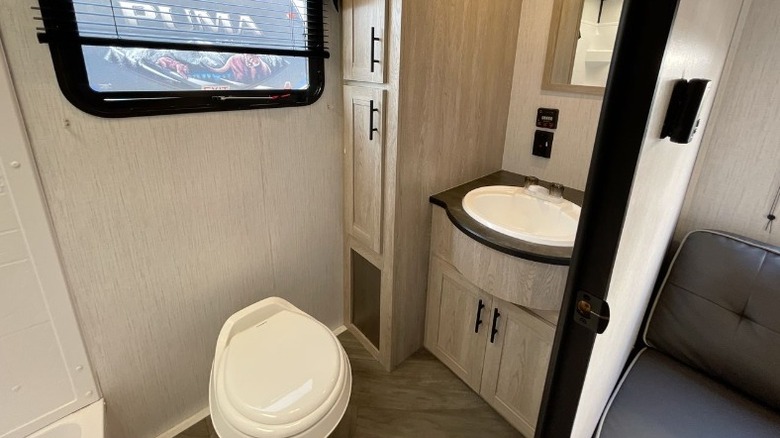
A rear bathroom (RB) layout in a travel trailer typically allows for a larger shower, vanity, and additional storage for linens or medications. Retired couples — or any couple — may appreciate the elbow room to maneuver around. A larger shower can also make it easier to add safety features such as grab bars or even a bench or seat. Little comforts like this can go a long way to making life on the road safer and more enjoyable for retirees.
One reviewer noted that in smaller layouts, bathrooms can feel cramped — "like a closet" — while a rear bathroom often spans the width of the trailer. On Forest River Forums, one reviewer noted that in smaller layouts, bathrooms can feel cramped — like a "closet" where " you have to sit on the toilet with a foot in the shower and your elbow in the sink" — while a rear bathroom often spans the width of the trailer.
Whether you choose a fifth wheel or a travel trailer, both options allow you to unhitch your tow vehicle once you arrive and use it for local driving. That flexibility can be especially useful in urban areas or for day trips. Those in a Class C motorhome, which we'll look at next, don't have that option as their living and driving areas are combined into a single motorized RV.
Class C motorhome
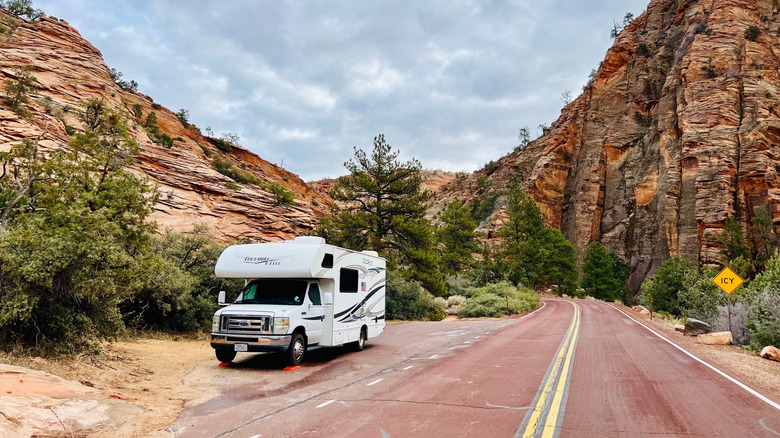
Motorhomes come in three main classes: Class A, Class B, and Class C. A Class A motorhome is "bus-like" and typically ranges from about 26 to 45 feet, making it the largest option. If you want the closest thing to a replica of an apartment, it's the ideal choice. A Class B motorhome, meanwhile, is van-based and more compact, often easier to drive and park, but with a significantly tighter living space.
For many retired couples, a Class A may be larger than necessary, while a Class B may feel too small for comfort. This is why a Class C motorhome is frequently the best motorhome choice for retired couples, according to RV owners. Typically ranging from about 20 to 32 feet, Class C motorhomes offer enough space for multiple sleeping areas while remaining relatively manageable to drive. Unlike towable RVs, they require minimal setup — just park, and you're ready to go. "If I was a older senior, I'd have a class C for ease of driving even with a tow car," says RV owner and retiree Rubirose Wingman.
One senior on Facebook, who owns a 27-foot Class C motorhome, points out that smaller Class C models are more likely to fit in national park campgrounds, which often have length limits. In general, the larger your RV, the fewer campsite options you'll have. Before hitting the road, be sure to check out these national parks, which are the best for camping in America, according to campers.
Methodology
Deciding on the "best" RV floor plans for retired couples was tricky, as so much of what makes someone prefer one style of RV over another is personal. Someone who loves taking a bubble bath every night will naturally want an RV floor plan with a large bathroom. Someone who loves baking will want a floor plan that has a large kitchen prep area and a spacious oven. Retired couples' interests, financial situations, and relationship dynamics can span a wide spectrum, and what works well for one couple can be a nightmare for the next.
To narrow the list to five floor plans, we excluded rear-kitchen layouts, which some owners describe as more prone to movement ("bouncy") while traveling, requiring extra care to secure plates, cups, drawers, and appliances. We also excluded pop-up campers, truck campers, and toy haulers, as they tend to be either smaller or more specialized.
To further narrow down the list, we combed through RV Facebook groups to see what others have recommended in the past. We then reached out to several RV owners active in these groups to get their thoughts on their favorite floor plans.