
The Caribbean Is Home To The World's Smallest Commercial Airport
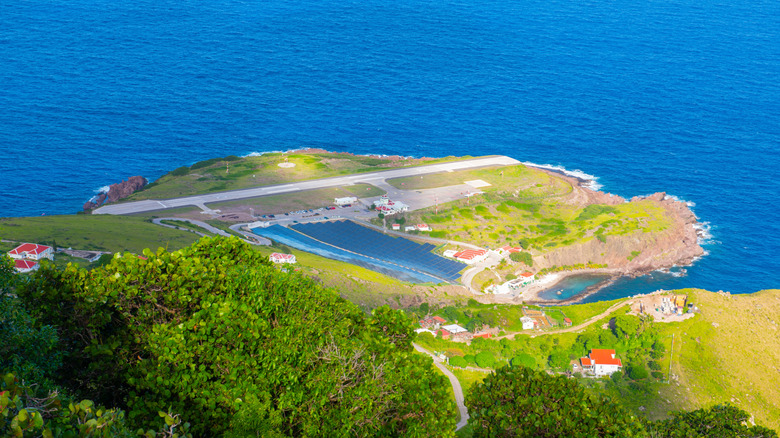
When it comes to airport runways, size definitely matters. Large commercial aircraft need longer runways for takeoff, particularly if they're traveling at faster speeds or carrying lots of people and cargo. Commercial runways generally measure between 8,000 and 13,000 feet, although there are certainly exceptions. The title of world's longest airport runway is tied between two large countries: both China's Shigatse Peace Airport and Russia's Ulyanovsk Vostochny Airport boast tarmacs running a staggering 16,404 feet. It's not surprising, then, that the world's smallest commercial airport lies in the Caribbean, home to hundreds of minuscule islands with naturally limited runway space. Saba, one of the Caribbean's tiniest islands, is home to the world's smallest commercial airport. Flanked by an azure sea on one side and jagged mountains on the other, the runway at Juancho E. Yrausquin Airport is a diminutive 1,300 feet long.
Saba measures a pint-sized 5 square miles. Together with Bonaire and Sint Eustatius, it comprises the Caribbean Netherlands, a trio of special municipalities known as the "BES Islands." As you would imagine, Saba also has one of the smallest permanent populations in the Americas, with just 2,158 inhabitants as of 2025. The island does, however, boast one massive feature: Mount Scenery, a menacing volcano rising almost 3,000 feet above the Caribbean Sea. With the volcano occupying a vast portion of the island, there was no place to put an airport except on the island's fringes.
Before Saba's airport came to be in 1963, Caribbean resident and pilot Rémy de Haenen was determined to make Saba's first landing. Haenen identified one of the craggy island's only level areas, which was fittingly called Flat Point, as the promising spot for his touchdown. Indeed, Haenen landed Saba's first flight here in 1959, effectively bringing air travel to the wee island.
What landing and takeoff are like at Juancho E. Yrausquin Airport
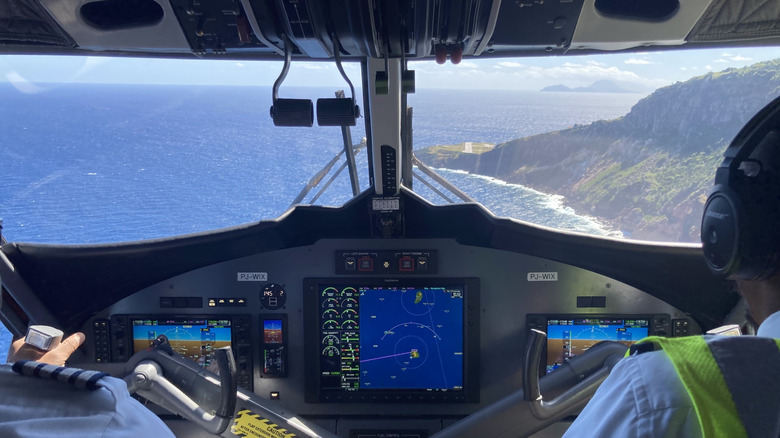
Juancho E. Yrausquin Airport's compact landing strip, slivered between steep cliffs and the deep blue sea, is regularly placed on lists of the world's scariest airport runways. However, Google reveals Saba's airport has a 4.6 rating out of 98 reviews, indicating that most touchdowns here are crowd pleasers. "The impossible little runway is exciting to experience and made all the better by the jagged cliffs and shortest of runways," gushed a thrilled visitor. However, the experience isn't for the faint of heart. While prayers for a smooth landing seem obvious, takeoff is another nail-biter. With nothing but Caribbean in front and Caribbean behind the tarmac, let's hope your speeding plane lifts off in time to avoid plunging into the sea!
Naturally, several precautions are taken to prevent runway disasters. Perhaps the most obvious is no flights in the rain. Only small, regional, propeller aircraft with short landing and takeoff capabilities can operate here. Saba's three partner airlines — Winair, SXM Airways, and Windward Express Airways — fly planes carrying no more than 20 passengers, and that adhere to strict weight and wind speed restrictions. Most direct, 20-minute flights to Saba depart from the popular island of Sint Maarten. This sounds amazing until you realize it, too, has a dicey reputation for the dangerous "fence surfing" trend at Princess Juliana International Airport.
Fortunately, airport mishaps at Juancho E. Yrausquin are rare thanks to rigorously trained pilots, many of whom are taught by Captain Roger Hodge, a flight instructor for Winair. In an interview with CNN, Hodge shared that although Saba landings can get "hairy," they're also thrilling. "There's always adrenaline that kicks in because you're being watched by passengers and people on the ground, but you've just got to fly that machine."