
This Vibrant West Coast Hub Is America's Most Traffic-Congested City
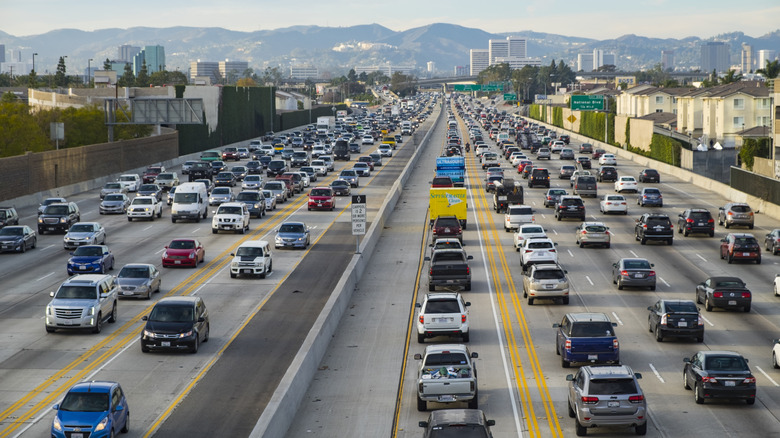
There's an old "Saturday Night Live" sketch called "The Californians," a recurring soap-opera parody. One of its memorable running gags features characters, in exaggerated West Coast vocal fry, reciting elaborate driving directions for how to cross town and avoid traffic. This is because the sketch is set in Los Angeles, a notoriously traffic-choked hotspot where every commute turns into a game of Tetris, and showing up late because of "traffic" barely raises an eyebrow. The metropolis is so congested that it's given rise to zeitgeist monikers like "Carmageddon," the mythical 20 (now 30)-minute drive," "merge or die" on-ramps, and the "Rush Hour" movie.
To further cement this reputation, INRIX, a data analytics firm, has ranked Los Angeles among the world's 10 most traffic-congested cities in its 2025 Global Traffic Scorecard. The city ranked fourth in the United States — behind Chicago, New York, and Philadelphia – making it the most congested major city west of the Mississippi. According to INRIX, Los Angeles drivers lose an average of 87 hours per year behind the wheel thanks to pervasive gridlock.
To measure congestion, INRIX analyzes peak travel times across nearly 1,000 urban areas over 3 years, evaluating changes and patterns. It then calculates economic cost. The firm reported that traffic congestion cost the U.S. more than $85 billion in 2025, an increase of more than 11% from the previous year. As fuel prices climb to record highs and inflation continues to rise, this data may prove more valuable than ever.
2025 actually saw a slight improvement for L.A. congestion, which had ranked 8th globally in 2024. The Los Angeles Times noted this could be attributed to COVID pattern disruptions, office vacancies downtown, and the fact that L.A. traffic is already so bad, it's hard to get any worse. Indeed, UCLA urban planning professor Michael Manville noted most drivers wouldn't perceive that level of improvement.
Does Los Angeles have a transportation problem?
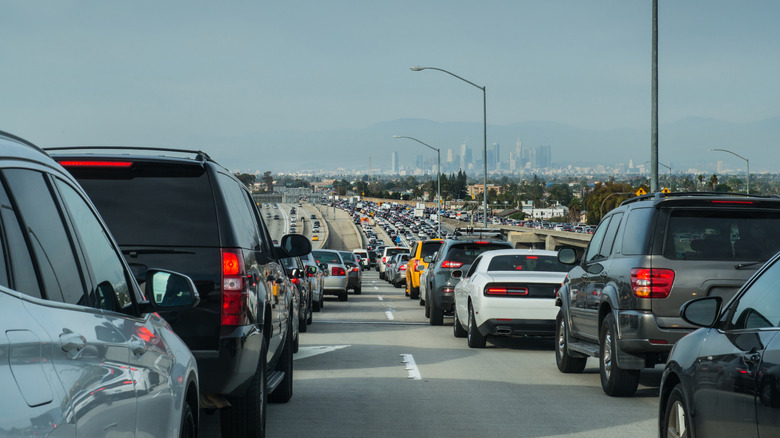
It's not unusual for Los Angeles to dominate national traffic congestion rankings. INRIX named it the most congested city in the U.S. in 2017, and in 2025, Consumer Affairs ranked it second in the U.S. after Washington, D.C. (via MSN). The state's highway system snarls across the SoCal hub, and freeways commonly referred to by their numbers — the 101, the 5, the 110, the 10, the 405 — have become essential pathways for commuters across the city's sprawl, which includes two of the 5 busiest highways in America.
The effects go beyond soul-sucking aggravation and economic cost. Severe wildfires that have ravaged L.A. in 2024 have highlighted how gridlocked roads can complicate evacuations. On the west side, traffic in the Pacific Palisades became so bottlenecked that some residents were forced to flee on foot. Additionally, although traffic fatalities have increased overall in the U.S. since the 2010s, INRIX reported a slight plateau in 2025, a trend mirrored in L.A.-specific data, too. Data-driven solutions, such as lowering and enforcing speed limits, may improve road safety and help mitigate congestion overall.
Though early Los Angeles developed an extensive, privately subsidized streetcar network, automobiles were seen as ideal for a modern city. Building those roadways often controversially disrupted communities, displacing residents and accelerating segregation and redevelopment. There's also the enduring "Great American Streetcar Scandal," a theory that alleges L.A.'s mass transit infrastructure was forcibly sabotaged, ostensibly to line the pockets of automobile, rubber, steel, and oil manufacturers (though this is disputable). INRIX also noted that in 2025, the U.S. federal government revoked $4 billion in funding for the California High Speed Rail, a long-anticipated, controversial public transit project that could, in theory, help ease the state highway system.
Los Angeles does have an underrated public transit system
What Los Angeles might lack in congestion-free roadways, it makes up for in appeal — which may partially explain why those freeways are just so crowded. The city is a world-class destination, a vibrant, creative metropolis that draws millions of annual visitors. It's home not just to storied spots like Hollywood, Malibu, and Venice, the most filmed beach in the world, but to numerous cultural enclaves that give the city flavor. From the foodie hub of the San Gabriel Valley featuring authentic eats and cultural charm to its status as a Sanctuary City, L.A. is a welcome haven for residents and a vacation destination for visitors.
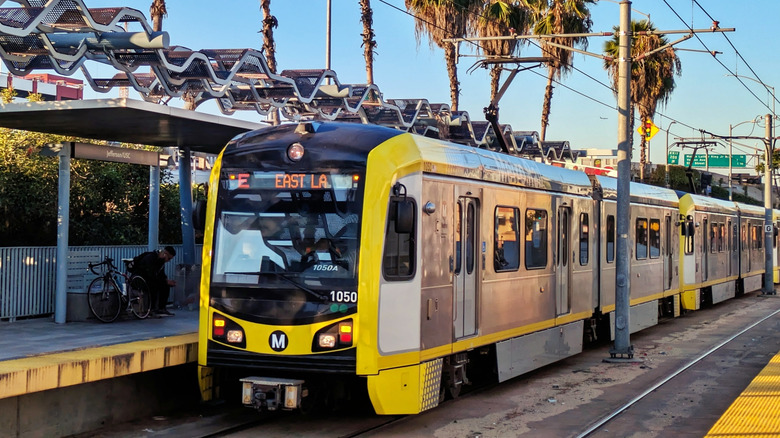
And while nothing beats a windows-down cruise along Pacific Coast Highway ("the One") from Santa Monica to Malibu and beyond, Los Angeles does indeed have an underrated public transportation system; you may be surprised how connected you can be if you try it. Buses, shuttles, light rail trains, and subways do, in fact, cover the far corners of the county. Ahead of the 2028 Summer Olympics, the city has been making additional efforts to expand mass transit access.
In 2025, Los Angeles opened the LAX Transit Center, and in 2026, it debuted the long-anticipated Metro D Line connecting Downtown Los Angeles to Miracle Mile and Koreatown all the way to Beverly Hills. Additional planned metro expansions are expected within the coming years. Angelenos have widely celebrated the D Line's expansion, and L.A. County ridership has increased in 2026 in part due to high fuel costs. It's unlikely Los Angeles will thoroughly ditch its association with cars any time soon, but in the meantime, increased public transportation options may help reduce traffic on the roadways.