
North Carolina's Once-Abandoned Psychiatric Hospital Is Now A Thriving Urban Park In Raleigh
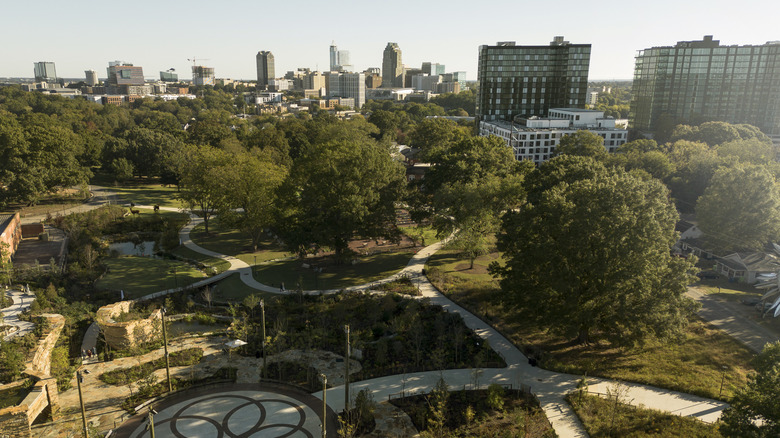
When it comes to cities in North Carolina, Charlotte may be the biggest, but you could make the argument that Raleigh is the most pleasant. Known as the "City of Oaks" for its beautiful tree-lined streets, the Tar Heel State's second city has long made greenery a priority. It also has a fascinating history, and the two come together in one of the city's newest public spaces, Dix Park.
Named for Dorothea Dix — the social reformer of the 19th century who tirelessly advocated on behalf of the poor, indigenous, and mentally ill — this 308-acre property is not only Raleigh's leading urban park, but occupies the site of North Carolina's first psychiatric hospital. Filled with public art, oak trees, bucolic meadows, classic architecture, and flower fields, the park embraces its complicated past and reinvents itself as a place of healing and hope.
Situated just a stone's throw from downtown, this is the cutting edge of urban design, as driven home by these reviewers on Tripadvisor. "We loved this beautiful park, which included some open spaces, some wooded areas, cool wooden trolls and other art installations," wrote one visitor in a 5-star review, while another remarked, "It is fantastic to see how Raleigh has repurposed this campus into an urban park. There is something for everyone."
History and nature in Dix Park, Raleigh

Historic plantations — like those once found in this Louisiana river town near Baton Rouge — were a part of the fabric of the American South, and the spot Dix Park occupies is just one example. Home to the Spring Hill Plantation for 150 years, the state of North Carolina eventually acquired the land and established what was to become Dorothea Dix Hospital in 1856. This mental health facility operated for nearly 160 years, officially closing its doors in 2012.
The creation of the park began in 2015, when the city of Raleigh purchased the grounds from the state, beginning the extraordinary process. Over 65,000 members of the local community were consulted for their input, resulting in a public space that embraces natural scenery as well as history. The developers also worked with the Nature Conservancy to maintain a natural feel and ensure sustainability, and Dix Park is a member of the International Coalition of Sites of Conscience, the global NGO that operates under the slogan: "Preserving memory. Promoting truth. Pursuing justice."
While most of the hospital's main buildings have been or are in the process of being demolished, three historic stone houses remain: The Superintendent's House, Physician's House, and Gatekeeper's Cottage, all of which were constructed in the 1920s. These picturesque structures not only preserve some of the site's heritage but also serve as vital office space for both park staff and the partner organization, the Dix Park Conservancy.
Stroll amongst the flowers and trolls at Dix Park

While the site's history as a psychiatric hospital may make it a slightly bizarre novelty to some, it is — like New York City's iconic Central Park, recently named the number one tourist attraction in America — a functioning green space. One of Dix Park's biggest draws is its fields of daffodils and sunflowers, which add a big splash of color to the surroundings. "Gorgeous, breathtaking and enchanting sunflower field that you can visit from the dawn to the dusk," reported this visitor on Google Maps, referring to it as the "Perfect place for great summer family pictures." Sprouting from 50,000 originally-planted bulbs, the daffodils reach their peak bloom in early March, while the sunflowers are at their tallest and most vivid by mid-July.
Perhaps the biggest attraction at the park is the Gipson Play Plaza, an 18.5-acre gathering space that calls itself the "largest adventure playground in the Southeast." In addition to an array of activities to keep the kids entertained, the complex also boasts a 91-foot-long swing, along with the House of Many Porches Market, which sells food and refreshments and offers plenty of room to sit down and relax.
That said, it's the park's troll statues that really seem to have captured the hearts of visitors. Designed by renowned artist Thomas Danbo, five massive trolls (created entirely from repurposed materials) are scattered throughout the park, where visitors are encouraged to touch and interact with them. "We went to Dix Park to see the five trolls. They were more impressive than I had imagined. The details and craftsmanship were amazing," wrote this visitor on Google Maps, while another had these simple words: "The Giant trolls were amazing!!!" For more charms in the area, check out Pittsboro, an artsy town full of local shops and cafes.