
Florida's Wildlife Refuge Outside Tallahassee Is A Birdwatching Haven With Fishing Spots And Scenic Trails
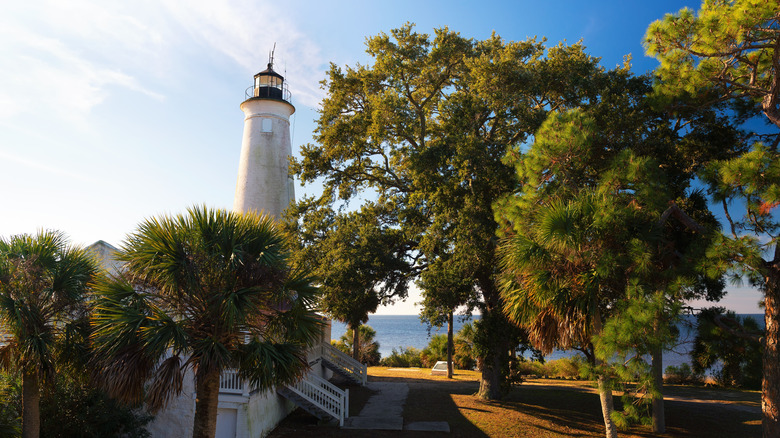
The Florida Panhandle is home to some of the most beautiful nature preserves in the state. This wild Gulf Coast includes national seashores, forests, wildlife refuges, and more. Just 23 miles outside Florida's state capital of Tallahassee, it boasts over 86,000 acres of federally protected Florida wilderness for visitors to explore. First established in 1931 as one of the first-ever refuges created within the National Wildlife Refuge System, the St. Marks National Wildlife Refuge is a living example of Florida's history and natural wonder. The St. Marks Lighthouse, which was erected in 1842, is still in operation and open to guests. You can learn about its storied past through exhibits at the refuge's visitor center.
Open year-round during daylight hours with admission fees of just $1 for cyclists and pedestrians ($5 for those coming by car), this refuge is a hub for outdoor recreation in the Big Bend. With 43 miles of shoreline along the Gulf of Mexico (renamed the Gulf of America in 2025 by U.S. President Donald Trump), visitors can boat, paddle, and fish in the refuge's many wildlife-rich freshwater and saltwater waterways. As a critical wintertime sanctuary for migratory birds, St. Marks is an essential stop for birdwatching enthusiasts. Visitors can expect to spot several birds and native wildlife as they walk along the refuge's many multi-use trails, which accommodate hiking, biking, and even horseback riding. The trails also comprise a significant portion of the National Florida Scenic Trail.
The St. Marks National Wildlife Refuge is so large that it's located in three different Florida counties: Wakulla, Jefferson, and Taylor. Given its proximity to the Sunshine State's capital, it's a great place for travelers to slow down and immerse themselves in Florida's wilderness. Those traveling down the coastal US Highway 98 or visiting the panhandle, especially nature lovers, will want to make time to explore this thriving ecosystem. Out-of-state visitors can come to the area via Tallahassee International Airport (TLH), which is located just 40 minutes north of the refuge.
Fish amidst over 300 bird species at the St. Marks National Wildlife Refuge
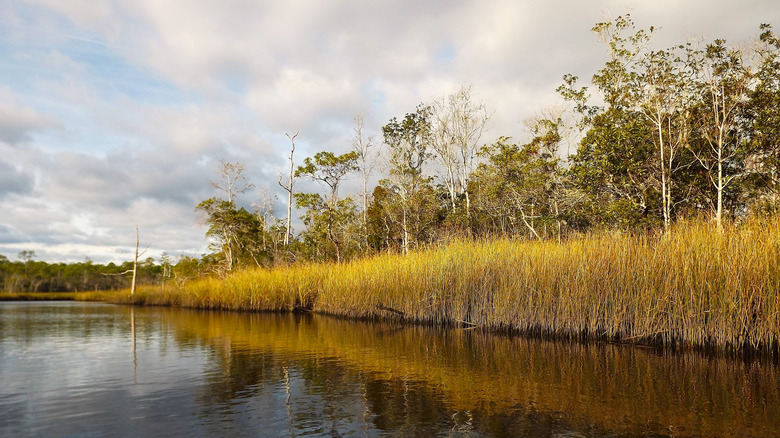
As a wildlife refuge, it should come as no surprise that St. Marks offers remarkable wildlife and birdwatching. Many Florida species can be found at this expansive park, including over 52 mammal species, 40 amphibian species, and 66 reptile species. It's common for guests to seek out alligators, river otters, deer, bobcats, bears, turtles, raccoons, and wild hogs. Visitors can even spot rare and endangered Florida species here, including the West Indian manatee, the flatwoods salamander, the whooping crane, and the swallow-tailed kite, among others.
Over 300 bird species have been sighted at the St. Marks National Wildlife Refuge, making it one of the best destinations in Florida for birdwatching along the Great Florida Birding Trail. The region is a reprieve for migratory birds that flock to the state during cooler months, which causes a flourishing mix of native Florida birds and limited-time migrating species. Birdwatchers can find many species of ducks, geese, woodpeckers, bald eagles, hawks, wild turkeys, egrets, herons, storks, warblers, osprey, waterfowl, falcons, owls, and various songbirds. "The drive through the expansive park was gorgeous ... [and] lots of folks [were] out birding," one Google reviewer noted.
St. Marks also offers freshwater and saltwater fishing. Anglers can cast lines in several rivers, 2,000 acres of man-made pools, and even the Apalachee Bay, roughly 32,000 acres of which lie within the refuge's boundaries. Bank and saltwater fishing are open year-round with a proper Florida fishing license, with boat access points for those wanting to fish in the bay. Some of the most commonly caught fish in the refuge include sea bass, catfish, sunfish, trout, mullet, mackerel, flounder, red drum, and even sharks. Crabbing is also permitted, but only near the lighthouse. One Google user shared a charming fishing anecdote: "Watching a bald eagle fly off with a speckled trout as I was reeling in a speckled trout myself was a highlight of the visit." More local fishing can be found at Big Bend Seagrasses Aquatic Preserve, Florida's top sea life preserve.
Hike scenic coastal, swamp, and palm hammock trails at the Refuge
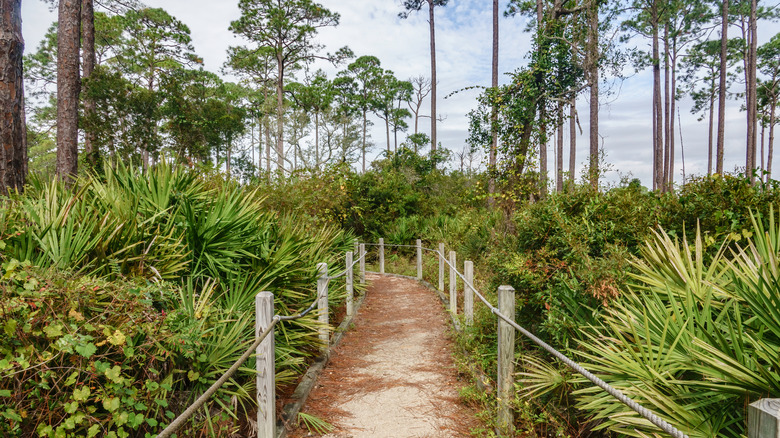
The St. Marks National Wildlife Refuge has many scenic trails made of varying terrain, including 41 miles of the Florida National Scenic Trail that intersects with many of the area's popular trails. Listed as the number one trail at St. Marks on AllTrails, The Cathedral of Palms via Florida Trail is a 5.9-mile loop through swamps and palm hammocks that offers views of the serene Shepherd's Spring. While leashed pets are permitted throughout the refuge and its trails, some caution against bringing them on account of the abundance of ticks in the area. To better avoid mosquitoes, ticks, and other bugs that thrive here, using bug spray is highly encouraged for all hikers who come here.
For those with limited time, the refuge has plenty of easier hikes that are less than a mile long. To quickly take in the area's natural beauty, try Levee Trail, a 0.9-mile path that takes guests to many points of interest. These include the lighthouse, a boat ramp, the coastal shoreline, and a pond where you can spot aquatic wildlife. Cedar Point Trail is even shorter at 0.6 miles out and back, with benches along the trail for birders to stop and watch nearby birds. One of the shortest routes in the area is Headquarters Pond Trail, an accessible 0.2-mile trail that ends with an observation deck atop a saltwater pond that's home to even more wildlife.
Those looking to be on the water can canoe and kayak on the refuge's Florida Circumnavigational Saltwater Paddling Trail, albeit by permit only. The area also supports equestrians looking to go horseback riding on its roads, and here you'll also find the Piney Ridge Loop Trail, a multi-use trail that's popular for both horseback riding and mountain biking. For more local nature and hiking in the area, make sure to check out these seven state parks that are hands-down the Florida Panhandle's best.