
Between Athens, Atlanta, And Augusta Is Georgia's 'Outdoor Classroom' With Camping, Fishing, And Archaeology
It is often said that the United States is a young country. This is true if you compare the year of its founding, 1776, with the historically preserved ancient civilizations found within India, China, Italy, Greece, and Egypt. But if we look at archaeological evidence of human habitation, America's history runs deep. And if you want proof, look no further than Rock Hawk in Georgia.
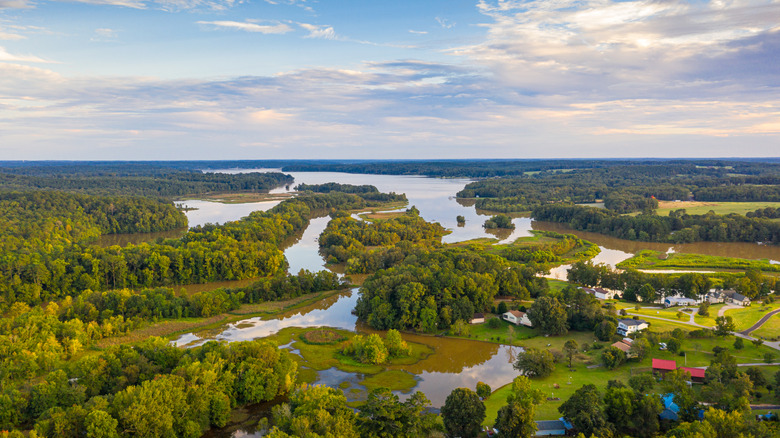
Per the official website, the archaeological site is an "outdoor classroom," located in a rural stretch of the state near the shores of Lake Oconee. If you view travel as a largely educational pursuit, budget a couple of days for exploring Rock Hawk, because there's much to learn here. Discover its history, nature, and abundant wildlife through displays scattered along miles of trails. Also visit the site's centerpiece: a mysterious stone effigy shaped (sort of) like a great bird in flight.
Some of Georgia's major cities form a loose triangle around Rock Hawk, with Atlanta around 87 miles to the west, Athens 60 miles north, and Augusta 82 miles to the east. This makes Rock Hawk a great day trip option or a stop-off point on a cross-state road trip. Nearby, there's a campground overlooking Lake Oconee, one of many scenic Georgia lake getaways just a day trip from Athens, with facilities like electrical hookups, grills, and picnic tables. It's also a prime spot for fishing, swimming, boating, and kayaking.
Rock Hawk's outdoor classroom
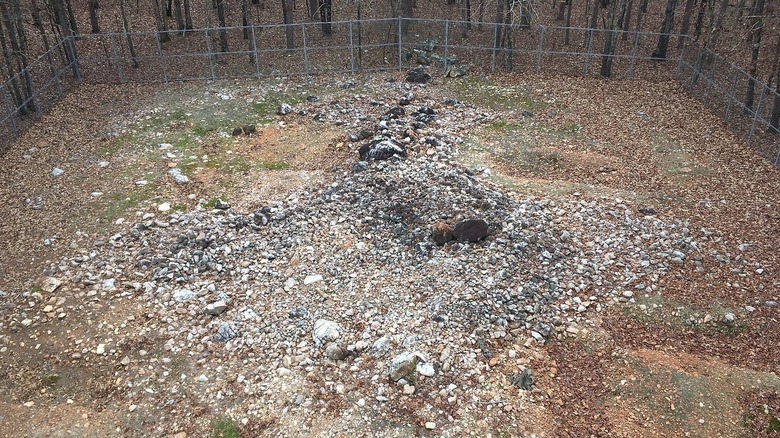
Rock Hawk's county, Putnam, and the city where you'll find it, Eatonton, were named after two prominent 19th-century military men — Israel Putnam and William Eaton — but the region's history is considerably older. Thousands of years earlier, Native Americans lived on these lands and built effigies, mounds of dirt and rocks shaped into a symbolic animal or figure. Two remain in the county: Rock Eagle and its smaller sibling, Rock Hawk. Because no artifacts in the Rock Hawk area can be reliably dated, some estimates place it at around 2,000 years old.
Compared to Rock Eagle, which has a clear, well-preserved image of an eagle made with white quartz rocks, Rock Hawk is in poor condition. Although it was comprehensively restored in the 1950s, it is still hard to make out the shape from ground level (plus, a fence obstructs your view). To better appreciate Rock Hawk, climb the adjacent observation tower and interpretive centers. The effigies also have significant astrological alignments. Rock Hawk's wings align with the summer and winter solstices, so we can infer that it celebrates the sun. Its direction also suggests it was constructed to guide souls along the Milky Way and into the afterlife, called the Path of Souls in Native American beliefs.
To learn more, head to the Rock Hawk trail network, which runs for 25 to 30 miles and features educational exhibits. Signs along the routes discuss the area's geology, the effigy's history, and the wildlife you might encounter: raccoons, skunks, armadillos, snakes, and plenty of birds, including woodpeckers, cardinals, herons, and raptors. A downloadable trail map indicates five color-coded hiking routes ranging from 1 to 3.6 miles. There are also shortcut trails, bike routes, and paved roads leading to parking areas.
Camping and fishing at Rock Hawk
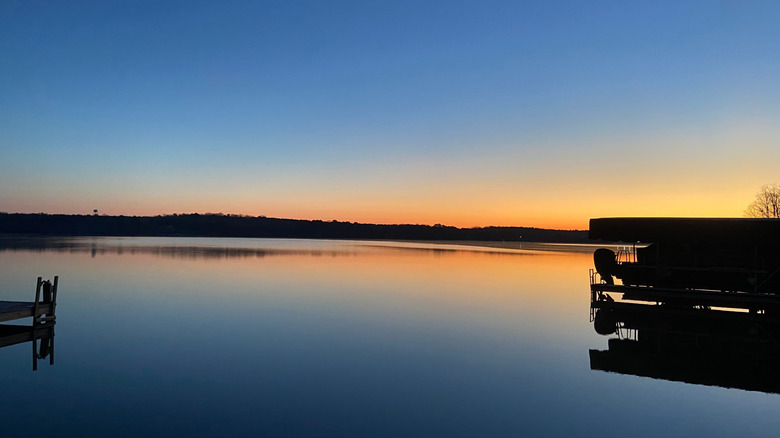
There's an inherent childlike wonder about hypothesizing the purpose of an ancient stone mound, but Rock Hawk's history and its philosophical musings are only part of the experience. The Lawrence Shoals Campground, connected to the effigy by trails and a paved road, has more than enough activities to keep you entertained. There are white sand beaches for swimming, pavilions, picnic tables, and barbecue grills. Open March through November, the campground is best suited for RV users, but tents are welcome as well. And although there are limited reviews on The Dyrt, most are positive, highlighting how clean, well-maintained, and accommodating it is. For those who aren't keen on camping, the nearby town of Greensboro is a scenic fall retreat, with golf, spas, and cozy campfires, close to Lake Oconee and the campground.
Fishing is popular on Lake Oconee, with anglers reeling in catfish, pickerels, bluegills, carps, and crappies, per Bass Online. It's also well-known in the fishing community for its healthy population of bass. You can access the lake from a boat ramp near the Lawrence Shoals Campground, and don't worry if you don't catch anything early on; there are 19,000 acres of freshwater to explore. You can get an up-to-date report of the water level at Lakes Online, and monthly Lake Oconee fishing reports at Georgia Outdoor News. For those who simply want to make a day trip to Rock Hawk and Lake Oconee, set up a base in Athens to experience its vibrant rock music scene.