
What A Blue Flag Beach Really Tells You Before You Book

When deciding if a beach is worth visiting, you might look for clear, turquoise seas and a scattering of sun loungers for post-swim snoozing. Perhaps you want a beach abounding in wildlife and devoid of fuel-chugging motorboats. But while simply looking at a destination can be useful, the Blue Flag designation is often used as the benchmark for assessing beach quality. The international sustainability program is overseen by the Copenhagen-based Foundation for Environmental Education (FEE), and Blue Flags are awarded to beaches that meet certain environmental, educational, safety, and accessibility criteria.
These criteria include displaying information about the local ecosystem and the Blue Flag designation, taking regular water samples for quality and hygiene assessments, maintaining high safety standards, and ensuring the beach is managed sustainably (covering carbon emissions, pesticides, and other pollutants). A Blue Flag beach should also be kept clean and waste free, and its sensitive environments should be transparently protected. But it would be wrong to think of a Blue Flag as guaranteeing every aspect of environmental health and user safety — a Blue Flag beach could, for example, fall victim to an unexpected oil spill. Rather, as BeachFinder pithily puts it, "It helps you identify beaches where management standards are visible and where information should be easier to find."
There are Blue Flag beaches and marinas across the world, particularly in Europe, which is positively swarming with them. Spain has the largest number of Blue Flag beaches of any country, with 676, though other Mediterranean countries, like Greece, Italy, and Turkey, also have several hundred each. But if you're booking a trip to one of these spots, it's also good to know what the Blue Flag doesn't guarantee, such as warm and clear waters, crowd-free sands, docile marine life, or immunity to severe weather.
How to assess a Blue Flag beach before booking your trip
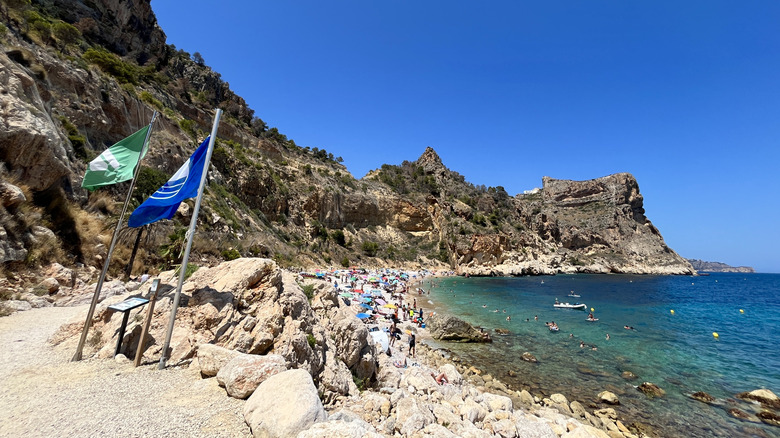
Clean water is one of the principal criteria for Blue Flag designation. Each month during the season, Blue Flag beaches are required to collect and test water samples, which must meet strict bathing-water quality standards. Beach authorities also must provide solutions for pollutants and chemical spills. But it would be wise to cross-reference the Blue Flag status with current water quality data found on government websites or state-level authorities to ensure up-to-date accuracy. For example, a temporary water-quality warning negates the Blue Flag certification.
Instead of just showing up at the first Blue Flag beach you see, it's wise to assess other safety indicators. Are there lifeguards on the beach? What weather can you expect? Will sharks, jellyfish, or stingrays be present? How about riptides? Blue Flag beach Playa Hermosa in Costa Rica, for example, receives powerful surf waves, but it's one of the world's most dangerous swimming spots. Display boards at Blue Flag beaches detail such information, and prior to booking your trip, you can consult the Blue Flag Site Map, indicating a beach's location, season length, facilities, and geological characteristics. You'll also find contact information for the relevant local authority. However, Blue Flags are different from colored warning flags. It's good to know what these flags mean, as they give a beach's current safety status, like red for dangerous currents or purple for dangerous pests. Similar color-coded systems exist worldwide, but regional differences remain.
The Blue Flag doesn't represent a list of the best or the prettiest beaches either. Some wild beaches might be too remote to meet all Blue Flag criteria, like accessibility or waste management. Additionally, maintaining this designation can be expensive. The number of Blue Flag beaches in the Balearic Islands has dropped in recent years, primarily because authorities have decided to divert funds elsewhere.