
Outside Belfast Is Northern Ireland's Destination For Scenic Camping, Mountain Trails, And Fairytale Beauty
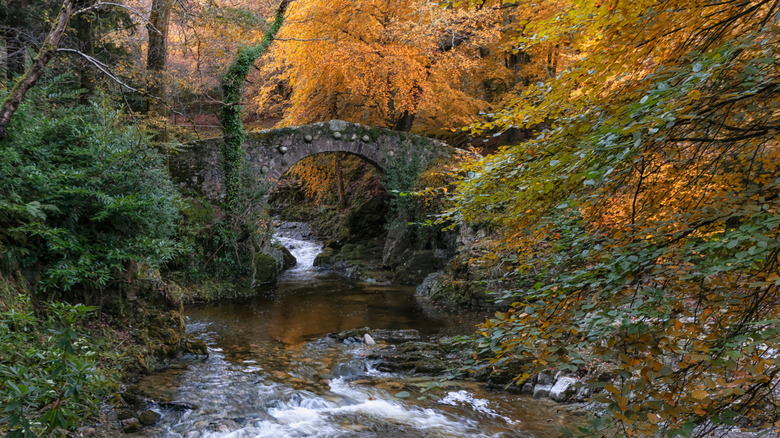
Rural Northern Ireland is marked by cattle-filled pastures, rolling sand dunes, and an aggressively beautiful North Atlantic coastline. But before farmland covered the landscape, it was also rich in native forests, where rainfall was full and frequent, and lichen and mosses clung to every surface; a place to inspire folktales of faeries, crones, screeching banshees, and shapeshifting tricksters. Though most of this native woodland is no more, Tollymore Forest Park is one of the few stretches of countryside that gives an impression of Northern Ireland in millennia past.
Tollymore isn't a traditional Irish forest; it's a mix of native woodland and imported species, with monkey puzzles, Himalayan cedars, Monterey pines, and giant redwoods congregating near the banks of the River Shimna. As The Irish Times once put it, the forest was "planted over centuries by green-fingered noblemen," and "looks like it has sprung from the pages of a European fairy tale." From the early 1700s, aristocratic owners took the already scenic landscape, a wooded hill at the base of the Mourne Mountains, and crafted it to fit their desires. They constructed pretty stone bridges, added a brooding barbican gate, and planted hundreds of thousands of trees, including lots of larch, a deciduous conifer native to the European mainland. Much later, in 1955, Tollymore Forest was opened as Northern Ireland's first state forest park, allowing the public to avail of the aristocrats' creation too.
Four waymarked trails navigate the forest, some connecting to the Mourne Mountains, including Slieve Donard, Northern Ireland's tallest summit at 2,789 feet. The forest park also offers year-round camping, though the town on its doorstep, Newcastle, a seaside resort with a beach and world-class golf, has some nice hotels. If you're staying in Belfast, Northern Ireland's capital, Tollymore is only an hour's drive away.
Hiking Tollymore Forest's trails
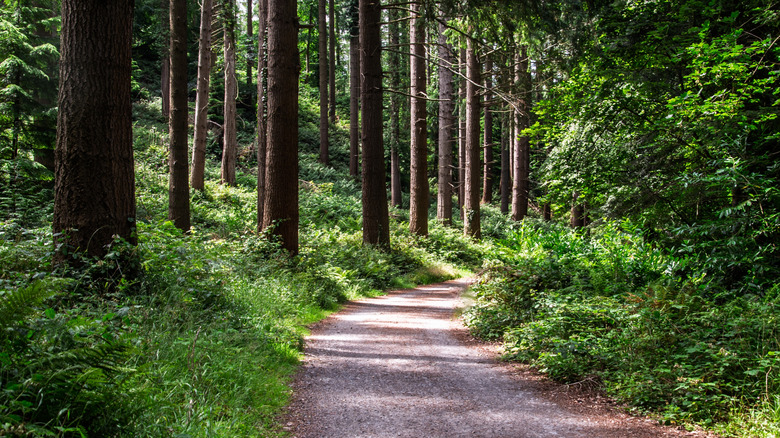
Hiking Tollymore's trails is the best way to explore the forest, whether you opt for the gentle Blue and Red trails or the demanding Black Trail (which is technically two trails, one of which climbs into hills known as the Drinns). The half-mile Blue Trail is the easiest, but it's worthwhile, guiding you through an arboretum — a showcase of tree species from across the world — whose history stretches back to 1752, making it one of the oldest in Ireland. The Red Trail hugs the banks of the Shimna River for around 3 miles, passing through mixed forest. At one point, it offers a great view of the Pot of Legawherry, a deep depression, or corrie, on the slope of Slieve Commedagh, formed by glacial movement, likely during the last Ice Age.
For a more challenging hike, hit the Black Trail, divided into the 5.5-mile Mountain Trail and the 3-mile Drinns Trail. If you hike the two together, you'll have to contend with around 1,400 feet of elevation gain, which might not be much for experienced hikers, but wet weather and sloppy underfoot conditions can add to the difficulty. The reward is a route through arched stone bridges, great mossy rocks in the river, tree trunks rising from the pine straw, and views of the Mournes as you ascend through the hills towards the Curraghard lookout.
"Game of Thrones" fans may find the forest looks familiar. Several scenes from the TV show were filmed here, including Ned Stark finding the direwolf pups and Jon Snow and Tyrion Lannister conversing over a campfire en route to The Wall. Game of Thrones Tours offers a 3-mile hike to these and more "Game of Thrones" filming locations in the forest.
Camping in Tollymore Forest
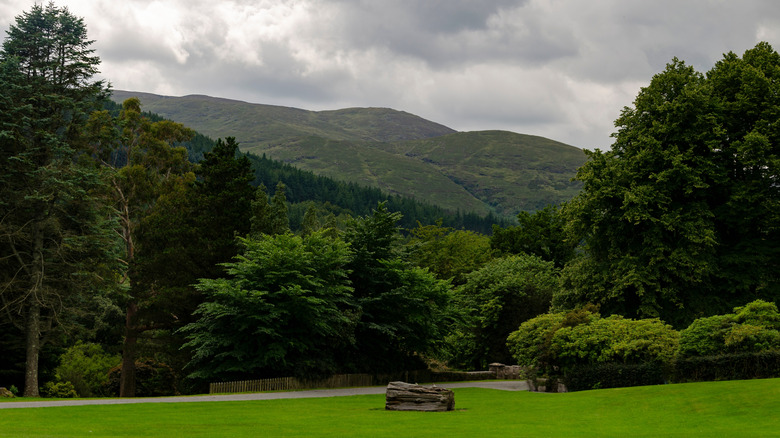
Though winters can be forbidding in Northern Ireland, camping is possible year-round in Tollymore Forest, in tents, caravans, motorhomes, and trailer tents, depending on your preferred accommodation. The camp and caravan sites are located next to each other by the park's entrance, providing access to the hiking trails. In terms of access to nature and facilities, it's one of the most well-rounded campsites in the Mournes, though temporary closures are possible during severe weather.
It's a scenic spot, to say the least, entered by driving through the barbican gate and along a road shaded by stately trees, while the lawn where you pitch your tent offers great views of the curvaceous mountains in the distance. According to NI Direct, the campsite includes toilets, showers, running water, electricity hookups, and a chemical toilet disposal point. A food van serving coffee, tea, and pastries is occasionally on site, but Newcastle is only a short drive away if you need to pick up more provisions.
For a change of scenery, you could easily add in some more rural camping destinations in this corner of Northern Ireland. Castlewellan Forest Park, with its own scenic campsite and one of the world's biggest hedge mazes, is about a 15-minute drive away. Other camping areas in County Down, where both Tollymore and Castlewellan are located, include Bloody Bridge, just outside Newcastle, and Kilbroney Park in Rostrevor, an area that helped inspire C.S. Lewis's fantastical world of Narnia.