
Why Travelers Should Avoid Putting Their Laptop In The Airplane's Overhead Bins
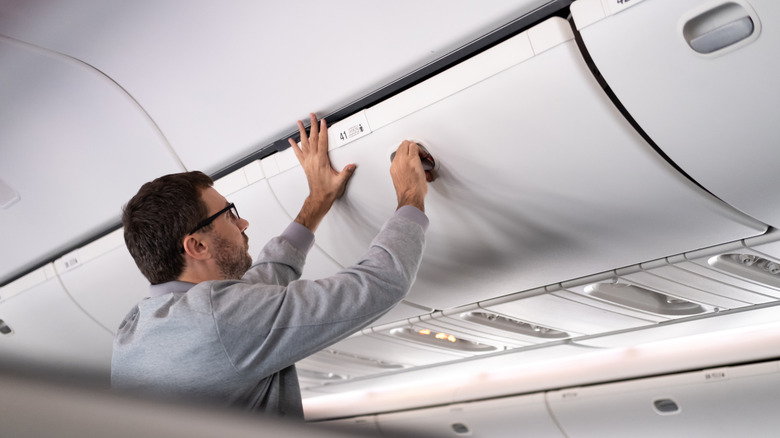
Securing a spot in an overhead bin can feel like a race you didn't sign up for, as these spaces quickly become prime real estate when passengers start to board the plane. At that point, you just want to toss your things up there and relax before the plane takes off. But before you do, laptop owners should think twice about storing their devices in overhead bins, as they could get damaged, stolen, or even pose a fire risk.
If you're wondering whether you're allowed to store your laptop in an overhead bin, it helps to know the rules. The Federal Aviation Administration (FAA) allows passengers to bring laptops, smartphones, and tablets in their carry-on bags. Each airline may also have its own rules for storing these devices during a flight. For example, Southwest Airlines requires "laptops weighing 2 pounds or more to be stowed under the seat or in an overhead bin for taxi, takeoff, and landing." If you're not sure what to do, always ask the airline crew for guidance.
Even if your airline allows you to store your laptop in an overhead bin, the risks are simply not worth it. Should the lithium-ion battery overheat and catch fire, the crowded space could make it harder for the crew to locate it. Your laptop could also get crushed between heavier bags or stolen while you're dozing off. These aren't just hypothetical risks, and airlines take them seriously; an international United flight from Washington to Rome was forced to turn back because a laptop got wedged behind a panel where it became out of reach. While overhead bins might seem like a convenient space to store your device, keeping your laptop somewhere you can easily reach and keep an eye on may be a safer option.
Overhead bin dangers every laptop owner should know
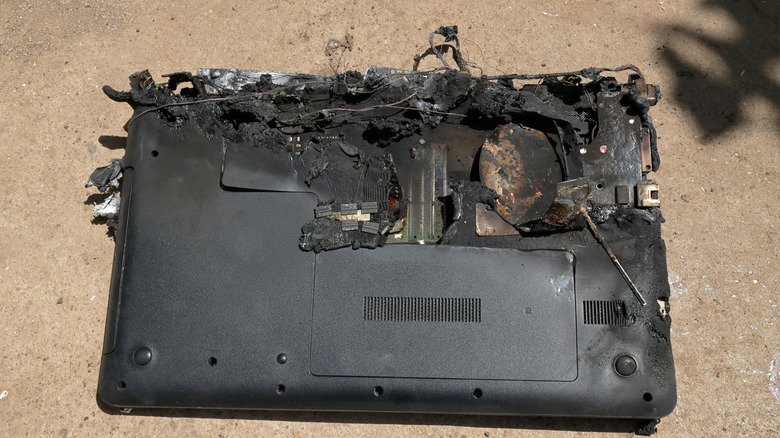
A battery fire is one of the biggest risks during a flight. Like power banks, most laptops use lithium-ion batteries, any of which can experience a thermal runaway if damaged, a chemical reaction that causes the battery to overheat and eventually catch fire. Storing them in crowded overhead bins can make it harder to spot the warning signs. The FAA advises passengers to immediately alert airline staff if a lithium battery or device is "overheating, expanding, smoking, or burning." An FAA report recorded 82 aircraft incidents involving lithium-ion batteries between January and September 2026, six of which involved laptops.
Aside from fire risks, your laptop could also get damaged or stolen. Flights can be chaotic, with people playing a game of Tetris with their luggage. Keep in mind that airlines aren't liable for incidents involving carry-on items. For example, Delta Air Lines states, "We do not assume liability for unchecked items unless they are given to our personnel for storage during the flight or otherwise delivered into our custody for travel."
Storing your laptop and other valuables under the seat in front of you is one of the safest ways to protect your personal items during a flight. If you decide to store your laptop in the overhead bin, make sure it's in a padded, secure traveler's laptop bag. If you have no choice but to check your laptop, you can, but FAA guidelines state that it should be "completely powered off and protected from accidental activation." You'll also need to follow the applicable battery capacity limits. If you really want to play it safe (and avoid a laptop crime scene investigation), getting insurance from trusted travel insurance providers is another option you have.