
What Do Buoys With A Red And White Diagonal Flag Mean In The Water?
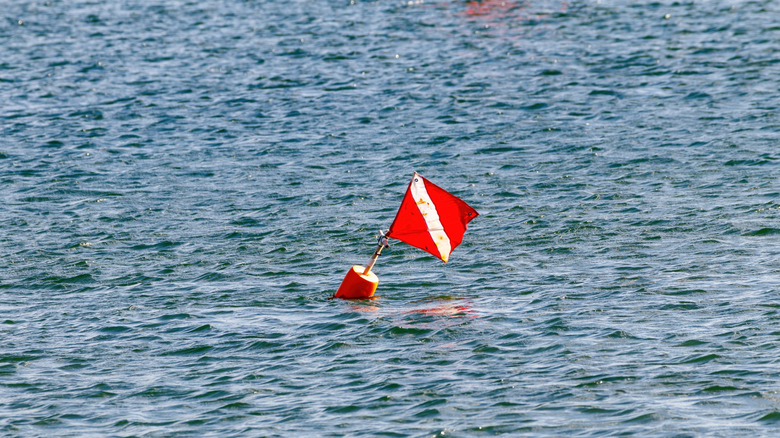
On bodies of water around the globe, boaters routinely encounter buoys of various shapes and colors. Each of these markers is designed to convey a specific directive or information to boat operators. The vast majority of buoys are standardized by the International Organization for Marine Aids to Navigation (IALA), although there are some special-purpose buoys that are not part of the international system. One such exception is a buoy with a red and white diagonal flag. Recognizing this flag and knowing how to respond to it can literally save the lives of people in the water.
A red flag with a white diagonal stripe is known as the "Diver Down" flag. It indicates that there are divers or snorkelers in the water nearby. Per Divingfl.com, this symbol began as one man's quest for personal safety, and since its creation in the late 1950s, the dive flag has spread across the United States and most of North America. In fact, today the majority of U.S. states require divers to display this symbol when in the water. The buoy itself may be various colors, such as red, white, or yellow, since the flag atop it is what conveys the warning.
Although used throughout much of North America, the Diver Down flag is not required by international law — so you may not see it at dive spots in Southeast Asia. In other locations, boats must use the blue-and-white Code Flag Alpha, which is an international sign to show that a boat has divers in the water. Many times, you will also see the Alpha flag in conjunction with the Diver Down flag.
Dive buoy basics for boaters and divers
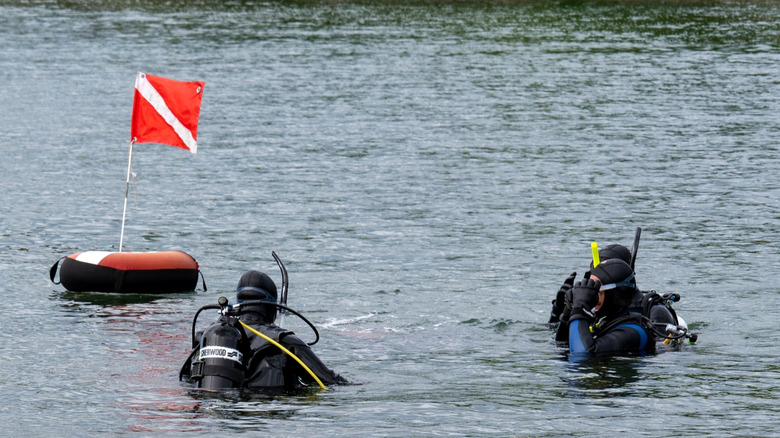
Unlike navigational signals, which are placed and maintained by government entities (such as a white-and-black-striped buoy that signals obstructed waters), divers must deploy their own buoys. As a result, proper usage is a shared responsibility between the divers and boat operators, whether you are just beginning scuba diving or are an experienced professional. To help avoid being run over by a boat or jet ski, divers should — and in some cases, are required to — use a dive buoy every time they are in the water. If you are on a scuba charter, the dive operator will handle placing the dive buoy in the water. However, when diving on your own, it is up to you.
Whether you are on a guided charter or DIY scuba trip, just having the buoy in the water isn't all you are responsible for. The purpose of the buoy is to indicate where divers are located. Therefore, individual divers must stay within close proximity to the marker. This is also why the flag is placed on the buoy, so it can travel with the divers.
Although requirements can vary by location, according to the Divers Alert Network, divers must stray no farther than 100 feet away from the buoy when in inlets, rivers, or channels. In open water, that distance extends to 300 feet. Conversely, boaters must pass at those same distances from the buoys. It is important to remember that those distances extend in every direction around the buoy. So if possible, boats should give divers or snorkelers some extra space, slow down, and keep an eye out for anyone who may have inadvertently strayed from the flag.