
The UK's Tallest Sea Cliff Is An Ethereal Destination Off The Coast Of Scotland With Panoramic Ocean Views
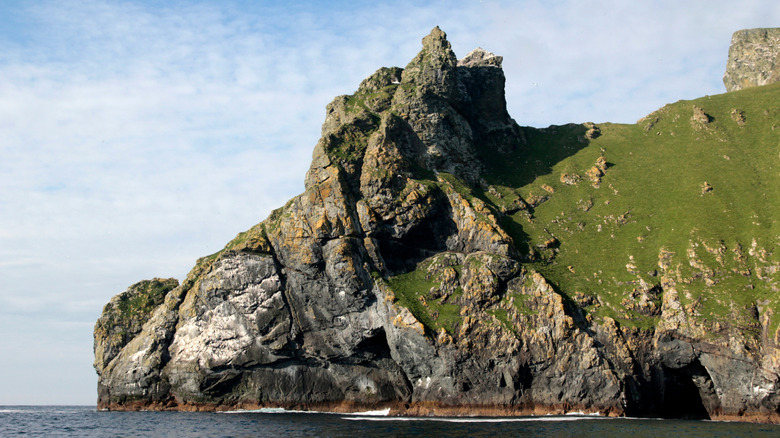
As charming as a quaint village or historic pub can be on a U.K. countryside trip, adventurous travelers might look to the nation's more remote corners for a place where the landscape is the showstopper. Far from the U.K.'s busy cities and well-trodden attractions, the Scottish Outer Hebrides are rife with dramatic scenery and far-flung coastlines. On the island of Hirta, you'll find Britain's highest sea cliff, a sheer headland plunging over 1,400 feet towards the Atlantic Ocean below. The views from the heights stretch across the open ocean, with neighboring islands and sea stacks completing the spectacle. Travelers will have to prepare for a more involved journey to reach the cliff, though.
Conachair is recognized by the official Outer Hebrides tourism portal as the highest sea cliff in Britain. The soaring formation's history begins with a volcano. St. Kilda, the archipelago that includes Conachair, is the eroded remnant of a massive volcanic complex that formed around 60 million years ago. Over time, glaciation and the powerful waves of the Atlantic shaped the islands' rugged coastlines, leaving behind steep cliffs and offshore stacks. The archipelago is now a UNESCO World Heritage Site. Hirta, home to Conachair, is the largest island of the archipelago.
There's more than just geology to draw travelers to one of the U.K.'s most scenic island destinations. Visitors may spot gannets, puffins, fulmars, and other seabirds wheeling around the cliffs — St. Kilda supports the largest seabird colony in the North Atlantic, according to its UNESCO listing. Hiking around Conachair also offers a glimpse into the islands' human history — routes pass through an abandoned village before climbing toward the 1,400-foot-plus summit.
Discover the rugged slopes of Conachair
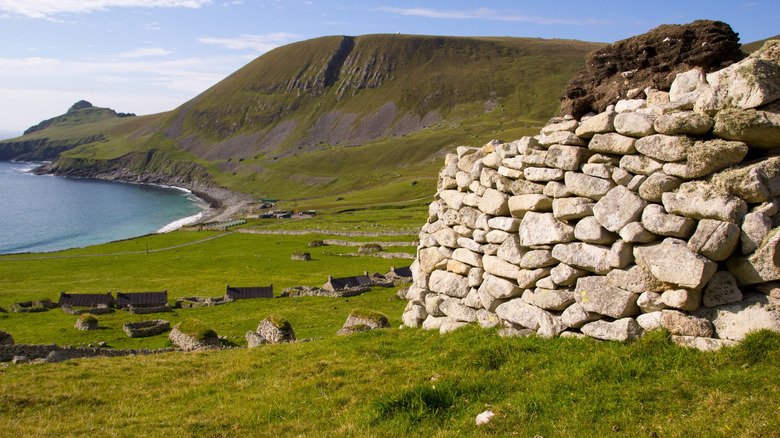
For most visitors, Conachair is best approached as a long day trip. The usual route is to travel first to Leverburgh, one of the U.K. destinations that could pass for the Caribbean, on the southern end of the Isle of Harris. From there, it's a two- to three-hour boat ride to Hirta. There are no formal lodgings on Hirta, and the only public overnight option is a small campsite provided by the National Trust for Scotland (NTS). There's no phone reception or internet on the island either — but that's another incentive to turn your attention to the rugged landscape.
Visitors get a briefing from an NTS ranger after landing and are then free to roam around the slopes of Conachair. You might start in the abandoned village, where the old stone houses and former church date largely to the 19th century. The last residents were evacuated to the Scottish mainland. There's also a small museum in one of the restored cottages, with exhibits on the islanders' way of life.
From here, you can hike toward the summit of Conachair via The Gap and Mullach Mor. A 2025 landslide left parts of Conachair's slopes unstable, but the NTS says visitors can still reach the summit from Mullach Mor. At around 3.5 miles, the route is steep and pathless, with boggy patches and exposed cliff edges. At the top, the ground drops away to reveal scattered islands and sea stacks, including the jagged profiles of Boreray and Soay, while seabirds circle below. Travelers continuing their journey through the Outer Hebrides might head next to the Isle of Lewis, home to some of the world's best standing stones.