
Is It Legal To Swim Up To A Buoy?
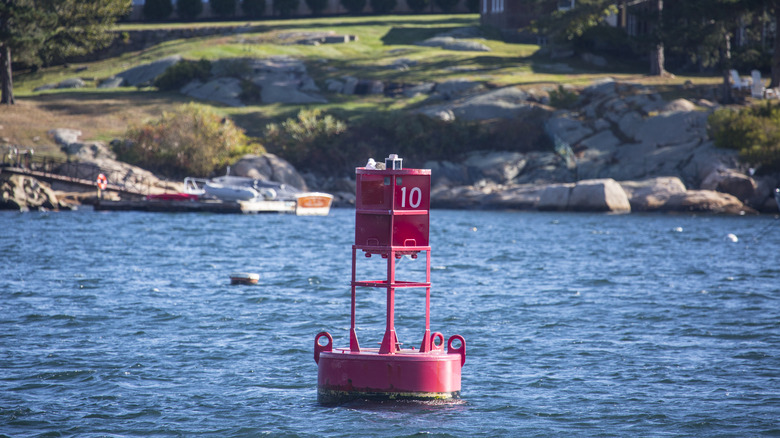
Buoys are common sites on lakes, as well as navigable inland and nearshore coastal waters. For swimmers, the temptation may exist to utilize a buoy as either a floating rest stop or turnaround touch point. But, is it legal to swim up to one? That depends on the type of buoy in question. In the vast majority of situations, it is not only illegal to swim up to a buoy, but it is also a very bad idea that can result in a dangerous situation or serious injury. However, there are a couple of types that are both legal and safe for swimmers to approach.
For starters, it is illegal to swim up to any navigational buoy. This would include red or green channel marker buoys, red-and-green-striped preferred channel buoys, both safe water and isolated danger buoys, and any other navigational aid installed, maintained, and/or operated by the U.S. Coast Guard. Under U.S. law, obstructing or interfering with these aids to navigation is a misdemeanor punishable by up to a $1,500 fine. This law applies to swimmers, boaters, and paddlers, as it is also illegal to tie up to these aids to navigation. So, when it comes to whether it is legal to swim up to navigational buoys, the answer is a firm "no."
Swimming to buoys is dangerous as well as illegal

Beyond the legal ramifications, swimming up to a buoy is typically a bad idea for several reasons, which essentially boil down to the fact that it's dangerous. For one, navigational buoys are placed in areas that are frequented by boats of all sizes. Swimmers attempting to reach a buoy may not be seen by boats or ships. This risk applies not just to navigational markers but to mooring buoys as well. Although it is not illegal to swim up to private mooring buoys, boats approaching these buoys or navigating through a mooring field present a serious risk to swimmers.
In addition to boat traffic, there are times when swimming to a buoy can be dangerous because it is actually marking a hazardous area. For example, a red-and-black-striped buoy on a lake indicates a boating hazard, which, in turn, could also be dangerous for swimmers. The floating structures themselves can be dangerous for swimmers. Many navigational buoys are large, steel objects anchored to the bottom of a body of water, but they are not inherently stable and often roll from side to side. They are also slippery, extremely hard, and at times covered in barnacles or other growth. Just attempting to touch or get on a buoy can result in serious injuries for swimmers.
That said, not all buoys are no-nos for swimmers to approach. For example, swim area buoys are intended to mark safe areas. It is perfectly legal and safe for swimmers to paddle up to these buoys while inside the designated swim area. Swimmers in open water should consider using swimming buoys or tow floats to ensure their safety. For those who want to explore the natural areas below the surface, a buoy with a red and white diagonal flag indicates that there are scuba divers underwater.