
What Happens If You Accidentally Run Over A Buoy?
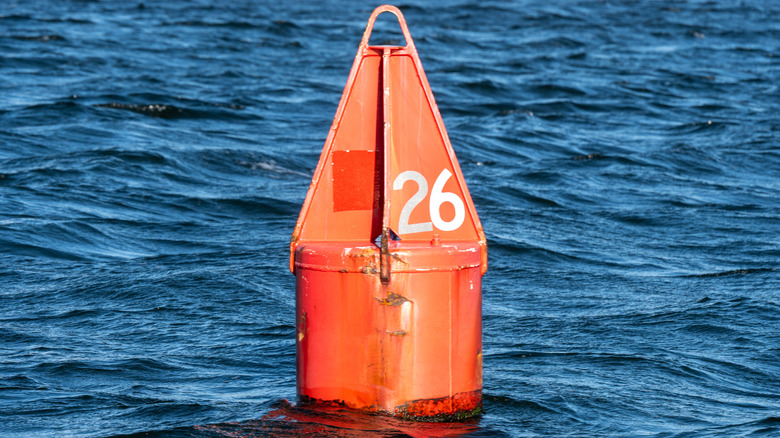
Perhaps nothing can ruin a bucket-list-worthy boating adventure quicker than an accident. As any boater knows, there are lots of potential hazards in the water. Among the objects that boaters may collide with are floating buoys, many of which, ironically, are meant to make boating safer. So, what happens if you accidentally run over a buoy? That depends on what type of buoy you hit. But among the possible consequences of such a collision are physical damage to your boat and motor, injuries to those aboard the boat, and possible fines.
It's important to understand that there are many buoys of various shapes and sizes on inland lakes and coastal waterways. These range from buoys marking crab traps to mooring buoys to white-and-orange buoys denoting regulations. In each instance, these buoys are attached to a point on the bottom with a chain or rope. So even if you run over a small foam buoy that doesn't cause physical harm to your boat, you may end up with the attached rope or chain wrapped around your propeller. Such an entanglement can cause serious damage to your engine, and in order to continue your journey, the rope needs to be removed immediately.
Hitting a larger buoy of any type, whether it be a mooring ball or a navigational buoy, can also cause serious harm to your boat's hull. If the impact is significant enough, it can also cause the passengers on the boat to be injured or even thrown overboard. If the collision involves a navigational aid installed, operated, or maintained by the U.S. Coast Guard, such as a red-and-green-striped preferred channel buoy, then you may also be subject to fines or prosecution, or be forced to pay restitution if you are found at fault.
What to do if you run over a buoy
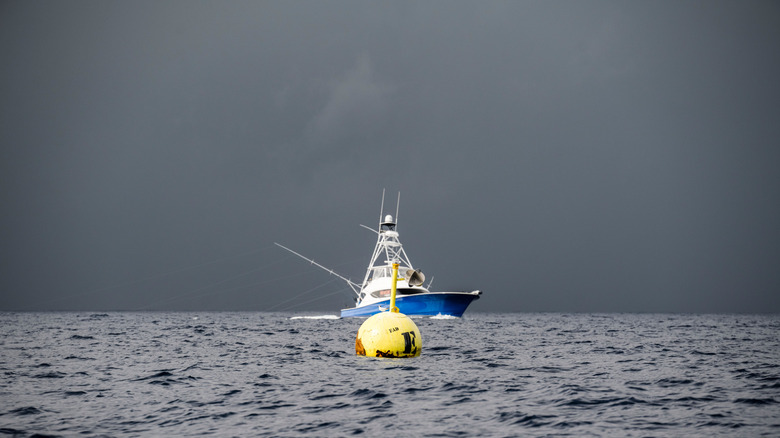
While running over a navigational buoy seems farfetched, it does happen, and the results can be serious. According to U.S. Coast Guard statistics, boating incidents in 2024 resulted in more than 550 deaths and 2,000 injuries, as well as nearly $90 million in property damage. Collisions with fixed objects were the most common incidents. Although not all fixed objects hit by boaters are buoys, such collisions do account for some of these accidents. Additionally, boat-buoy accidents aren't just limited to inexperienced or amateur boaters — there have even been cases of Coast Guard and U.S. Navy boats running over navigational buoys.
If you are involved in such an unfortunate incident, it is important you know what steps to take. For the most part, you should deal with running over a buoy in the same manner as you would any other boating collision. That means first you should kill the engine, check on passengers, and assess the damage. If there are any injuries or your boat is incapacitated or sinking, notify emergency responders by calling 911 (the Coast Guard can also be contacted via a marine radio if you're on coastal waters). You should also activate a distress signal and tend to any injured persons while waiting for help to arrive.
After the immediate aftermath of a collision with a buoy is resolved, you will still have tasks that need to be completed. Federal law requires a boating accident report be completed if a person dies, is seriously injured, or goes missing, as well as if property damage exceeds $2,000 or the boat is demolished. Some states have additional reporting requirements, as do other countries. For example, if you hit a navigational buoy while sailing in the "Boating Capital of The Bahamas," the Abaco Islands, you must follow The Bahamas' reporting procedures.