
Colorado's Once-Thriving Mountain Town Between Grand Junction And Denver Is Now Abandoned
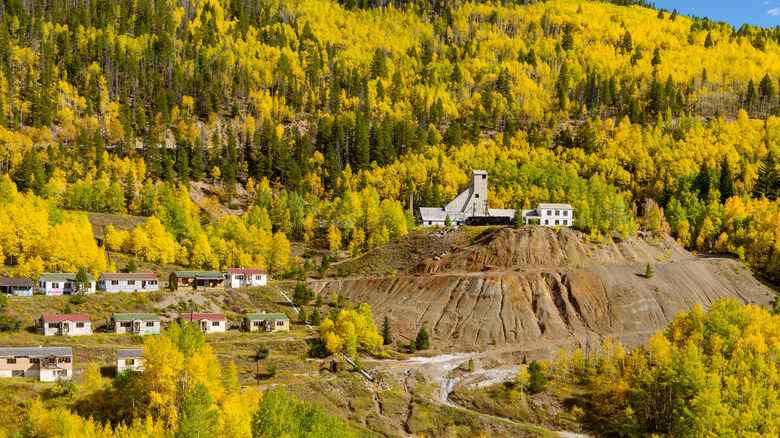
The story of Gilman, Colorado reads like a dramatic tale. The setting: a small Rocky Mountain town in 1984. The characters: the residents of a decades-old mining community. The plot: the mines within the town closed due to financial hardships, jobs vanished, and the soil became contaminated with deadly toxins. Thus, the town was eventually abandoned. Locals left with whatever they could, and as they drove away, looked longingly at the rows of modest homes they had left behind. Today, silent roads are stippled with empty buildings. Above them, at the top of a dirt hill, looms a massive processing plant, a reminder of the area's industrial past.
Like St. Elmo, one of the American West's best-preserved ghost towns, this place casts a haunting spell. The real history of Gilman was a bit less dramatic, but it ended similarly. The town was founded in 1886, and workers moved to the area to mine zinc, copper, silver, and gold. Over the next century, they would extract millions of tons of material. Production started to decline in the 1960s, and by the time the Environmental Protection Agency arrived in the mid-80s, mine runoff had contaminated Gilman's groundwater. The landscape was unsafe enough that residents were ordered to leave, and the town's collapse has since served as a cautionary tale about unregulated industry.
The remains of Gilman still hug the steep slopes of Battle Mountain. Its ruins now stand on private property, which is off-limits to visitors. But you can still stop and see Gilman from the shoulder of Highway 24, which runs parallel to the site. There's a broad gravel area to park on, which overlooks a building-studded valley. Stopping there is free, and it's the only legal way to see Gilman's remains. Bring binoculars, or better yet, a telephoto lens.
What Gilman, Colorado, looks like today
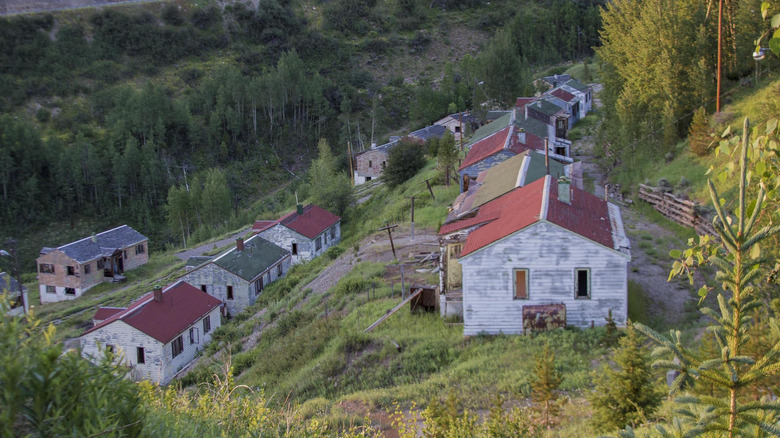
Gilman is hardly alone when it comes to abandoned Colorado towns. Hundreds of ghost towns were scattered across the state as of the late 2010s, representing a wide range of industries and eras. Intrepid explorers have made their way into Gilman, photographing and filming the town's crumbling remains. What's so unsettling about these images is how contemporary they all look. The buildings aren't frontier shacks, but split-level homes you could find in modern-day suburbs.
Young trespassers have left patches of graffiti on the old walls. Many of these roads are still paved in modern asphalt, although their surfaces are cracked after countless winters without maintenance, with mature evergreens growing through their cracks. At its peak, a thriving community lived on this ridge, overlooking the confluence of Rock Creek and the Eagle River. Today, even that modest population is hard to imagine. A few rows of gutted houses are still visible on the grassy terraces, but they offer only a vague impression of what life there was once like.
Gilman feels more remote than it is. Highway 24 weaves its way through the mountains and connects with Interstate 70, the main motorway between Denver and the major western Colorado town of Grand Junction. If you're already seeking the ultimate destinations to visit on a trip through Colorado, this site is surprisingly close to some of the state's major landmarks. Just 20 minutes from Gilman is the world-famous ski town of Vail, which draws 2.8 million visitors every year.