
5 Things You Might Be Doing That Can Get You Kicked Off An Airplane

Getting kicked off an airplane is possibly the most ignominious thing that could happen to a traveler. If you've ever seen someone being frogmarched down the aisle, while the rest of the passengers tut and whisper or cheer, you'll know the feeling of secondhand embarrassment. According to the Federal Aviation Administration's (FAA) Unruly Passenger Statistics, there have been 1,505 reported behavioral incidents on planes in American airspace in 2025 to date.
The figures indicate a drop compared to previous years — there were almost 6,000 in 2021 — but the offenses can result in everything from fines to jail time to lifelong bans. That said, you don't have to be hurling abuse at the cabin crew or coming to blows with the loudmouth in seat 12E to face such expulsion. Some people get kicked off flights for reasons that seem quite trivial.
Flying is full of unspoken rules as it is, from the etiquette of using the airplane's empty middle seats to the long list of common in-flight safety mistakes passengers make without realizing it. So you'd be forgiven for not wanting another set of dos and don'ts to add to the memory bank. But if you want to actually arrive at your destination — usually a prerequisite of the travel experience — take note of the following five behaviors, any one of which entitles cabin crew to remove you from the plane.
Drinking your own alcohol
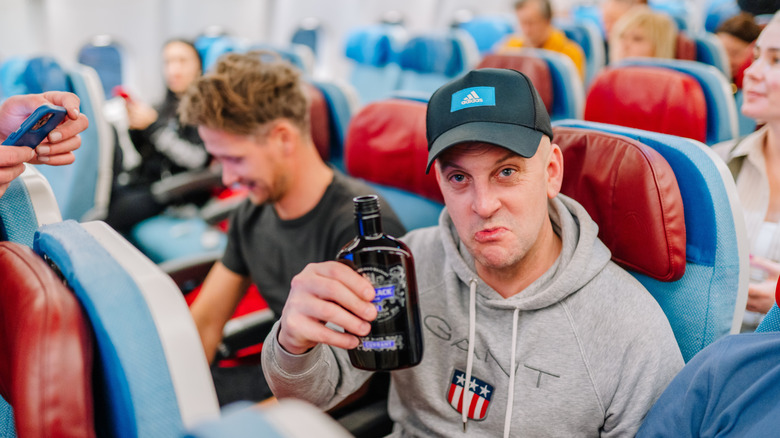
According to federal aviation rules, airport staff can deny visibly intoxicated passengers access to any commercial aircraft and cabin crew reserve the right to refuse anyone alcohol service. While these rules may seem harsh if the passenger in question isn't harassing their fellow fliers, they at least make logical sense. But strangely, drinking your own alcohol when on the flight could also land you in hot water.
Who hasn't purchased a bottle of the local tipple in Duty Free and thought to themselves, "I might just crack this open on the plane?" After all, you own the goods and no one's taking any notice if you start munching your own snacks mid-flight. But as the Code of Federal Regulations states, "No person may drink any alcoholic beverage aboard an aircraft unless the certificate holder operating the aircraft has served that beverage to him."
It's not as simple as airlines wanting to extract more money from you — though this is perhaps an underlying incentive. In principle, it's about safety. According to an article on the Harvard Health website, your blood oxygen level drops when flying at altitude, and drinking alcohol can further impair red blood cells' ability to take up oxygen. This is intensified in sleeping people, the elderly, and those with heart conditions, potentially increasing the risk of heart attacks and strokes. The experts at Harvard therefore recommend older passengers with cardiovascular comorbidities exercise restraint. Airlines also control your alcohol intake for risk prevention: it was the leading factor in unruly behavior reports in 2024, accounting for 12% of cases. Ultimately, cabin crew are responsible for passenger safety and are legally allowed to remove passengers if they're deemed a threat to themselves or anyone else.
Appearing sick
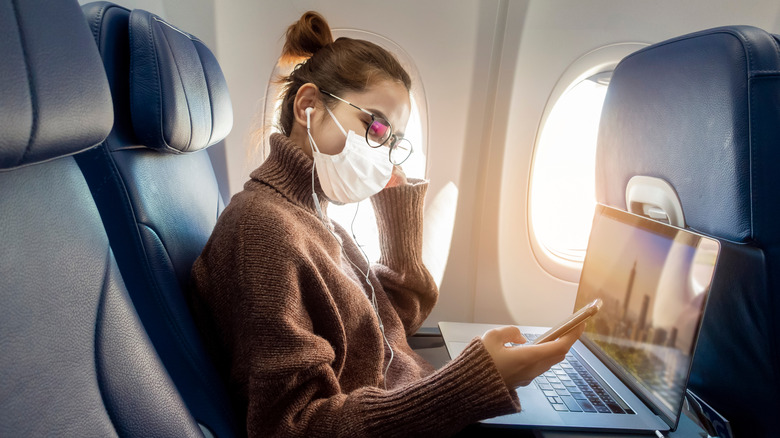
Getting kicked off an airplane for feeling unwell might feel like insult to injury. But it's advisable not to lock yourself in a confined space for several hours with fellow passengers if you're feeling contagious. The Center for Disease Control and Prevention (CDC) notes that flu viruses are spread primarily by water droplets expelled into the air when an infected person talks, sneezes, or coughs. These viruses are detected in carriers up to seven days after they get symptoms, though infected people are most contagious in the first three days of illness. The CDC also recommends avoiding travel until at least 24 hours after symptoms and fevers subside.
Research suggests the proximity to other passengers increases the likelihood of flu viruses spreading during a flight. It's no surprise, then, that cabin crews can stop you from flying if they're concerned about your health, especially given the long shadow cast by the COVID-19 pandemic. Confusingly, there is no overarching policy on the matter — airlines set their own rules — meaning you could end up wedged between two spluttering and sniffling passengers with little room for recourse.
Moreover, using your own initiative may pose a different problem. Passengers who want to delay their flight due to sickness — even with a doctor's note — typically incur ticket amendment fees, which serves as a disincentive. That's why consumer advocacy groups, like Travelers United, are making the case for legitimately ill travelers to be able to postpone flights at no extra cost.
Wearing the wrong clothes

There's a chance you probably don't overthink what you wear to the airport. Is it comfortable? Will wearing it free up more luggage space? Can I remove it if the plane gets hot? These are the kinds of questions that idly come to mind. But how you dress is one of the odd reasons TSA pulls people aside for additional screening. Sartorial choices are so personal that this can feel like an affront to your sense of self. Who is a stranger to tell you that oversized jumpers or dresses that don't hug the contours of the body are signs of suspicious activity?
If you get through TSA screening unscathed, the next line of clothing inspectors are the aircraft staff. Once again, there's no federal rulebook for permitted passenger attire, so airlines use their own discretion. United Airlines' Contract of Carriage states that passengers can be removed from the plane if barefoot, improperly clothed, or wearing lewd, obscene, or offensive garments. Delta's similarly vague policy states that passengers can be kicked off the airplane if their "conduct, attire, hygiene or odor creates an unreasonable risk of offense or annoyance to other passengers."
Both leave a lot of room for interpretation — who decides what constitutes too smelly? — so it's best to err on the side of caution. Avoid making overtly political or incendiary statements with your style choices. Save those bikinis for the beach, and make sure you shower and embrace deodorant.
Being too tall

According to the U.S. Department of Transportation, federal law prohibits airlines from discriminating against passengers based on immutable characteristics like race, color, sex, natural origin, and ancestry. So it seems odd that the same courtesy isn't extended to people of unorthodox height. Ultimately, a person no more chooses their level of verticality than they do their race.
There are numerous reported cases of such "heightism" in the airline industry. In 2011, Horizon Air was forced to apologize after removing a 6-foot, 9-inch passenger from a plane because his legs were blocking the aisle. Following the event, as reported by NBC, a Horizon Air spokesperson said, "The flight attendants should have asked for passengers seated in an exit or bulkhead row to voluntarily give up their seats to provide the passenger with the much needed leg room he requires." In 2017, 7-foot-tall Russian athlete Alexander Kimerov was hauled off a plane set to travel from Siberia to Moscow, under similar circumstances. Given Kimerov's profile in Russia, it caused fierce public debate in his home country.
Airlines have customer-of-size policies to preempt such occurrences. United Airlines' rules, for example, state that all passengers must fit comfortably in their seat on the aircraft. If they occupy the space of another seat when sat down, they're expected to purchase an additional seat or a seat in a premium cabin. While this typically applies to plus-sized passengers, it can present complications for travelers with long legs. Less expensive alternatives for tall passengers include booking an exit-row seat, finding out which aircraft you're flying on (different models have different legroom specifications), and using accrued airline points to upgrade your ticket to a roomier class.
Taking photos of crew members
There are plenty of things flight attendants want you to stop doing — hogging the overhead bins and piling rubbish on your food tray — and there are other things you should absolutely never do, like take photos of the crew. Few people would quibble with this, but since the advent, and subsequent ubiquity, of smartphones the internet is full of news stories about passengers being removed from flights for doing just that. In 2022, even a Delta pilot was sacked for taking surreptitious photos of a female crew member.
In the event of turbulence or unruly behavior, it's not uncommon for passengers to take videos as well, often capturing cabin crew without their consent. The prevalence of the issue has caused airlines to impose harsher restrictions on smartphone users. Following a survey in Japan, in which 38% of flight attendants said they'd been photographed or filmed without permission, local airlines have enabled staff to request the content be deleted, and in extreme cases, to hand offenders over to the police.
International airlines like KLM, Qantas, and Virgin Australia have photography rules in place. United Airlines' policy says recordings can't interfere with crew members' work or safety. Delta, taking a similar approach, encourages photos but asks customers to be mindful and respectful of crew and fellow passengers. Some guidelines are more opaque than others, but generally assume it's not okay to include unwitting flight attendants in your smartphone content. And if they ask you to delete anything, duly oblige, or you could find yourself back on the tarmac.