
The World's Former Fourth-Largest Lake Is Now A Mostly Dried-Up Desert With Haunting Shipwrecks
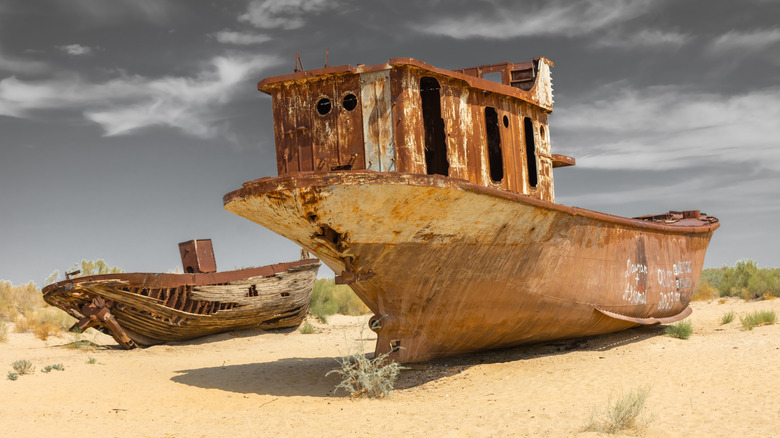
At first glance, images of the Aral Sea don't make sense. After all, boats simply don't belong in the middle of the desert. There are many places where you might see the rusted hull of a fishing boat on the seashore, dry-docked, or abandoned, but the sight of such vessels resting on bleached sand in Uzbekistan just doesn't feel right. And if it's called the Aral Sea, then where's the water? These landscapes almost always look parched and empty, like they've been that way for eons.
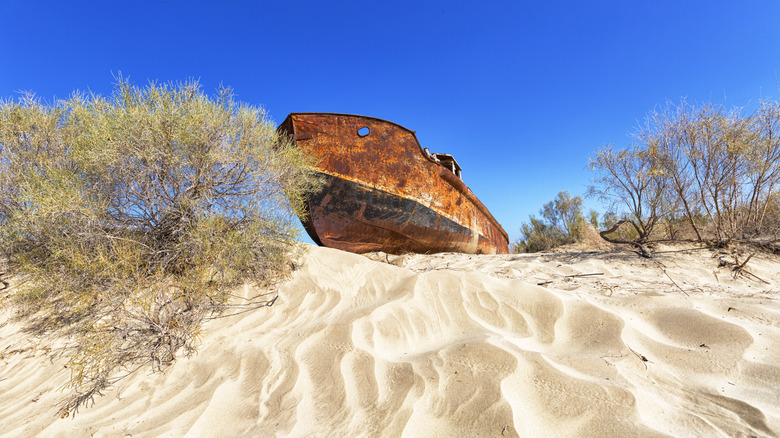
The "ship graveyard," as it's known in English, stands near the former fishing port of Moynaq, where it marks the historic edge of a dying sea. Photographers have returned from this Central Asian frontier with both haunting images and a cautionary tale about environmental carelessness. And yet, the apocalyptic vistas are part of the region's appeal. Isolated and surreal, the ship graveyard has become an offbeat tourist attraction. After all, where else can you see a fishing trawler perched high upon a sand dune?. Even as Moynaq's population evaporates, curious adventurers are taking trips out to the former sea, now known as the Aralkum Desert.
If you can stomach the region's tragic past, the terrain is eerily beautiful, and Uzbekistan's government has embraced this strange ruin as part of its Soviet heritage. The main site is treated as an open-air museum, a place where visitors are welcome to poke around the old ships, imagining what the area was like when these exposed sands served as a sea floor. Uzbekistan is already home to one of the oldest cities in the world, a Central Asian gem with Silk Road history and traditional crafts, but the ship graveyard speaks to the present day and how Uzbekistan has reinvented itself as an independent nation.
How the vast Aral Sea dried up
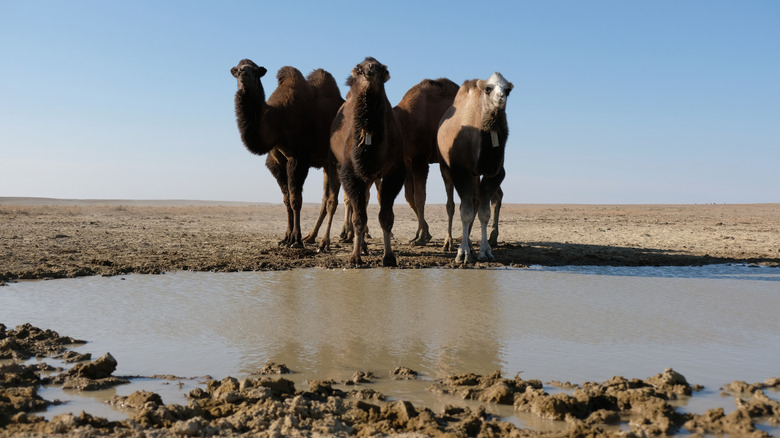
The good news is that the Aral Sea still exists, straddling the border between Kazakhstan and Uzbekistan. However, the "eastern lobe," as it was once known, dried up completely in 2014, the end result of a decades-long shrinkage. In Turkic languages, "Aral," roughly translated, means "Sea of Islands," a reminder that this body of water was once famous for its 1,100 distinct islands. More astonishing, the Aral is widely considered a saltwater lake and was once the fourth-largest lake in the world. Uzbekistan became part of the Soviet Union in 1924, and, during the 1960s, Soviet engineers started to divert tributaries away from the Aral Sea in order to irrigate farmland elsewhere. The effects were rapid and devastating; today, the sea boasts only 10 percent of the water it had six decades ago.
To make matters more complicated, communities like Moynaq aren't truly in Uzbekistan but are, rather, in Karakalpakstan, an autonomous republic within Uzbekistan's borders. This region is home to about 2 million people, who are culturally more similar to the people of Kazakhstan than the Uzbeks. There has been some tension between Uzbekistan and Karakalpakstan, mostly in the form of strong words and street protests in 2022. The conflict hasn't been violent, but Western visitors are generally hazy about the politics of the region, and the mostly agricultural people of Karakalpakstan haven't had it easy.
The vanishing of the Aral Sea is a vivid metaphor for these Turkic peoples and the thoughtless destruction outsiders have wrought on their traditional ways of life. Still, many travelers are gravitating toward Uzbekistan and, by extension, Karakalpakstan. It's easy to understand why, considering this breathtaking Central Asian country has glorious architecture that rivals that of Renaissance Italy.
Getting to the ship graveyard and where to stay
To reach Moynaq and its ship graveyard, you'll have to work for it. The good news is U.S. travelers no longer need a visa to visit Uzbekistan for periods less than 30 days, thanks to a law that took effect on January 1, 2026. Most people will fly into Islam Karimov Tashkent International (TAS), which is generally considered the busiest airport in Central Asia. However, Tashkent is tucked into the northeast corner of Uzbekistan, and the closest significant city to the ship graveyard is Nukus, which has its own airport and is 3 hours away from TAS by plane. If you prefer to take a land expedition to the graveyard, the overnight train from Tashkent takes about 18 hours.
The easiest way to visit the graveyard is by signing up for an organized tour, which will typically provide transportation, food, and lodging. Moynaq is pretty far out there — nearly 100 miles across the arid badlands from Nukus — and although these tours can cost a few hundred dollars, they'll spare you the headache of arranging rides and hotels in a language few outsiders speak.
The good news is that cell phone signals are usually strong in the region's towns, and Karakalpakstan uses a shared taxi system that can be extremely budget-friendly for backpackers. The village also has several hotels and quite a few restaurants to choose from. If you do decide to travel independently, you may have trouble reserving transport and accommodations online and therefore have to improvise on the ground. Note that Uzbekistan's people use a mix of Roman and Cyrillic writing styles, and Moynaq is also written "Muynak." Assuming you don't speak Uzbek or Russian, be sure to check out Rick Steves' genius tips for overcoming a language barrier.