
Rick Steves Reveals 5 Big Ways Your United Kingdom Vacation Is Impacted By Brexit
Back in 2021, the United Kingdom finalized its split from the European Union, in an event known as Brexit. No one was sure exactly how Brexit would affect trade, immigration, and business, let alone the nuances of travel. At the regulatory level, travelers to the UK post-Brexit have had to comply with separate entry requirements on a trip spanning both the UK and EU — whereas before Brexit, an EU authorization would allow you to move freely between Britain and the rest of Europe. For example, with the new permit requirements affecting travelers in Europe as of 2025, you'll need to apply for separate authorization to enter both the UK and the EU if both are on your itinerary.
Beyond just administrative changes, though, travel expert Rick Steves has pointed out some of the less obvious ways that Brexit has changed travel experiences in the UK. Writing on his blog, Steves noted changes to prices, the workforce, and availability of tourist-related businesses, among other things. Some of those changes might reshape the way you budget your trip or plan a sightseeing itinerary, considerations that fall under the Rick Steves-approved checklist to always do before a vacation. While making sure you get UK-specific travel authorization before entering the country is an essential first step, these are some of the other impacts to expect for your UK travel.
Longer lines at the borders
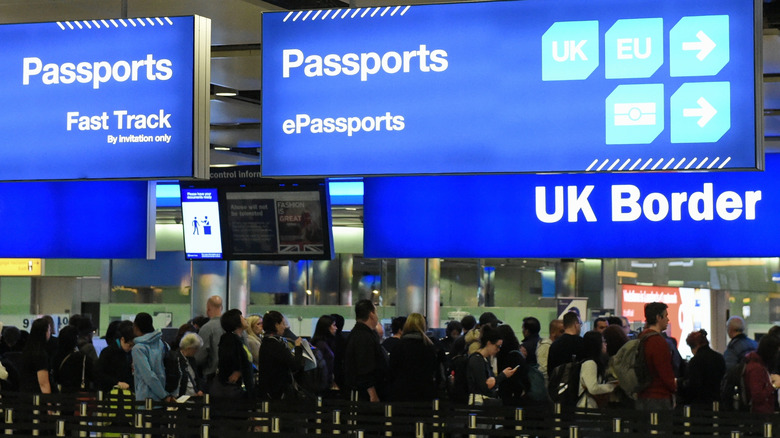
One of the initial ways Brexit is felt occurs when you arrive in the UK and have to go through border controls. "At the UK immigration checkpoint, there's no longer a 'fast lane' for European passport holders," Steves said, "meaning EU citizens now queue up with many other nationalities. This means longer lines."
The point Steves makes about lines for different passport holders being merged is true, although the reasons are a bit more complicated than simply a "fast lane" for EU citizens vanishing. In fact, as a UK Parliament member clarified in a Home Office answer, the ePassport gates (essentially, the automated "fast" lanes) remained open to EU nationals after Brexit. Those automated lanes were opened up to seven other nationalities in 2019, including Americans. So, rather than EU nationals being excluded from their fast lanes, it was the American travelers (along with six additional nationals) who got access to those lanes, which might explain why they're busier (and less fast).
With that said, Steves' observation about longer queues is pertinent for when you're leaving the UK, and in this case, it has a connection to Brexit. The EU started implementing a new Entry/Exit System (EES) in October 2025 that requires non-EU nationals to submit biometric data before they can enter the country, which is replacing passport stamps. Pre-Brexit, UK nationals wouldn't have to join the queue for the EES, but, since they're no longer EU citizens, British nationals will be joining the lines for it, along with all non-EU travelers who might be heading from the UK to an EU destination. A travel advisor warned that waits could be up to three or four hours.
The international workforce has changed but not disappeared

Following Brexit, the UK has remained a highly internationally populated country. As of data from 2022, about 16% of UK residents were born abroad. But back in 2019, at the time of Brexit, 14% of its population was born abroad, meaning that the number of foreign-born residents actually increased post-Brexit. Those foreign nationals aren't just statistics, but are part of Britain's workforce, especially when it comes to the hospitality industry.
According to Bournemouth University, 43% of the UK's hospitality workforce are foreign nationals. That multicultural workforce wasn't thrown away by Brexit, but it did mark a shift in which foreign nations they were coming from. Steves noted that pre-Brexit, hospitality workers often came from Central and Eastern Europe, but with tougher restrictions on EU nationals working and living in the UK, they've sought work elsewhere in Europe. "In their place, businesses are hiring workers from countries like India and Taiwan — because the UK's Commonwealth ties and mobility schemes make it easier for their citizens to be employed," Steves wrote.
The change in accents you're most likely to hear at the hotel counter or café is hardly a concern for travelers, but it is somewhat ironic, given Brexit's motivations. "[F]or a referendum that promised to 'make Britain British again,' an international workforce remains," Steves said. Changes in the hospitality workforce are, however, tied to the next point Steves makes, which does have a potentially disruptive effect on travel.
Understaffed businesses means reduced offerings
The population growth of foreign nationals in the UK doesn't equate to workforce availability, especially outside of cities. When the hospitality industry was hiring foreign workers from EU countries pre-Brexit, it relied on the fact that those workers could come seasonally, with the flexibility of movement between the UK and their home countries. According to a 2022 report from the Office for National Statistics, the post-Brexit growth in immigration has been largely fueled by non-EU nationals. The report also shows that, since 2019, non-EU immigration to the UK has increasingly been for education or humanitarian purposes — not short-term work at, say, a small inn in the countryside.
Steves quoted a Yorkshire bed-and-breakfast owner, who said, "We used to get a lot of Romanians who liked the idea of spending a summer surrounded by York's history. Not anymore." Meanwhile, The Independent profiled the struggles of Gary Curley, owner of the Sligachan Hotel on the Isle of Skye, a scenic island in Scotland famed for breathtaking landscapes. He said his staff has decreased from 50 to 33 workers since 2019, and that there are days he has to turn away potential guests because of shortages. Examples like this are why Steves concludes that "B&Bs are either closing altogether or trying to get by with a shoestring staff."
In the same spirit, the consequences of a limited workforce "extends to the UK's major attractions," Steves wrote. "As a result, opening hours are slimmer, too." For example, Clarence House, a royal residence in London, had to close to visitors in the summer of 2024 due to staff shortages from the double burden of COVID-19 and Brexit. As of this writing, Clarence House remains closed to visitors.
Shrinking menus and rising prices in restaurants
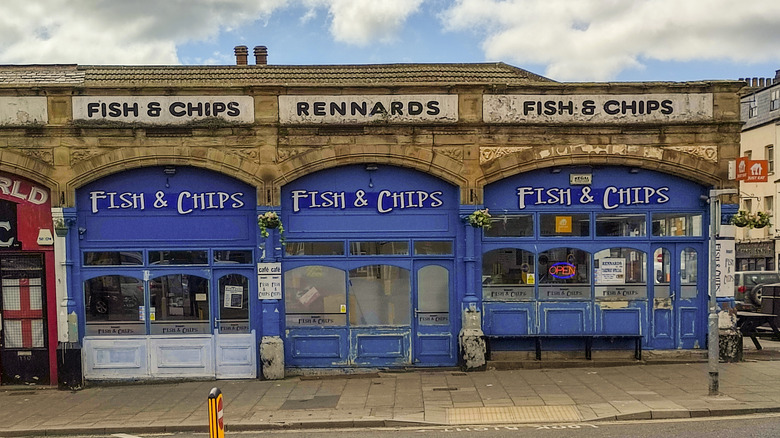
Steves highlighted that restaurants are facing the same issues as the rest of the hospitality industry: staff shortages, financial strain, and reduced offerings as a result. One of the restaurants he enjoyed in Warwick, which used to be open for lunch and dinner, reduced its hours to only dinner time availability (and increased the dinner prices).
An article from The Independent reported over 1,400 restaurant insolvencies in 2022. Peter Kubik, an insolvency practitioner, told the publication, "Restaurants that only just managed to survive the pandemic thanks to government support are now facing fresh challenges in the form of rising inflation, a post-Brexit labour shortage and consumers who simply cannot afford to spend as much." Restaurants have to increase prices to keep up with inflation and overheads, while tourists might choose to eat at home or dine somewhere more affordable because of the costs, creating a self-perpetuating loop of declining business.
A new Brexit-related regulation, which came into effect in April 2024, increased the salary threshold for skilled worker visas to £41,700 ($55,665), a £15,500 ($20,691) jump from the threshold just a year before. An article from The Guardian profiled how the new threshold was affecting Italian restaurants in London, since it's well-above the average salary of restaurant workers. "We've been open for 22 years and held on to many of the same staff for a long time," Italian restaurant owner Plaxy Locatelli said. "They're now feeling it's not worth it in the UK and are deciding to leave after all this time."
You'll pay more for souvenirs, too
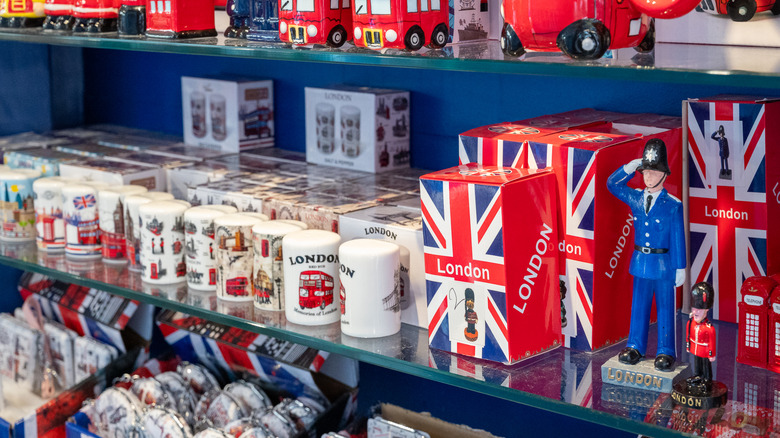
After all the spending you'll do on dinners and accommodations, don't forget to put a little extra in your budget for souvenirs, too, as they've only gotten more expensive after Brexit. Inflation might have something to do with it, but there's a new additional cost that's a direct product of Brexit: Value Added Tax (VAT). "Before Brexit, non-EU visitors (like Americans) could get a VAT refund — effectively a 20% discount — on eligible souvenirs bought in the UK," Steves wrote. "But that was an EU perk. Now, it's full price for your British scarf or soccer jersey."
The VAT Retail Export Scheme, which came to an end starting in 2021 (once the Brexit transition period was over), allowed non-EU visitors to get a built-in rebate for taxes on goods bought at an airport or port before leaving the country. Now, you'll have to pay the standard VAT of 20% on your departure purchases. So, suppose you bought a small souvenir bag at the airport, which costs £50 ($67) on its own. With the added 20% VAT, you'll end up paying £10 ($13) more than you would have with the pre-Brexit refund. Notably, though, the VAT refund scheme is still offered in Northern Ireland, the underrated European country with no crowds and low prices.