
Why TSA Cautions Travelers To Check Their Bagels Before Going Through Security
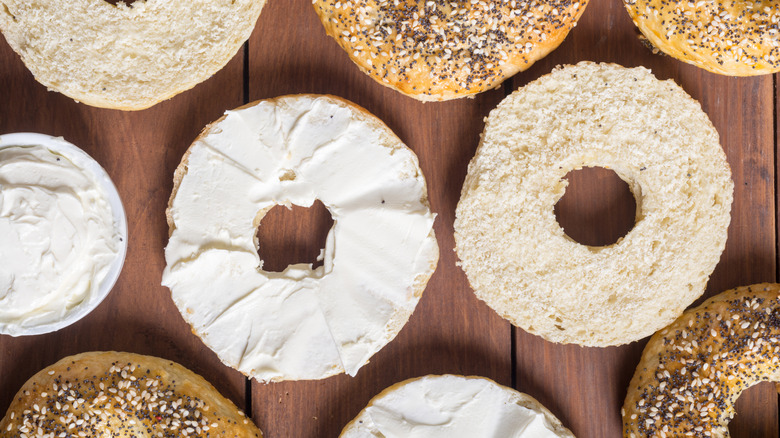
It doesn't matter how early your flight is, everyone knows you can't go through an airport security checkpoint with a cup of coffee or a bottle of freshly squeezed orange juice. But what about breakfast foods? Generally, most travelers would assume it's no problem to get a bagel through security, whether you toasted it at home or picked it up inside the airport after checking in for your flight. Not so fast, says the Transportation Security Administration (TSA), which recently cautioned travelers to think twice about approaching their checkpoints with bagels in hand.
There's nothing wrong with the bagel itself. The breakfast food falls into the "Bread" category, which can be transported in both carry-on and checked bags, on the TSA's "What Can I Bring?" list. It's the cream cheese that comes with it, sometimes packaged on the side. Similar to yogurt and ice cream, it's one of the liquid-like foods that will almost always get flagged by the TSA.
But as mentioned in the TSA's humorous post on the social media platform X, formerly Twitter, it's all about portion size. "Who likes a plane bagel?" the caption reads. "If this snack is your everything, it's good to go. Just make sure any cream cheese not on your bagel is 3.4 ounces or less, and that each container fits within a single quart-size bag per passenger." According to TSA regulations, cream cheese is categorized under "Cheese (Creamy)," meaning that, as with many other liquids, you can carry it on the plane as long as the amount is equal to or less than 3.4 ounces or 100 ml. Of course, if you want to pack to ensure getting through security is a breeze, check out these airport hacks that can help you zip through the TSA process.
Take the bagel, leave the extra cream cheese
The TSA's bagel post is a helpful reminder for travelers that plenty of edible items can be qualified as liquids. Think hummus, honey, peanut butter, salad dressing, and salsa, many of which come in single-serve packages on the side of a main dish. "If you can smear it on toast or eat it with a spoon," a news writer for Men's Journal succinctly put it, "it probably counts as a liquid. And if it's over the limit, it's not coming on board."
But liquid-like foods aren't the only snacks that can cause trouble at a TSA checkpoint. Due to a combination of factors, including security concerns and how it appears on an X-ray scan, simple canned goods (like a can of tuna) can be problematic. The TSA advises travelers to pack canned goods in a checked bag or leave them at home. Similarly, a foil-wrapped sandwich or burrito could trigger a security alert and prompt the TSA to inspect your bag. You'll probably be able to bring it through, but if you want to avoid potential delays — and if you have another option — it's better not to approach a TSA kiosk with any foods wrapped in aluminum foil.
Finally, if you happen to be traveling with frozen food, make sure it's on dry ice. Regular ice will melt, and ice packs will soften and transform into a liquid-like consistency, potentially before you ever make it to a TSA security checkpoint. The TSA will likely make you pitch either of these, but properly packaged dry ice is permitted, at least by the TSA and Federal Aviation Administration. The website notes that dry ice may not be approved by all airlines, so be sure to check with yours before traveling — or better still, leave your frozen fish in the freezer at home.