
The Electrician's Tool You'll Always Want To Keep In Your RV, According To Campers

Operating an RV requires a level of self-reliance, such as learning budget-friendly secrets to keep your RV warm or choosing the right sealants to fix leaky windows and seams. Campers have many systems that require monitoring and maintenance, and perhaps the most mystifying of these is the electrical system. When queried on Reddit as to what tools were must-haves when on the road, one commenter replied, "A multimeter. Indispensable with any electrical issues."
A multimeter is a tool that can help you diagnose electrical issues without needing an engineering degree. It's a device with a display and two probes, positive and negative, that can measure multiple electric properties, including voltage, current, and resistance. They come in many models, from basic and cheap to advanced and expensive. For the tests you'll likely be conducting on your RV, a basic model will suffice. You should consider getting digital over analog as they're easier to read, quicker, and more precise.
While a multimeter isn't a tool that actually fixes anything, it allows you to test components and narrow down problems while troubleshooting. For example, if you aren't getting power to the AC outlets in your RV, the multimeter allows you to test the outlet, the circuit breaker or fuse, the wire, the inverter, the battery, or the shorepower outlet separately to find where the issue lies. As you'll be dealing with batteries and electrical currents, be sure to take proper precautions to stay safe.
A multimeter has a multitude of uses
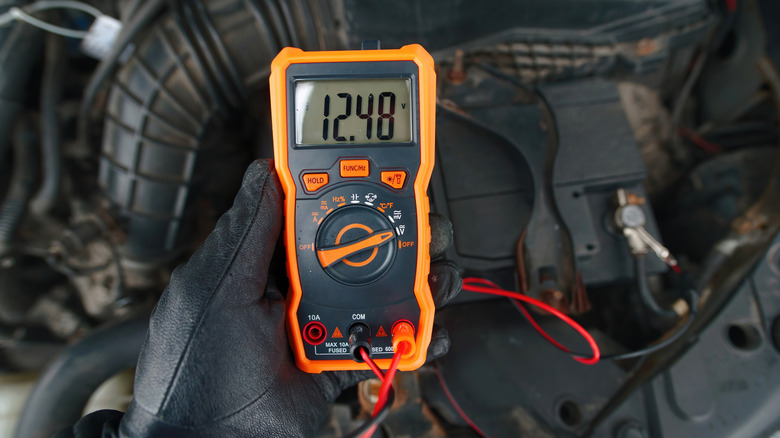
You may already know how useful a multimeter is for checking the health of your engine battery, but it's actually the most basic tool for diagnosing any issue with your electrical system. When something doesn't work, be it a light bulb or an air conditioner, the first question to consider is whether or not it's getting the right voltage. The meter tells you whether a simple fix or component replacement will solve the problem, or if a new appliance is needed.
There are a multitude of other tests you can perform. In a video, Love Your RV explains that the tool can be used to test batteries, wires, fuses, and both DC and AC power. So, if you plug something into an outlet and it doesn't power on, a quick check with your meter will determine if the issue is with the outlet or the device. Likewise, if you plug in at a new campsite and nothing happens, you can test to find out if the problem is at the outlet or in your RV. Fuses and some lightbulbs can be tested by selecting the meter's continuity setting. You can even test tank sensors, a crucial feature that almost never works in RVs.
So take your multimeter on the road and begin a journey of unraveling the mysteries of electricity. You will be more independent, possibly save some money, and feel the reward of taking on a challenge and learning a new skill. Using a multimeter is one of those little RV hacks you learn along the way, like this secret for getting prettier sites at some campgrounds.