
Does Your Bathing Suit Color Really Play A Part In Staying Safe From Sharks In The Ocean?

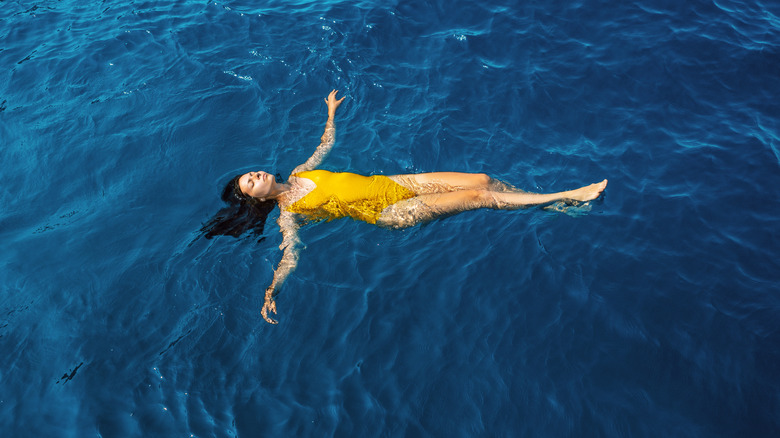
With the recent spate of shark attacks — including several reported attacks off Australia in January 2026 and a widely covered case involving a British vacationer in Tobago – there has been renewed interest in how to stay safe in the ocean. While much of the advice circulating online is sound and backed by science, misconceptions surrounding these animals still abound. One of the most persistent is the "yum-yum yellow" myth: the idea that vibrant colors make you much more visible and likely to be attacked. So, will your bright-yellow bathing suit make you seem like more of a snack to a shark? Experts generally say no.
Carlos Castro, captain and marine biologist with Pure Adventure PR, confirmed in an interview with Islands that "there is not a noticeable reaction around different colors or brightness ... However, on the surface, some sharks have shown interest in white, silver, and yellow in small items," most likely because they are shiny and may look like bait. Dr. Tom Griffiths, a risk management expert from the Aquatic Safety Research Group, echoed that view, noting that bathing suit color isn't a significant attractor or deterrent for underwater attacks. Gavin Naylor, director of the Florida Program of Shark Research, shared with BBC News that light-catching items like watches and camera lenses might be more attractive to sharks than specific colors, as they resemble light reflecting off the scales of a tasty fish.
That said, there are swimsuit colors that are considered the safest to wear to prevent drowning, including neon pink and orange. These will make you more visible to rescuers, as you're far more likely to drown than have a meet-cute with a shark. In fact, drowning, not shark attacks, is the leading cause of death for children ages 1 to 4 in the United States.
'Yum-yum yellow' — fact or fiction?
The idea that sharks are drawn to bright colors dates back to World War II, when various naval sinkings led to several shark-related deaths. Case in point: the 1945 USS Indianapolis disaster. Of the roughly 900 crew members who ended up in the water, only 316 survived. It isn't known exactly how many died of injuries, drowning, or other causes, but it has been confirmed that shark attacks were responsible for some deaths. After hearing first-hand survivor accounts of these incidents, the U.S. Navy's scientists developed an interest in understanding why some men were attacked while others were left alone. It was then thought that the neon-yellow life preservers may have had a role in the high number of casualties. Although later research failed to show that sharks target specific colors, the "yum-yum yellow" theory stuck.
Of course, we're still learning about these ancient predators, who have been around for an estimated 450 million years. As of research published in 2020, all sharks that have been studied thus far are cone monochromats, meaning they can only differentiate among shades of black, gray, and white. They do have good vision and are sensitive to light, but if sharks appear to be attracted to bright colors, it's only because they provide greater contrast against the water around them.
Additionally, "There are many species of sharks around the world with different behaviors and habitats," Carlos Castro told Islands. Each species may vary in its perception of contrast and light. Still, the evidence suggests no shark species is known to distinguish colors the way humans do.
The truth about shark attacks and ocean safety
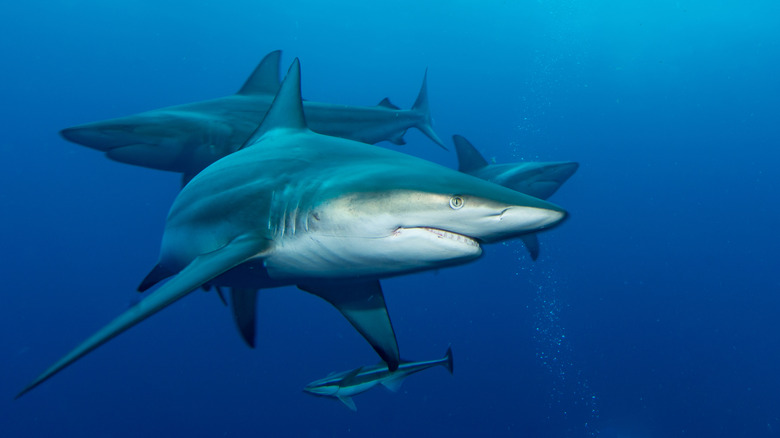
For those worried about encountering a shark while snorkeling or scuba diving, experts recommend remaining calm and backing away slowly while using your fins as a barrier. Then again, keep in mind that attacks are exceedingly rare. Dr. Tom Griffiths stressed in the Islands interview that "the chances of getting attacked by a shark are less than getting struck by lightning" and "shark attacks, although they do happen, are not a significant threat." According to the International Shark Attack File, a database run by the Florida Museum of Natural History, there were 47 unprovoked bites worldwide in 2024, with only 4 resulting in fatalities. This number is on par with previous years, but incidents may seem more frequent than they actually are due to the heightened media coverage that accompanies them. In reality, though, beachgoers don't need to be worried about rising shark attacks.
After all, the natural shark diet typically includes fish, sea lions, seals, and other marine mammals — not bony, low-fat human beings. When sharks do bite, it's because they are curious, they've mistaken our erratic splashing around for the movements of a seal, or they're provoked.
Finally, it's important to remember that humans pose a much greater risk to sharks than vice versa, with an estimated 100 million killed annually through finning, bycatch, and more — a devastating loss for an ecosystem that needs them for population management and even climate change mitigation. As Carlos Castro highlights, "They are the most important element of the ocean pyramid. Sadly, sharks are completely misunderstood, and the health of the ocean depends on them."