
One Of The World's Most Remote Destinations Is A Pacific Island With A Marine Preserve Bigger Than Texas
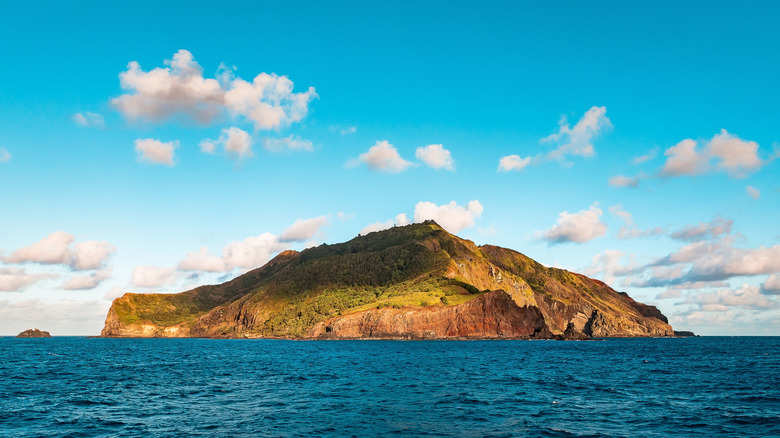
While the backcountry landscapes found across North America might feel removed from the buzz of the big city, there are only a few destinations on the planet that can really be called remote. One such place is a petite Polynesian outcrop where tourists can explore ancient mysteries and volcanic landscapes, Easter Island. But perhaps one of the most remote locales anywhere in the world is Pitcairn Island, a minuscule speck of rugged cliffs in the South Pacific Ocean not far east of French Polynesia.
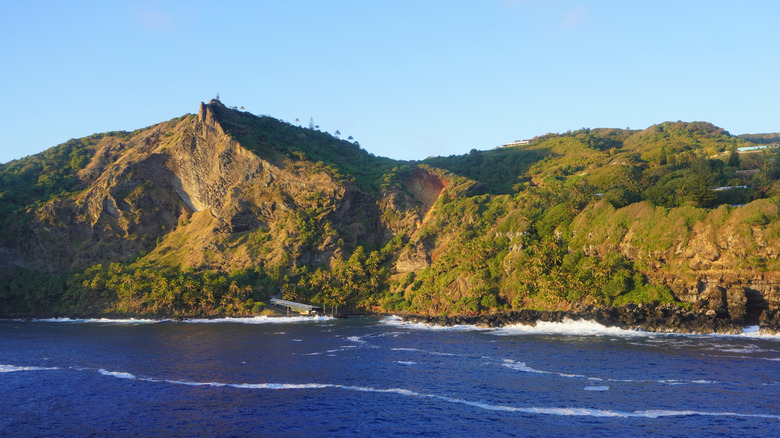
Even with planes and boats, it takes almost a week to reach Pitcairn Island, but despite this remoteness, the island is inhabited. Its capital, Adamstown, which overlooks Bounty Bay, boasts a scanty population of barely 35 residents (with the whole island having around 50 residents). Many of them are descendants of crew members from the 18th-century British navy ship, the H.M.S. Bounty. The crew members mutinied and fled to Pitcairn Island, which is still a British Overseas Territory today. The island itself is too small to have an airport, and while Adamstown's human population might be in danger of dwindling to nothing, the marine population in the surrounding waters is doing better than ever.
Pitcairn Island is actually part of the Pitcairn Islands archipelago, which includes the nearby isles of Henderson, Oeno, and Ducie. As of 2015, the Pacific waters encircling the entire Pitcairn Islands cluster have been designated as a marine reserve, with aims to protect the health of the reef systems and aquatic life below the blue depths. Racking up a total surface area of about 324,000 square miles, the Pitcairn Marine Reserve completely dwarfs the entire state of Texas (which can only claim about 268,000 square miles of land area) and is currently the biggest marine preserve in the world.
The mutinous history of Pitcairn Island
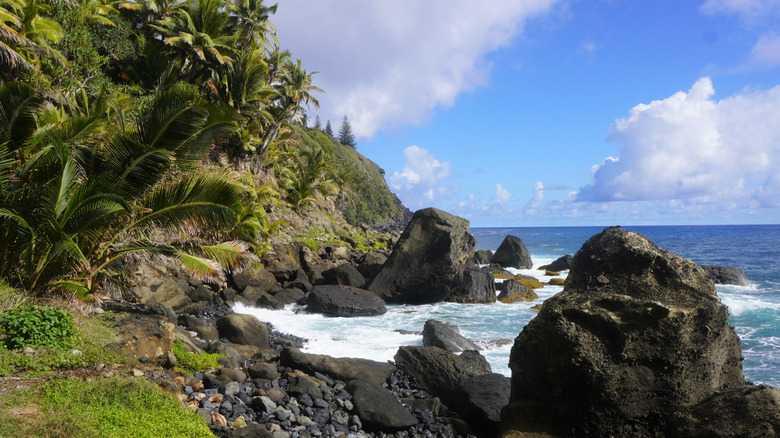
Without the help of Pitcairn Island's residents, the Pitcairn Marine Reserve might never have come to fruition, and without the H.M.S. Bounty, Pitcairn Island may never have been inhabited. Centuries earlier, at the height of England's age of seafaring expansion, the H.M.S. Bounty was a Royal Navy ship sent on a botanic expedition to Tahiti, a bucket list-worthy French Polynesian island. The Bounty's mission was to collect breadfruit plants in the hopes that they could be cultivated into a cheap crop to provide sustenance for the British Empire's enslaved labor force in the West Indies.
However, the Bounty never completed its mission. After securing the cargo of breadfruit seedlings and setting sail from Tahiti in 1789, several of the ship's crew members, who had grown enamored with the blissful, tropical lifestyle they had enjoyed while moored in Tahiti, forcefully gained control of the ship in what is now remembered as the legendary "Mutiny on the Bounty". Now fugitives from the British Navy, the mutineers, a mix of British and Tahitians, sailed the Bounty to Pitcairn Island, where they established a crude settlement.
That settlement is now called Adamstown, one of the smallest cities in the world. Today, Pitcairn Island is almost like any other town, with the exception of its minuscule population. Children attend school, a post office delivers mail, and the General Store supplies locals with household items. The Pitcairn Islands Museum displays artifacts from the Bounty, while a handful of restaurants offer islanders a place to relax. What's more, thanks to Pitcairn's extreme isolation, the reefs beneath the waves of the island are wonderfully unspoiled, prompting the National Geographic Society to work together with the people of Pitcairn Island and the British government to ensure its protection for the future.
The Pitcairn Marine Reserve protects underwater ecosystems
Flourishing below the surface of the Pacific off the shores of the Pitcairn Islands is an otherworldly landscape teeming with rare aquatic life. The National Geographic Society led expeditions back in 2012 to examine the deepwater habitats surrounding the Pitcairn Islands, which revealed coral atolls and tropical reefs that remain minimally impacted by commercial fishing and other human activities. Realizing what a hidden treasure lay on their doorstep, Pitcairn locals voted to declare the waters a protected area.
The Pitcairn Marine Reserve is essentially an exclusion zone, which prevents illegal fishing around the islands to ensure the reef systems and marine life that depend on it are allowed to continue flourishing. Endangered marine animals like humpback whales and sea turtles ply the waters within the Pitcairn Marine Reserve, making the protection area all the more necessary.
Conservation efforts have already produced results — the waters around Henderson and Ducie Islands are now a flourishing haven for whitetip reef sharks and grey reef sharks, both threatened species. To further the initiative, a research laboratory was established on Pitcairn Island in 2023, built by the residents with their own hands, further revealing their commitment to maintaining the island's vital ecosystems. The laboratory has facilities allowing scientists to monitor the health of life under the sea. With such a hardworking community, Pitcairn Island is making its mark on history beyond the infamous Bounty mutiny, ensuring the continued protection of endangered marine species. And while certainly an arduous journey, tourists can still visit Pitcairn Island. First, take a flight to Tahiti, then a connecting flight to Mangareva Island. The cargo ship, MV Silver Supporter, ferries passengers from Mangareva to Pitcairn Island. Various home stays and cottage rentals allow tourists to experience life on Pitcairn with the locals.