
5 Vintage Travel Accessories Everyone Used To Have
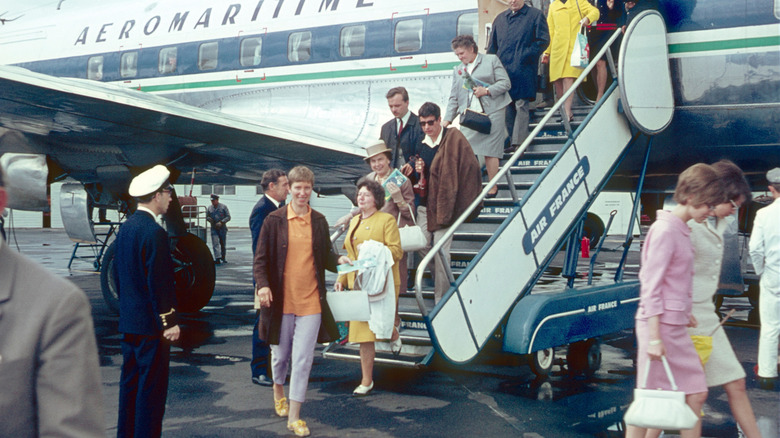
Travel has changed a lot over the last century. Once upon a time, your vacation meant that work couldn't contact you at all, with no cell phones or email. Postcards were the best way to let loved ones know you wished they were there with you. Even as the digital age ramped up, checking your messages often meant hunting down an Internet cafe and paying for time with coins that gave you a few minutes of access to the web.
While things are really different these days, it's fun to look back at the past. That includes vintage travel accessories that you no longer have to take with you. We picked our top five, which include travelers' checks, paper maps, road atlases (those aren't the same thing), cameras that require film, and heavy, wheelless, hard-sided luggage.
Many people reading this may not have been alive when these items were an essential part of traveling. Others are likely to look back at some of them with a sense of nostalgia. While it's certainly easier to make plans, snap shots, and lift your suitcase over your head without help these days, there was something about actually being unreachable while off from work, and a joy in taking time to plan a vacation. However you feel, it's always fun to look back.
Travelers checks
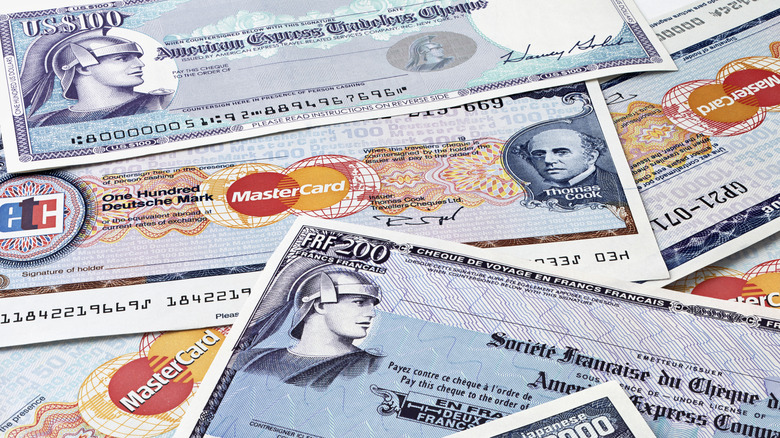
The first credit card-like systems were introduced in the 1930s in the United States. However, it took a while for their use to become widespread. In fact, women couldn't even get a credit card in their own name until 1974. Instead of carrying credit cards, people often relied on travelers' checks (or cheques) on vacation.
These were printed checks that stood in for a currency amount that you could purchase at a bank or credit union before your trip. They had two signature spots. You'd sign one when you purchased them, and sign again when you used them to buy something. They had serial numbers, so they could be replaced if they were lost or stolen, which made carrying large amounts of money with you while traveling safer.
These days, you obviously don't need to carry travelers' checks anymore. While they still exist, and you can still buy them and cash in old ones, lots of places may not accept them. Plus, there are safer ways to deal with purchases. You can pay digitally in many stores, and credit cards are even accepted in most towns and cities. Instead of dealing with the serial numbers of lost travelers' checks in the event of theft, you can call your credit card company to have a charge removed pending investigation if you have an issue. However, as travel pro Rick Steves advises, it's still smart to have some cash on hand for small purchases like snacks and little souvenirs, or in more remote areas where credit cards or digital payment aren't accepted or widely used.
Paper maps

Trip-planning looked very different in the past. It was one thing if you were heading to the next state over for a visit to a familiar spot like grandma and grandpa's house. It was quite another if you were looking at an extended road trip, an overseas vacation, or traveling to a place you weren't familiar with. To get a sense of where you were heading, how far it was between states or countries, and how to make everything fit within a week, you had to have a paper map.
Imagine trying to book hotels (over the landline phone with long-distance fees) that you found in a travel guide, without any sense of how many miles separated one in southern France from another in Italy. Without the internet to help you search or Google Maps to get a relative idea of distances, a paper map was the way to go. You might even have gone to the library to use their maps for planning.
These days, the internet has changed everything. Apps give us driving directions and distances. Heck, there's even a Google Maps feature that lets you navigate unfamiliar airports and helps you find just the right restaurant. Back in the day, you could certainly book through a travel agent if you wanted to pay extra. Still, your best bet back then was to ask friends who had been there and had their own route.
Road atlases
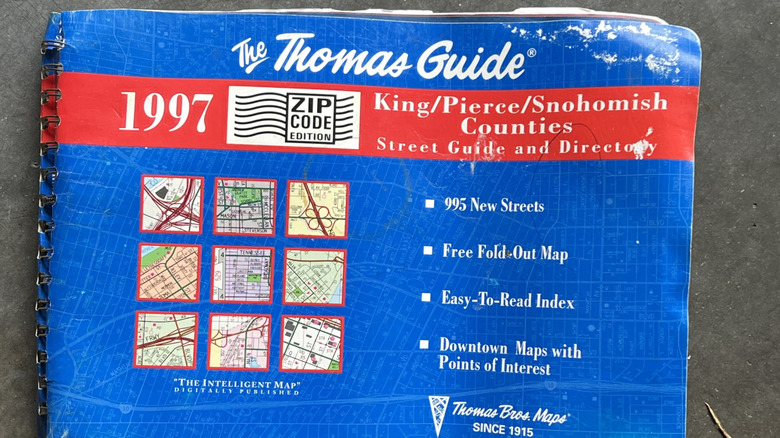
Once you had your overall route planned on a paper map, you may have picked up a road atlas to get down to the nitty-gritty. While a regular map is useful for looking at larger areas, and a road map shows you the streets in a certain area, a road atlas is a collection of road maps that are bound together in one book. While you might have used a single road map for a single city, a road atlas was helpful if you planned on traveling through several states or countries.
Road atlases like the Thomas Guide (above) were also really useful even within larger cities where there are so many roads that the print would have to be far too tiny to read easily. (For personal experience, I can tell you that you really had to have one in Los Angeles if you didn't know the area.) However, if you didn't have your route memorized or you got lost, it was helpful to designate one of your travel companions as a navigator who could read the map while you drove.
Cameras that require film
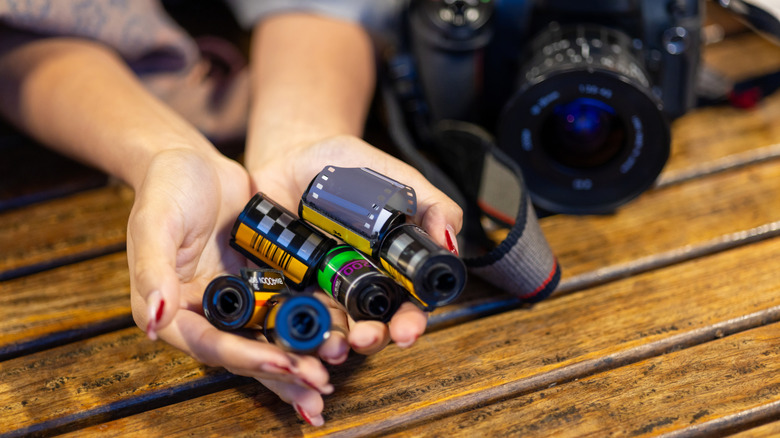
If you travel with your phone (and it's a good bet that you do), you really don't need a separate camera. Sure, you can bring one if photography is your hobby or you want better quality, but it's not necessary. Even if you do bring one, you can usually see the image you've just captured immediately, choose whether or not to delete it and reshoot, and transfer it to your phone or computer to share it instantly with the world. However, once upon a time, you needed a physical camera that used film.
Many of you may not be old enough to remember, but you really had to pick and choose the photos you were going to take on vacation. A roll of film only had a certain number of exposures, usually 12, 24, or 36. And that was all you got, unless you bought extra rolls of film. You didn't get to check your hair in a shot or find out if your kid was sticking their tongue out in a family photo.
It took days (or you could pay more for a quicker turnaround) to develop film, so you didn't know how your vacation photos would turn out until after your return. You may have needed a flash but didn't know it. You might have loaded the film incorrectly, meaning the whole roll could be ruined. Photos may not be as precious these days because of how easy they are to take, but you're certainly more likely to get pictures you actually like.
Heavy, hard-sided luggage with no wheels
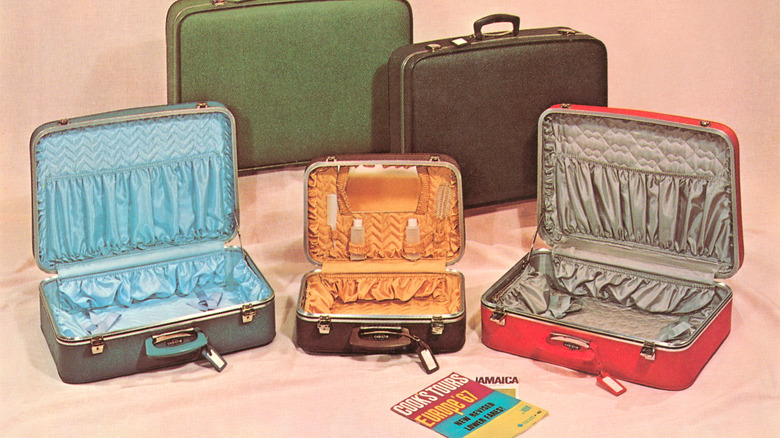
If you're looking into buying a new suitcase, you're probably looking for something lightweight with four spinner wheels. The idea of lugging a bag that was heavy before you put a single item in it, or carrying it by a handle through an airport, seems ridiculous. However, in the past, luggage looked very different.
Once, people traveled with heavy trunks on steamships (often with servants to carry them). Once suitcases appeared on the scene, it made things easier, but only so much. They were usually hardsided and heavier than they are now. They closed with clasps rather than zippers, and they didn't have wheels. In fact, the first rolling suitcase wasn't patented until 1972.
The weight of suitcases began to change in response to the rise of the jumbo jet in the latter part of the 20th century. Once there were weight restrictions for airlines, it only made sense to use more modern materials to create something lighter, which allowed people to pack more. The next time a wheel breaks on your bag, and you have to drag it through a giant airport, spare a thought for your older relatives who had to do this all the time. If talk of vintage travel accessories makes you long to see the world the way your parents and grandparents did, check out some nostalgic '70s American road trips for future travel ideas.