
What Happens To Retired Airplanes?
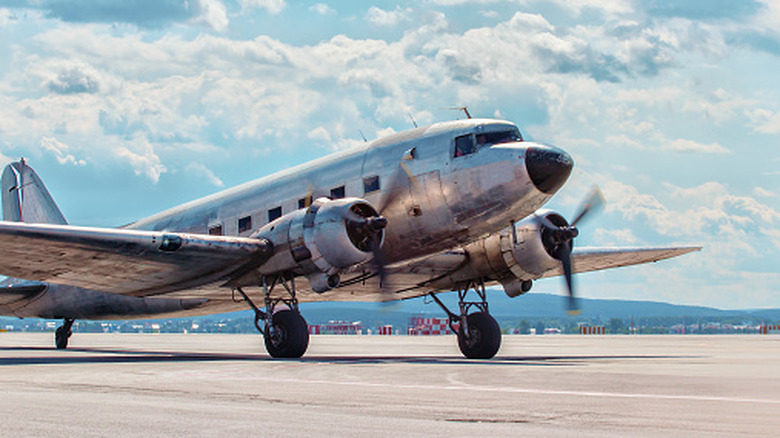
You've very likely had the same thought, perhaps during a long flight: Where do old airplanes go, once they're no longer fit to fly? What do you do with a Boeing 747-400, a massive plane that's more than 230 feet long and weighs 170 tons even when empty? Surely, it's too big for a landfill. Can you chop it up into recyclable parts?
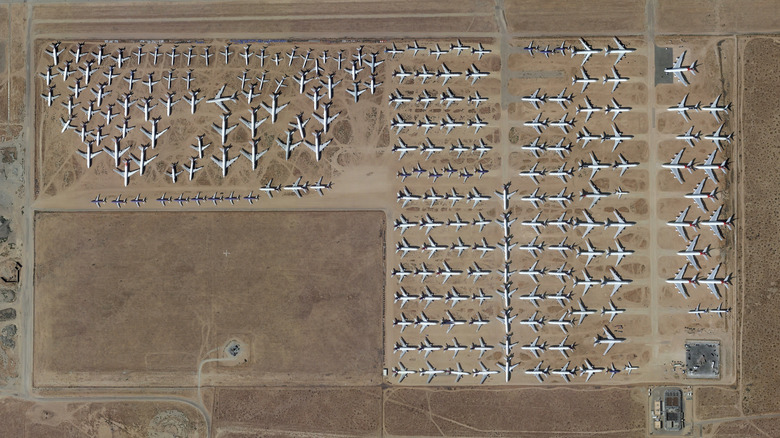
Many commercial planes are preserved in boneyards (sometimes called graveyards) — outdoor storage facilities where airlines park their retired or temporarily stored aircraft. In a way, they're junkyards for aircraft — imagine hundreds of parked airplanes at enormous, remote airports around the world. There are several in the U.S., but a few with large commercial aircraft include airports in Mojave, California; Kingman, Arizona; and Roswell, New Mexico. If you noticed that all of these are in the Southwest, there's a good reason — the dry air prevents corrosion and decay. Like once-thriving island resorts that are now abandoned, the planes parked in boneyards are eerily well preserved. Many planes are stored here indefinitely, and a good number are salvaged or scrapped. About 90% of any aircraft can be reused or recycled, with their components finding new uses.
These boneyards fascinate many people, from aviation fans and history buffs to "weird places" enthusiasts. Unfortunately, they're off-limits to visitors, so tourists can't walk among these sleeping giants. But, like some of those abandoned Colorado mountain mining towns, some sites are visible from the road but strictly closed to the public.
Boneyards and interactive displays
Commercial aircraft have a typical lifespan of 20 to 25 years. Yet the longevity of an airplane is measured less in actual time than in flight hours and pressurization cycles; each cycle takes place between the moment the plane takes off and the moment it lands. Pressurizing the cabin puts stress on the plane's structure, which isn't a big deal during daily operations but can wear it down over time. To keep it airworthy, mechanics constantly perform maintenance on planes. On average, there are about 12 hours of line maintenance per week, engines are overhauled every 20,000 to 30,000 flight hours, and avionics and landing gear are replaced about every decade.
Boeing 747-400s are limited to around 35,000 cycles; the exact number of years will vary, depending on how often the plane flies. By this point, the physical structure is much different from what it was a quarter-century earlier. Many planes are refurbished to extend their service time and cut costs, leading to a multibillion-dollar modernization industry. But eventually every plane makes its final flight. According to the European Union Aviation Safety Agency, more than 600 passenger planes are retired each year globally.
If you want to see retired aircraft up close, many aviation museums around the country display commercial aircraft. The best-known locations are the Smithsonian Air and Space Museum and the Steven F. Udvar-Hazy Center in Washington, D.C. If you're on the West Coast, the Museum of Flight in Seattle, Washington, is a good option. Or, even more unique: WB1200, a pair of residential towers in Seattle — still being developed at the time of writing — will suspend a retired Boeing 747 between them as a public sculpture.