
New Hampshire's Once-Thriving Settlement Was Abandoned And Transformed Into A Scenic Landmark
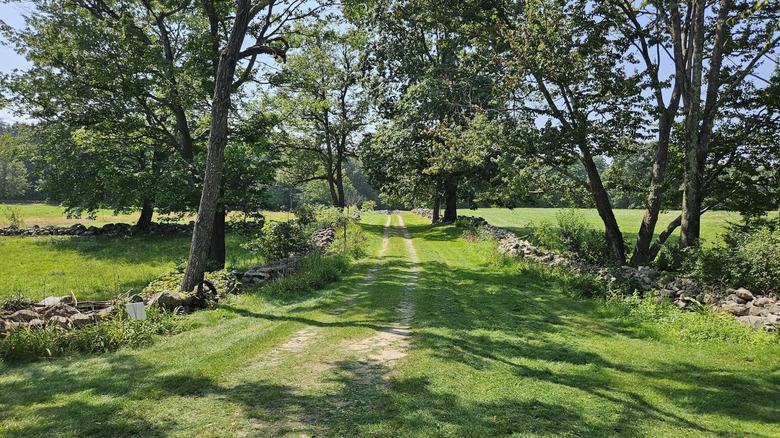
If you want to imagine what it was like to live in the early New England colonies, you can do so trail-side at the Monson Center in New Hampshire. Certainly, it's possible to glimpse American history at New Hampshire's 19th-century towns like Harrisville, but the former town of Monson was much older than that. In fact, according to the Society for the Protection of New Hampshire Forests, Monson was New Hampshire's oldest inland colonial settlement, which was active for just over 30 years in the mid-1700s before being abandoned. Luckily, the location was spared from development, and you can still see some relics of the original settlement today on scenic woodland trails.
There's no more than one intact, original house from the settlement at the Monson Center, but some stone walls and foundations lend the outline of what once stood. Monson was first settled in the 1730s, before New Hampshire was even a state. According to New Hampshire Magazine, Monson never evolved into a full-blown town (It didn't even have a schoolhouse.), and its residents began to desert it around 1770, though the exact reasons why aren't clear. For two centuries, the town was left to deteriorate. Before being swallowed up by new developments, though, a grassroots campaign saved what remained of the town in the 1990s, protecting the old foundations and quiet trails that mark the land today.
What you can see at the Monson Center
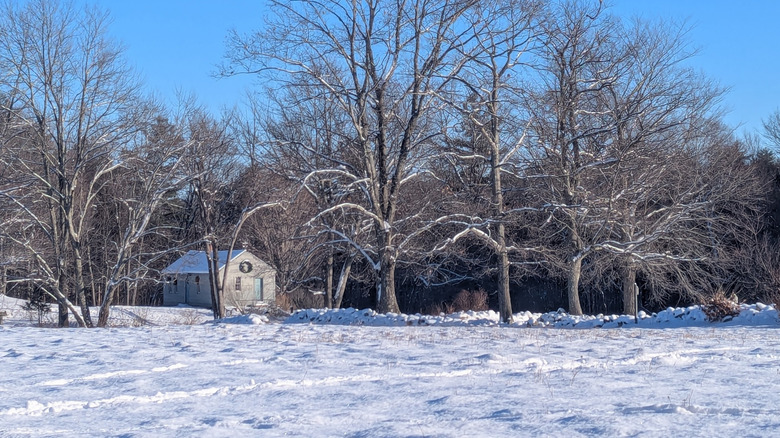
After being neglected for two centuries, only one property has been fully restored in what was once the Monson village. It's the Gould homestead, a squat, two-room structure that's been turned into a museum with some archival materials and antiques, though the museum may only be open if the caretaker is available. To reach the museum house, you'll already have to venture onto a woods road in a short trek from the parking lot. From the museum, you can diverge onto the hiking trails. (The Forest Society provides a helpful map to see where trails go.) The trail network covers three miles in total, covering pretty views of some marshes and forest. "In the Spring, you can even see herons nesting in the dead trees at the North end of the main trail if you're lucky," one Google reviewer shared.
The Forest Society map lists seven preserved foundations from homes of the original Monson settlement, though they may be difficult to spot. They mostly appear as some sunken plots with a few scattered stones, though there are signs to mark where each house was with some background about who lived there. You'll also notice stone walls lining the land — there's a reason you can see these all across New England.
Tips for visiting the Monson Center

The Monson Center property straddles two New Hampshire towns: Milford and Hollis, a gorgeous country getaway packed with New England charm. You can drive there in about 35 minutes from Manchester, New Hampshire, or — for long-haul travelers arriving through Boston Logan International Airport — just over an hour from Boston. There's parking available along Federal Hill Road, and the Forest Society notes that the parking lot gets plowed in the winter. Being a Forest Society site means the Monson Center is open every day from sunrise to sunset, and it's free to the public.
Birders may want to bring some binoculars along with them, as the site is a birding hotspot. Some of the birds most commonly reported here on eBird are warblers, herons, and robins. If you come in the winter, you can bring some cross-country skis or snowshoes, both of which are permissible on the property. When covered in snow, the trail network might be hard to follow, but you can find trail maps right outside of the museum house in a holder.