
Why There's Simply No Need To Travel With All Your Charging Cables Anymore
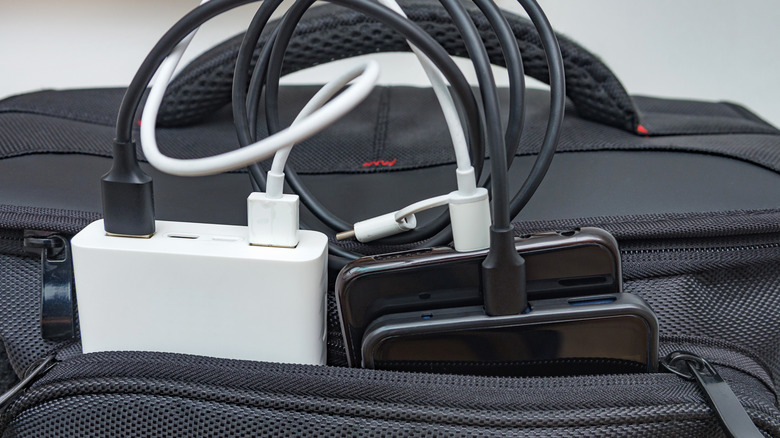
If you're used to your travel companion being a nest of tangled cables, there might be a simpler way to pack. For many travelers, an important step in packing for a trip is surveying all your tech and pulling together the appropriate charging paraphernalia for each. Before long, you've got separate cables for your laptop, phone, and headphones, plus multiple adapters and charging boxes. But these might be some items you should take out of your luggage before your next vacation, since charging tech has become more streamlined, and there are hacks to bypass needing so many cords.
There's one cable type that's slowly becoming universal: It's the slim, round-tipped USB-C. According to data published in Market Growth Reports, about 80% of smartphones, laptops, and tablets are compatible with USB-C plugs, as of 2023. Where you might have formerly had to bring one USB-A cable for older ports or a Lightning cable for Apple devices, for example, there's now a much better chance that all your devices will share a common port. USB-C became a standard because, as Wired reported, it charges fast, it's reversible, and it transfers data efficiently. In fact, the European Union even made it mandatory in 2024 that most new devices sold in the EU have to have a USB-C port.
Another tip to help reduce your charging tech load is to check if the destination you're traveling to supports the plug type of your home country. The International Electrotechnical Commission has a practical map showing the standard plug types worldwide. For example, the United States uses type A plugs, and these are supported in Canada, Mexico, Central America, and Japan. So, you could get by with just a USB-C cable and your regular charging box when traveling to one of these destinations.
When you might still need more cables
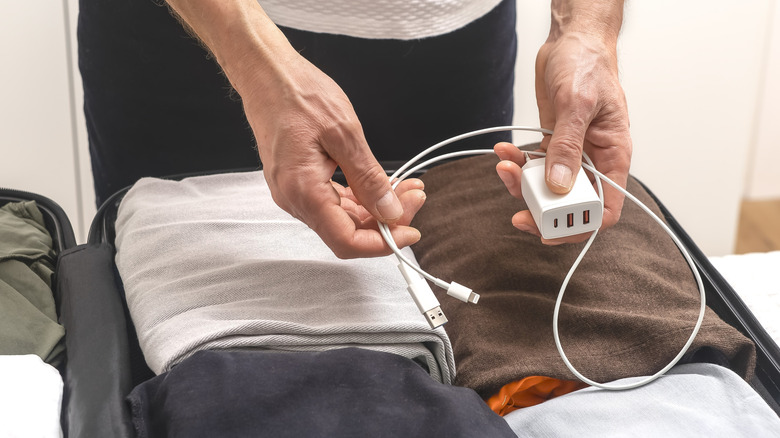
Assuming you're just bringing a few devices for everyday use (phone, laptop, earphones), one USB-C cable and charging box can suffice. When it comes to more intensive tech, though, you might need more cables and charging equipment to support higher wattage and faster speeds. That might be important if, say, you have various high-tech items essential to doing remote work while traveling and need to have multiple devices plugged in at once. For example, you might need to charge a camera battery and a laptop at the same time, both of which use high wattages — a camera battery pack can require around 50 watts, while a laptop can use 100 watts or more. In that case, you'll need a cable for each and an adapter that supports at least 150 watts.
Then, of course, there's a possibility you have older devices that simply don't have USB-C ports. It's a good idea to bring the appropriate cable with you in that case, since you might not be able to find the exact combination of port types you need in your destination's stores. One Reddit user shared that they struggled to find a micro USB to USB-C cable, for instance: "[A]s the port types are from different technology generations, it's hard to find." Finally, as you're assembling your charging inventory, you may want to get an affordable gadget to prevent "juice jacking" when you charge at an airport or hotel.