
Here's What Happens When Airplanes Dump Fuel
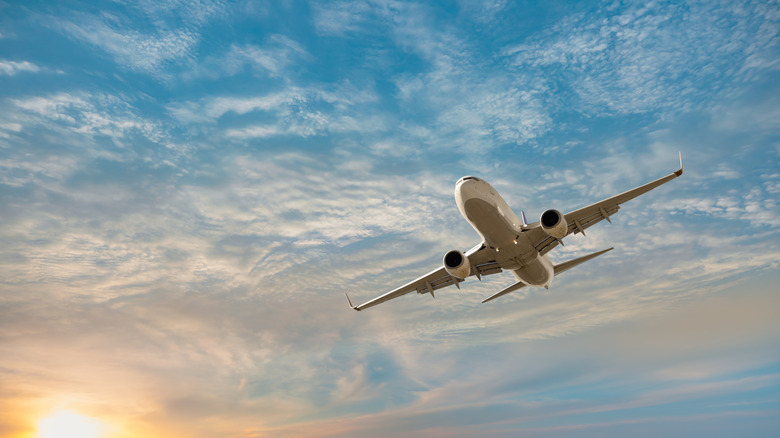
Air travel is so ubiquitous at this point in history that many people don't really think about everything that goes into it. However, if you're curious about flight, you may have wondered about things like what the weird in-flight sounds you hear mean, or why they really have to dim the lights during takeoff and landing. One thing you may never have thought about, though, is what happens when airplanes dump fuel, and why it does so in the first place.
A fuel jettison, as it's called, is done to lighten the load if a plane has to land early. Planes have a maximum takeoff weight and a maximum structural landing weight, which is lower than the former. If the plane has to turn around or land early for something like a mechanical, weather, or medical issue, fuel needs to be jettisoned to make the plane lighter and safe to land (or burned off with some airport circling). It's done through nozzles on the wings of larger aircraft.
According to AvioSpace, fuel can weigh up to 6 pounds per gallon, and a plane like the Airbus A380 can hold around 82,000 gallons. However, not every plane has the gear to do this. It's generally needed for widebody aircraft on longer flights. However, there is more to it than this.
How fuel jettisoning works on a plane
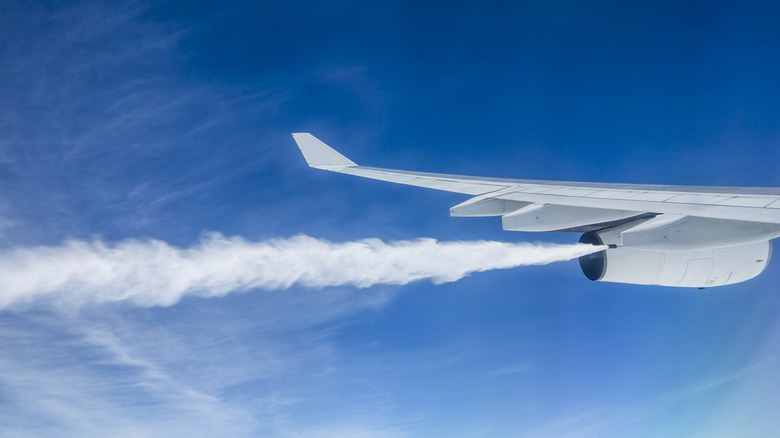
Trying to land with too much weight can stress the landing equipment, so jettisoning fuel is important for certain plane types. However, it isn't a simple liquid dump. When the plane is going over 200 mph, the fuel that is released turns into tiny droplets and is dispersed into the air. It's usually done where there is no habitation, and at least a mile in the sky, though it's usually released between 2.5 and 5 miles above the ground. From the ground, you may see a white trail coming from the wings when this is happening.
Fuel jettisoning isn't an ideal scenario. Fuel is expensive. If it happens when the plane is too low, the fuel can contaminate water or the earth. However, this isn't something that happens all the time. According to the Federal Aviation Administration, fuel jettisons occurred less than 30 times each year from 2015 to 2020. Generally, according to Skybrary, if a fuel dump is being considered, the pilot contacts Air Traffic Service to request a location and altitude to jettison the fuel safely. Circling the airport a few times to burn it off is easier, but sometimes fuel just has to be jettisoned. Finally, if this has you interested in learning more, here's how long it actually takes to refuel a plane.