
The Truth Behind The 'World's Emptiest Airport' That's All But Abandoned
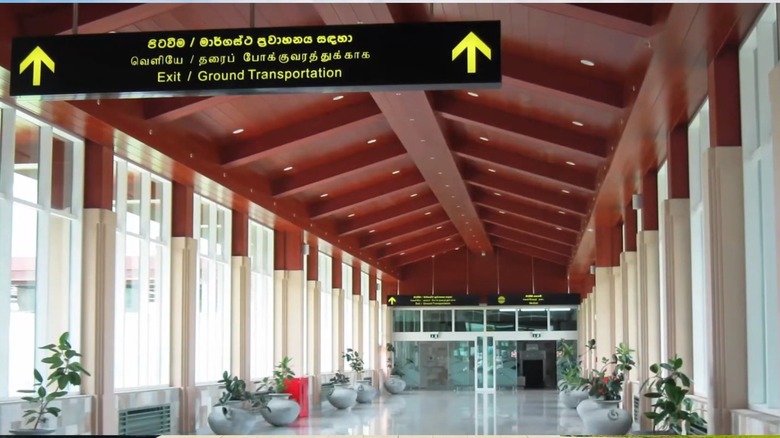
"The best laid plans of mice and men often go awry," wrote the poet Robert Burns. It means no matter how well you think you've planned, something can always go wrong. This is exactly what happened to the doomed airport nestled on the sun-bleached southern edge of Sri Lanka. Ambitious plans and a pipeline of foreign investment fueled the $162 million construction of Mattala Rajapaksa International Airport (MRIA), which opened in 2013 after four years of construction. MRIA was meant to serve 6 million fliers per year. Instead, the airport dwindled into a cautionary tale of political hubris and earned the nickname the "World's Emptiest Airport" because it serves just seven passengers daily.
Bobbing in the Indian Ocean, at its closest point, about 34 miles off the southern coast of India, lush, diverse Sri Lanka is one of the world's most gorgeous, budget-friendly island destinations. Before MRIA, people visiting this tropical paradise were serviced by Bandaranaike International Airport in Sri Lanka's capital, Colombo, on the island's western side. The idea to build a second international airport materialized in 2009. The site chosen was a patch of jungle 11 miles from Hambantota, a port town housing hot springs, nature reserves, and the biodiversity-rich Bundala National Park. The plan was to bring tourism and employment to the region, thereby boosting Sri Lanka's economy and fueling the growth of its aviation industry.
An 11,000-foot runway, 12 check-in counters, and a massive 110,000-square-foot terminal anchored by an enormous statue of Guan Yin, Buddhism's Bodhisattva of Great Compassion, were constructed. The airport's seven daily flights were packed when it opened in 2013. However, by 2016, flights had plummeted to just two per week. When 2018 rolled around, most of the airlines were gone, and Sri Lanka was looking to India for a bailout.
What went wrong at this all but abandoned Sri Lanka airport
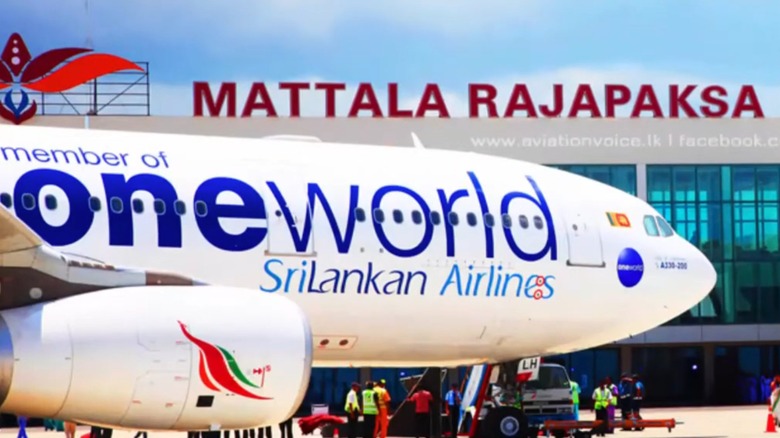
Spearheaded by Sri Lanka's president at the time, Mahinda Rajapaksa, it's not hard to argue that MRIA was doomed from the start. Rajapaska conceived the travel hub as part of a vast urban development to transform remote Hambantota, which he chose primarily because it's where he grew up, into a thriving destination replete with new housing and hotel developments, splendid amenities including a cricket stadium and conference center, along with a sprawling industrial zone and a bustling, state-of-the-art seaport. The latter alone would cost over $1 billion. Rajapaksa, who Forbes reports ruled as a dictator, appointed friends and family to run the project and affixed his own name to its buildings.
Hambantota, a fishing village on the fringes of a biodiverse jungle, couldn't have been a more terrible location. The 2,000 acres of land cleared for the airport were located in the middle of an elephant corridor and migratory bird zone, which sent environmentalists into an uproar. On top of this, the town lacked the most basic necessities needed to make it a destination in its own right. "To have an international airport, you need to have a resident population, you need to have attractions to make foreigners want to come there, and you need some commercial infrastructure," Deshal de Mel, a senior, Sri Lanka-based economist, told Forbes. Without these things, it was impossible for airlines to survive.
The final nail in the coffin was the $4.8 billion Chinese loan Rajapaksa secured to finance the project, and its staggering economic losses. Sri Lankans were incensed that their country had effectively been sold to China. At a point, the interest on the loans topped $17 million annually, while the airport was losing $18 million per year.
What it's like visiting the World's Emptiest Airport today
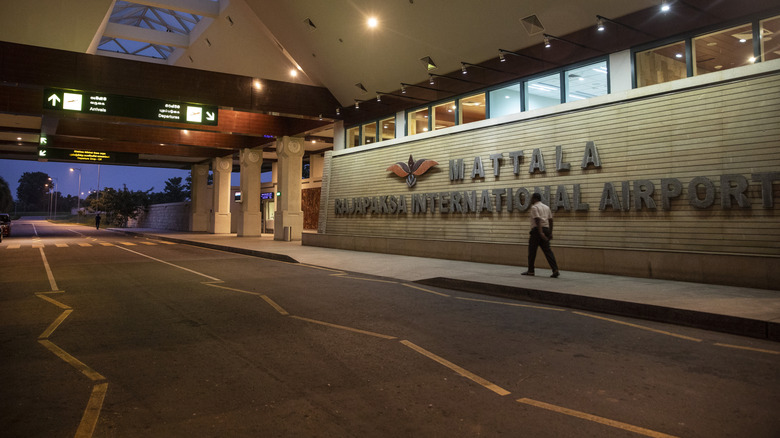
Today, MRIA is an aviation ghost town. While it's so far avoided making this list of airports that pilots secretly despise flying into, it's down to only three international and two domestic carriers. As shared in a video posted to YouTube by BeYouthfulDubai, the highway leading to the airport is deserted, and the spacious hub is drenched in eerie quiet. Remarkably, however, security, food stalls, and information services remain open and staffed despite the airport's shiny terminal receiving fewer than 10 passengers a day.
With so much empty space, MRIA is currently used for storing and refueling planes. It's also become an odd tourist attraction. Travelers visiting nearby wildlife parks and other points of interest have taken to popping into this aviation curiosity. For an entrance fee of 150 rupees, or $1.59, lookie-loos can stride down the temple-like terminal, marvel at the never-ending runway through giant glass windows, and spend time reflecting under the gaze of Guan Yin.
If you do happen to find yourself flying through MRIA, the good news is you won't need any of these hacks to help you zip through airport security. Chances are you'll only be one of seven fliers.