
New York's Once-Thriving Quarry Is Now A Scenic Nature Preserve With Mountain Views And Hiking Trails
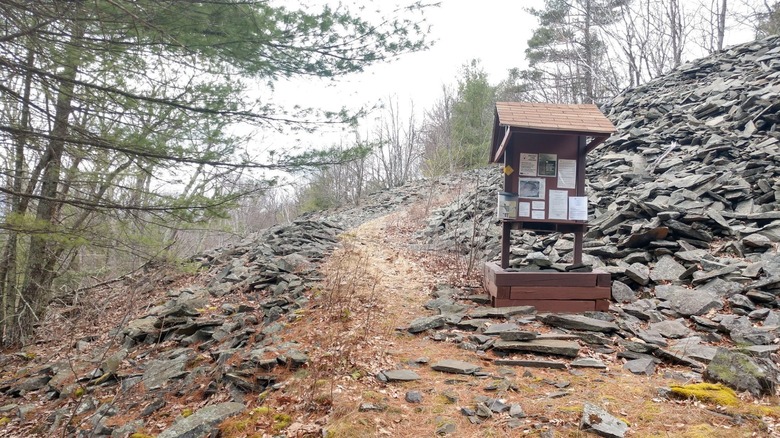
New York's Catskill Mountains are today so verdant and peaceful that it's hard to imagine that this was once a thriving industrial zone. Much of the stone that makes up New York City's historic architecture was quarried here in the late 19th and early 20th centuries, as was stone for the state capital of Albany. Today, the remnants of those quarry sites have reverted to nature to create fascinating landscapes like the one at Woodstock's charming Snake Rocks Preserve. The scenery and views here are first-rate, with a 1.5-mile trail (per AllTrails) that has something to offer visitors in any season.
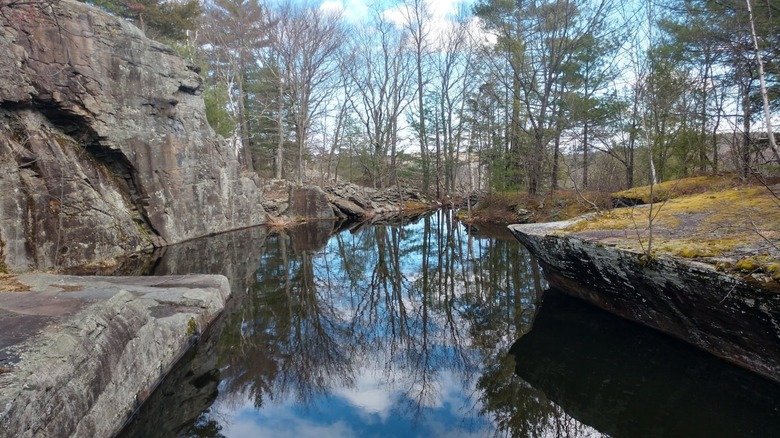
Abandoned back to nature in the early 1900's, the quarry pit here eventually filled with water, becoming a tranquil pond, and the surrounding stone excavations have become habitats for plants, creating an oasis of serenity and calm. Meanwhile, slag heaps of discarded stone left behind by quarry workers have become scenic viewpoints for taking in the surrounding mountains. In summer, the gentle, green-clad mountains roll across the horizon. In winter, when the trees are bare, you'll have the best panoramic views of the surrounding mountains; Snake Rocks Preserve is even a well-signed, beginner-friendly snowshoe destination.
The 36-acre Snake Rocks Preserve is a perfect add-on to a weekend getaway in New York's Catskill Mountains. It's located just 3 miles from the quirky, artsy town of Woodstock and 100 miles north of New York City. This area brims with weekend getaway amenities and other hikes to historic sites that you can combine with a visit to the quarry.
Hiking at Snake Rocks Preserve
After parking alongside the guardrail on Yerry Hill Road (where there are only two spaces), you'll walk 0.25 miles up the pavement along private, residential Nordic Drive to find the trailhead. Just past the entrance kiosk, you can see the slag heaps of discarded bluestone, where the park's namesake reptiles sometimes enjoy sunning themselves. Timber and copperhead rattlesnakes do inhabit New York's Hudson Valley in small numbers, and they have been spotted here. Still, if you come hoping for a snake sighting, you might be disappointed. "Have hiked there at least 10 times and no snakes yet!" writes one Facebook user.
The hike takes you through a fairyland forest that will turn fiery in autumn. Arriving at the quarry pond, a bench invites you to sit and contemplate. In warm weather, the deep, still quarry pond will be teeming with life, surrounded by ferns and lily pads, while frogs croak and fish swim, including colorful koi. Soft, cool moss and lichen grow on the exposed rock surfaces where you can still see chisel marks made by the quarry's laborers.
There are two scenic viewpoints along this hike. If you turn right when you reach the pond, a short spur trail takes you to the first one, atop a rock heap. Here, views of the rolling Catskill Mountains spread below to the east, above the treetops. Past the quarry pond, bearing right, you'll arrive at the trail's highest point for another view, this one toward the Wittenberg Valley from the tops of more rock heaps kids love to scramble up.
The Catskills' industrial past meets the recreational present

Fun fact: If you've walked up the steps of New York's Metropolitan Museum of Art, then you've stepped on bluestone from the quarry at Snake Rocks Preserve. The quarry's New York bluestone is a variety of sandstone that became popular in the late 1800s for building sidewalks and facades, turning this region into a thriving industrial zone. Irish immigrants worked the region's bustling quarries, and as they carved out wide, flat slabs, they threw broken fragments to the side, forming the picturesque slag heaps you see today. Just imagine the ringing and clanging of chisels here, where now there is only birdsong and silent contemplation. The Catskill Mountains' industrial quarry era was relatively short-lived; around the turn of the 20th century, elegant, hand-cut bluestone was superseded by Portland Cement, a newer technology that was cheaper and easier to use.
If your quarry visit whetted your appetite for exploring more ruins, then Woodstock's Overlook Mountain Trail is not to be missed. This 4.7-mile out-and-back hike (per AllTrails) climbs over 1,300 feet to an old fire lookout on the top, and visits the grand ruins of a once-majestic resort hotel along the way.
There are lots of options for stays in the Woodstock area. If you're feeling outdoorsy and nostalgic for the heyday of rock 'n roll, you can camp at the site of the original Woodstock Festival. Or if camping isn't your thing, the town brims with unique hotels and restaurants, like the hippie-chic Hotel Dylan. It's named after one of the town's famous residents, Bob Dylan, who lived and wrote music here and has all the cool '60s vibes you could hope for.