
The Simple Rule That Ensures Your Sunscreen Is Actually Protecting Your Face And Neck
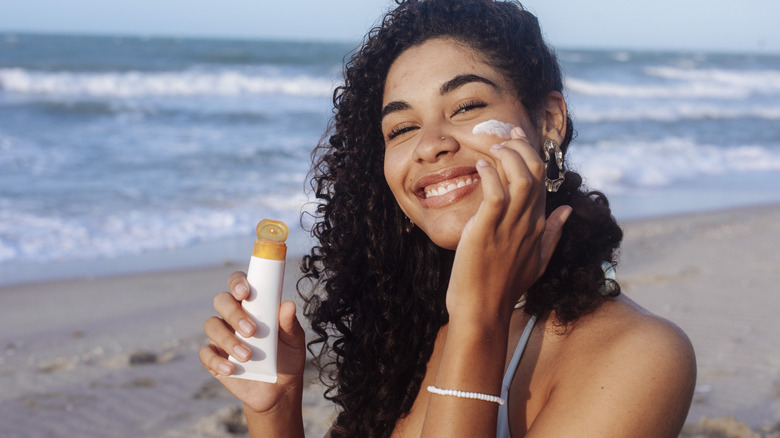
In this more sunscreen-savvy era, most people know that using sunscreen is an important — and even life-saving — practice. Pretty much all of us have gotten the memo: Sunburns are painful, they damage skin, and too much unshielded ultraviolet radiation can increase the risk of melanoma and other forms of skin cancer. Not everyone realizes that 1 in 5 Americans will develop skin cancer by the age of 70, per the Skin Cancer Foundation, but the seriousness of the threat is well known, especially when it comes to our face, scalp, and neck. As summer approaches, households across the U.S. stock up on sunscreen, alongside floppy hats and beach umbrellas. In fact, there's an unsettling reason you may want to wear sunscreen even when traveling by plane.
But are we applying sunscreen correctly? Like so many tools designed to protect our bodies — N95 masks, orthotic insoles, etc. — sunscreen only benefits us when we use it right. If we don't apply enough or fail to cover our skin fully, we leave ourselves vulnerable. Fortunately, there's a very easy trick for measuring the right amount: the two-finger rule.
Turn your free hand so you're looking at your palm. Squeeze sunscreen over one finger, like putting ketchup on a hot dog. Then do the same with a second finger. Together, these two lines of sunscreen should be enough to cover your face. Repeat the process to cover your neck as well.
The finer points of two-finger sunscreen application

Sunscreen comes in more varieties than ever, and users may wonder whether the two-finger trick works for all of them. In short, you can use two digits for creams and lotions. There isn't an obvious difference between mineral and chemical sunscreens; just squirt the lotion onto your fingers, and either version should provide adequate coverage when used correctly. The SPF level also doesn't affect this application technique, though higher-SPF sunscreens generally provide more protection against UVB rays. While you're upping your beach game, scalp-specific sunscreen is another product worth considering — and one many people forget to use.
But what about rollers, sticks, and sprays? The first two applicators are designed to be used directly on your face and neck; the American Academy of Dermatology (AAD) recommends running them over any given area of your skin four times for maximum effect. There's no advantage to applying the stick or roller to your fingers first, but do make sure to rub the sunscreen in. In contrast, sprays are best used on your limbs and torso, not your face. If a spray bottle is your only option, the AAD recommends spraying it generously onto your hands first; never spray it close to your eyes, nose, or mouth.
Not all sunscreens are created equal, of course. Some medical experts are critical of certain chemicals not only for their effects on users but also for their effects on the marine environment. If that's a concern for you, here are 15 reef-safe sunscreens to try.