
Southwest's Strangest Ban Yet Could Start A New Trend That Feels Straight Out Of A Sci-Fi Movie
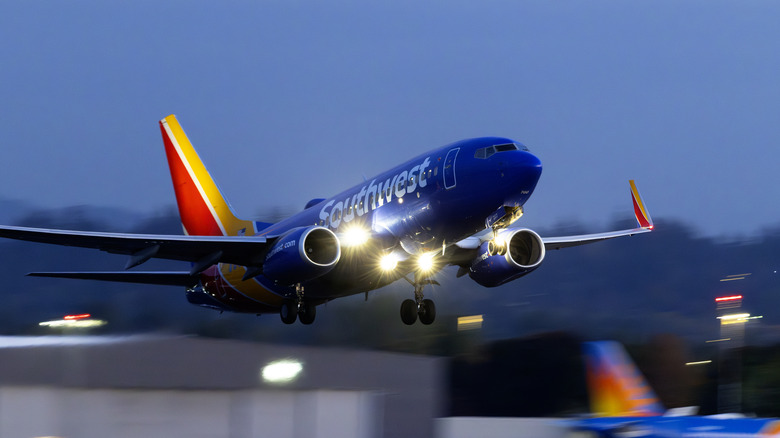
Aliens may or may not be among us, but robots certainly are — and no, we haven't entered "Westworld" just yet. Still, recent policy changes at Southwest Airlines make it easy to imagine a "Blade Runner"-style technodystopia creeping closer to reality. Beginning in May 2026, Southwest no longer allows "human-like or animal-like robots to be transported in the cabin or as checked baggage, regardless of size or purpose," according to the airline's Help Center. The policy defines such robots as those that mimic human and animal behavior. Other robotic items are permitted as long as they fit in an approved carry-on bag and comply with current battery restrictions.
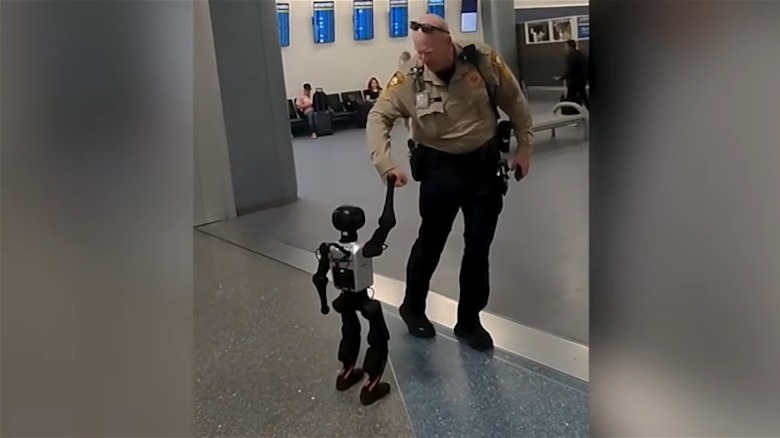
Though futuristic-feeling, this policy didn't happen in a vacuum. In two recent, highly publicized incidents, humanoid robots took ticketed flights on the low-cost carrier. Stewie, a 3.5-foot humanoid built by The Robot Studio and owned by Dallas entrepreneur Aaron Mehdizadeh, flew in a passenger seat from Las Vegas to Dallas earlier this month after being outfitted with a smaller, TSA-approved battery for the trip. According to social media footage later picked up by news outlets, Stewie and fellow passengers appeared to enjoy the experience — at least until Southwest updated its policy two days later, effectively prohibiting future in-cabin flights for the humanoid. "It's a total conspiracy, I swear," the robot declared, per CBS News.
@laniertv Stewie was catching flights not feeling lol .. #laniertv #robots #southwestairlines #fyp #ai
Another robot, Bebop — a 4-foot humanoid owned by Eily Ben-Abraham of Elite Event Robotics, is no stranger to travel, taking regular flights to attend expos and events showcasing its prowess. While waiting for an April 30 Southwest flight in Oakland, Bebop danced and entertained passengers at the gate before boarding a flight to San Diego. Despite the bot's boarding pass, however, 75-pound Bebop – too heavy to check when packed in its case — caused an hour-long flight delay before the robot's battery was removed and confiscated, and travel resumed.
Lithium ion batteries have become a risk for air travel, but is that why Southwest is banning robots?
Across the airline industry, lithium-ion batteries have posed safety issues in flight, prompting airlines to prohibit them in checked baggage. The Federal Aviation Administration (FAA) reports these incidents have increased since 2024. Less than two weeks before Bebop caused a stir, Southwest announced it would be limiting portable chargers on flights. Previously, Southwest banned batteries in portable chargers for scooters and mobility devices, a controversial move despite what the airline deems safety precautions. Now, Southwest's carry-on limits for lithium-ion batteries are more restrictive than those of most U.S.-based airlines and even the FAA's baseline directive — though they're in line with new international guidelines. "Another day, another new rule. What else is new," wrote a Reddit user in r/Southwest in reaction to Southwest's latest battery ban.
Now the airline's lithium-ion battery policy goes even further, restricting passengers to one power bank per carry-on, prohibiting storage in the overhead compartment, and capping capacity at 100 watts. Items like lighters and electronic vapes are not allowed, per Southwest policies, and spare batteries for cameras and drones must be terminal-protected.
In the case of Stewie, his owner, Aaron Mehdizadeh, says the robot's new, smaller battery is the size of a laptop battery, which, despite being made of lithium-ion, is allowed on Southwest flights. "The battery that we used was not a safety hazard," Mehdizadeh told Fox News. "This battery was totally under the FAA limit." Some speculate there may be an ADA lawsuit in the works: After all, the policy's language detailed reasons other than just battery restrictions. Nevertheless, the airline has maintained that its recent decisions stem from safety concerns; time will tell how these policies continue shaping up.