
TSA's New Controversial Security Program Just Launched. Here's What It Means For Travelers

For years, the Transportation Security Administration (TSA) has sought to balance national security with efficiency in travel. But government shutdowns have left TSA scrambling to manage hours-long security lines and staffing shortages, leading to a significant financial strain on the agency. To alleviate these financial concerns, TSA has announced a new program called TSA Gold+, a public-private partnership that the agency calls "the future of aviation security."
This isn't the first time TSA has pushed for partnerships with private investors to reduce the agency's financial burden. In April 2026, Ha Nguyen McNeill, the Deputy Administrator for TSA, testified in front of Congress that the financial strain of the recent government shutdowns resulted in nearly $1 billion in delayed paychecks for TSA staff. She argued the case for increased private involvement in airport security checks — with TSA guidance — to support a more efficient system for travelers. The result was TSA Gold+. In an internal communication obtained by Gate Access, TSA describes the program as an expansion of the original Screening Partnership Program (SPP), under which some airports' security checks are managed by a privately employed workforce. In addition to managing their own employees, TSA Gold+ would allow contracted private companies to implement their own technology to screen passengers and luggage in airports already operating under SPP.
This would, in theory, allow airports to screen passengers and their luggage faster and make security checks quicker and easier, as airports would no longer be reliant on outdated government technology. It would also allow airports to keep running without interruption in the event of another government shutdown. However, some have raised concerns, claiming that for-profit companies cannot be relied on to carry out TSA's critical task in ensuring national security.
How does TSA Gold+ affect travelers, and is it safe?
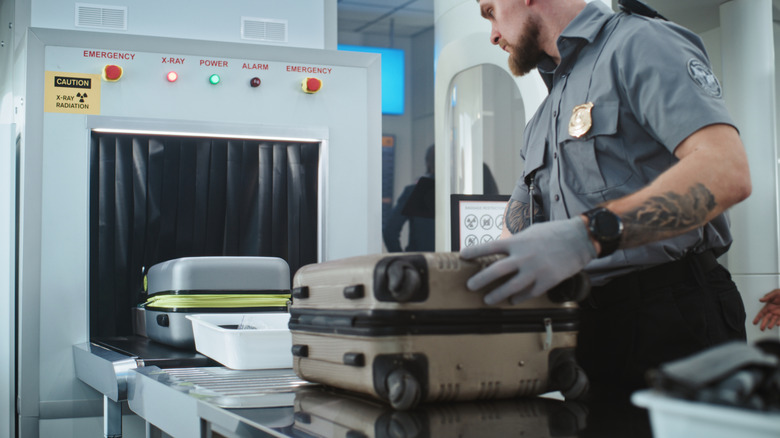
Unlike TSA PreCheck (which is running a sale for younger travelers during May 2026), TSA Gold+ isn't a membership program that travelers have to opt into. Instead, TSA Gold+ will slowly be implemented in the airports that opt for the program. While back-end technology and processes will change, the security checks will likely look the same to travelers at these airports. The biggest difference will be seen in the event of another government shutdown. Big, federally-run airports struggled during the shutdown, but airports under TSA Gold+'s predecessor, the SPP, saw smaller security lines and operated as normal.
Not everyone is happy about it, though. The American Federation of Government Employees (AFGE) published a statement in 2025, in which they strongly opposed private involvement in airport security, stating it could compromise security in favor of higher profits. However, the TSA maintains that security won't be an issue, as the private companies will have to comply with TSA standards. According to Keith Jeffries, a former TSA Federal Security Director at Los Angeles International Airport and vice president of K2 Security Screening Group, workers employed by private companies under SPP "receive the same type of training as TSA" (via CNN).
For travelers, the only visible difference between TSA workers and private screeners would be their uniform, as private employees will likely wear their company uniform instead of the TSA uniforms (via Yahoo). However, the security process is expected to remain the same. As of this writing, there is no confirmed information on which airports will fall under TSA Gold+, although the internal memo reports that "a handful of airports have expressed a strong interest" in being part of the program.