
What Nobody Believes About Niagara Falls Until They See It For Themselves
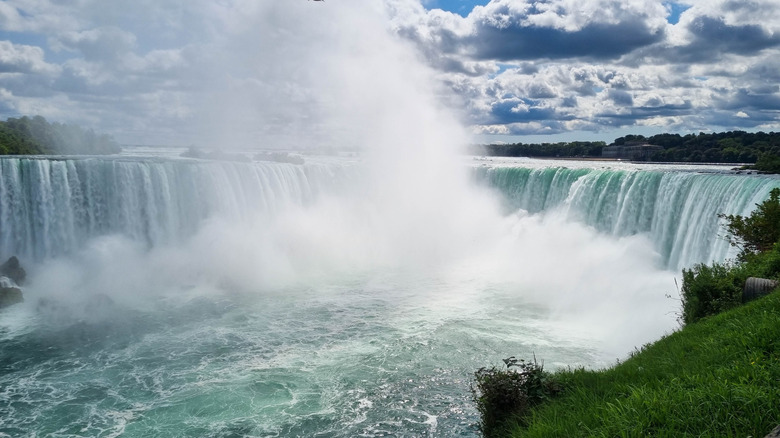
One of the most mythologized natural wonders of America is the grand, thunderous image of Niagara Falls seen from a clifftop lookout point at the edge of the country. Yet, Niagara Falls isn't entirely a "natural" wonder, nor is it a singular waterfall seen from one lookout point. The photographic version of the falls — a misty crescent seemingly plunging in a vague wilderness — has been reinforced by everything from postcards to honeymoon cruises.
Niagara Falls isn't one curved waterfall but rather is made up of three distinct falls: the American, Horseshoe, and Bridal Veil Falls. The falls you most likely see in pictures is the U-shaped Horseshoe Falls, which, to be fair, is the largest of the three, channeling about 90% of the Niagara River's flow, per Niagara Falls USA. But if you're a traveler on the U.S. side of the falls, you only get a limited view of the Horseshoe Falls from the side, while the Canadian neighbors see it in full sweep and can even zipline to get up close and personal with the falls.
Even if you don't get the full Horseshoe Falls view, that doesn't mean the experience is underwhelming. Quite the opposite: People often describe how intense the physical sensation of being near the waterfalls is just from hearing its ceaseless crash. Its grandeur comes more from force than height. At 188 feet at its peak height, Niagara Falls is far from the tallest falls in the world or even in the U.S., but it is one of the most powerful. Its flow rate stays at 100,000 cubic feet per second during the tourist season from April through October, which is actually required by law. Visitors might also not realize that Niagara is heavily engineered so that it can partially be controlled for hydroelectric power.
Niagara Falls is a waterfall, park, and city
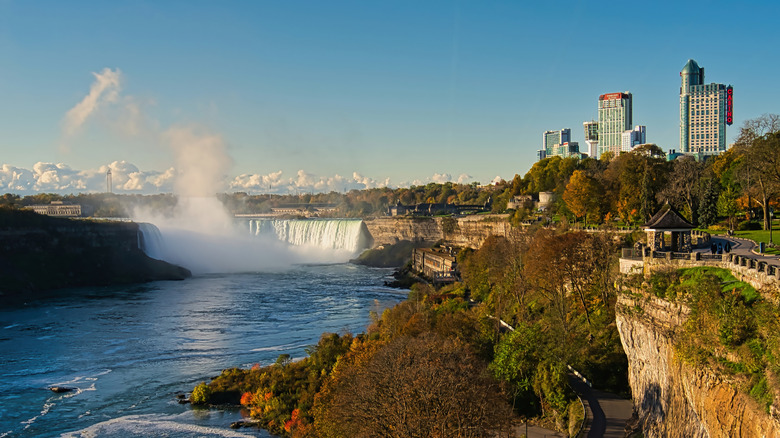
If you've never been to Niagara Falls, you might have the impression that it's a standalone landmark, far from the development of cities, and you wouldn't be alone. "I'd always assumed it was surrounded by forest. They never pan away from the waterfall itself whenever I see it in movies," one Reddit user admits. The falls are surrounded by the aptly named cities of Niagara Falls, located on both the Canadian and American sides. The area is full of kitschy attractions and lots of tourist traps you should skip on a Niagara Falls trip.
On a more immediate level, though, Niagara Falls is also a park. Niagara Falls State Park covers 400 acres of gardens, trails, and landscaping. The park sits about a 26-mile drive from the Buffalo Niagara International Airport, and its entry is free, so you don't need to worry about paying to step onto one of the observation decks over the tumbling torrent. In the park, climbing up the Niagara Falls Observation Tower is a must if you want to see all three waterfalls in a single panoramic vantage. You could also put on a poncho and descend to the Cave of the Winds deck, where you get close enough to touch the Bridal Veil Falls, or hike the Great Gorge Scenic Overlook Trail to see the canyon the river churns through. Afterward, there are plenty of other great activities besides seeing the waterfalls in Niagara Falls (the city) to stick around for.