
Forget Yellowstone, Visit The Midwest's Underrated Hilly Nature Preserve Where Bison Roam Wild
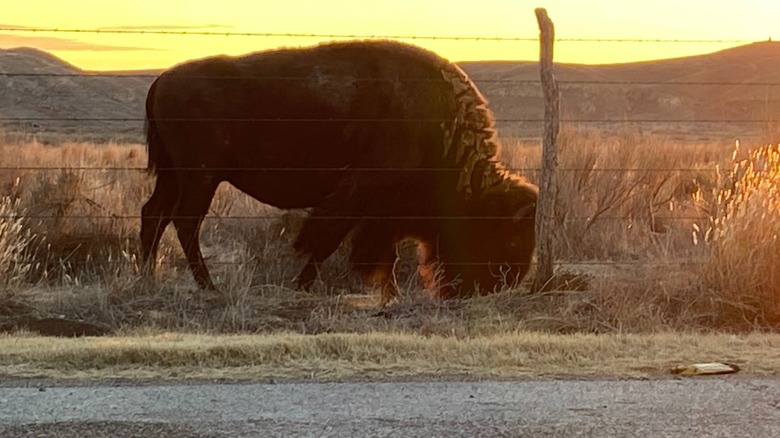
If you want to see bison roam the prairies much the way they did before Europeans colonized the West, don't head for Yellowstone's dramatic landscape of geysers and canyons. The popular national park in Wyoming is a memorable trip, but it won't necessarily give you a feel for what America's vast interior landscape of stately rolling grasslands really looked like once upon a time. For that view, head south to the Red Hills of Kansas, where you'll find a huge herd of bison at Big Basin Prairie Preserve.
Big Basin is a sink a mile wide and 100 feet deep, with rolling hills covered in native prairie grasses. The bison you see at Big Basin aren't just there to decorate the landscape; they're an essential part of maintaining the grassland ecosystem. Bison graze up to 11 hours per day, and once numbered in the millions, but by the 1880s, profligate hunting and the fencing-off of farmland by European settlers had reduced their numbers to the hundreds. Today, herds are being reintroduced to preserves like Big Basin, so the species is no longer endangered, with over 20,000 animals roaming free (with over 400,000 more being raised as livestock).
What to see and do at Big Basin Preserve
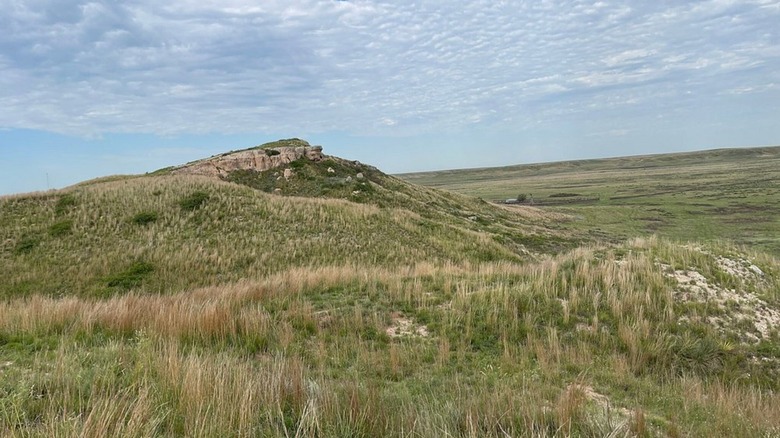
Yellowstone may well be on your bucket list, having been named the best national park to visit in 2026, and that popularity is well-deserved. But Yellowstone saw 4.7 million visitors in 2025, so you'll be contending with crowds there. That won't be the case at Big Basin Prairie Preserve, where you'll find solitude, whether you drive through along Highway 283 to take in the views, stop for the day to get out for a hike or bike ride, or set up for sunset or sunrise to take some unique photographs as magic hour bathes the basin in gold.
The 4.7-mile Little Basin Loop is a gravel road that tours Big Basin and neighboring Little Basin. It can be partially driven in certain conditions, but the best way to see and experience the landscape is to get out and take a hike. Mountain and gravel bikers can also use this trail which takes you past St. Jacob's Well, a 60-foot deep spring that was used as a watering hole on cattle drives out of nearby Dodge City. This is one place you may see bison, as this Tripadvisor visitor did, writing that "...there were approximately 12 buffalo cows with their calves... no traffic, no people, just the Great Plains in the 1880's."
Big Basin is a photographer's dream destination, with the 100-foot basin walls providing wide-open vistas you don't always find in notoriously flat Kansas. Be sure to bring a telephoto lens if you want to get a good shot of those bison. If you're on the road and looking for a quick stop at a viewpoint, take this Tripadvisor reviewer's advice and seek out the gravel road just south of the main parking area on Highway 283, for "spectacular views of the bison herd in the basin below from the ridge surrounding the basin."
How to safely view bison at Big Basin Preserve
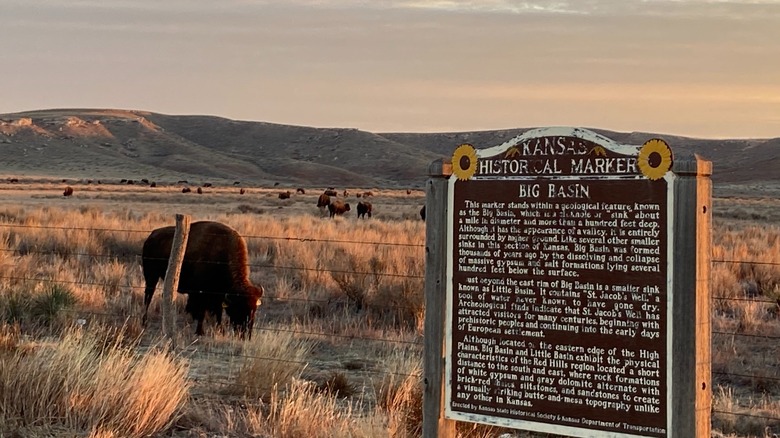
America's official national mammal once blanketed the Midwest's prairies, their numbers in the millions. To help avoid any confusion, bison and buffalo are the same animal; the species' scientific name is bison, while the term "buffalo" is a nickname. Theodore Roosevelt spearheaded the effort to rescue the species from extinction with the founding of the American Bison Society (ABS). The herd of 50 bison at Kansas' Big Basin Prairie Preserve was reintroduced to the region, as were most wild bison in America today. Only the Yellowstone herd can be considered indigenous, although there are plenty of other parks where you can see bison roam.
Bison may look big and bulky, but they are, in fact, quick and agile. In Ken Burns' PBS documentary American Buffalo, they're described as "a souped-up hot-rod of an animal hiding in a minivan shell." Bison can run 35 miles per hour and jump high enough to clear a six-foot fence. This is why visitors must exercise extreme caution around bison. Wild bison can be dangerous if you fail to keep yourself at a safe distance. That is a minimum of 100 feet, per the NPS, which also recommends staying in your car if bison are within 100 feet of the road. According to Popular Science, keeping "enough distance where your thumb can fully cover up the bison when you close one eye" is a good rule.
If you see bison while hiking, again, the advice is to keep your distance and enjoy the wildlife encounter from afar. If they are on the trail in front of you, wait for them to move along. Turn back if need be, and never try to shoo them off the trail. Signs a bison is agitated include pawing the ground, snorting, and raising its tail.