
Rick Steves Says This Breathtaking Attraction In France Was Once 'Europe's Cultural Heartbeat'
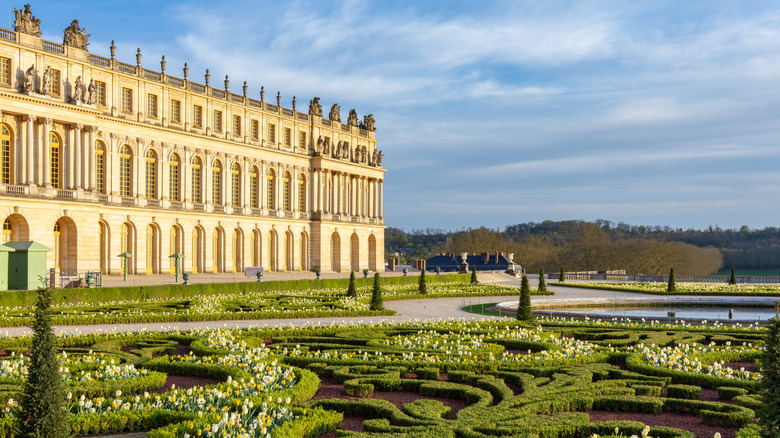
France is the most visited country in the world, drawing over 100 million tourists each year. While Paris is the country's bastion of art and culture today, about 18 miles west lies the Palace of Versailles, which was once "Europe's cultural heartbeat," according to travel expert Rick Steves. First built in 1623 as a hunting lodge, the palace was expanded into a Baroque architectural marvel in the mid-17th century by King Louis XIV. By the early 18th century, this royal landmark was the ultimate symbol of France's power, beauty, and grandeur, brimming with fine art, elaborate music performances, decadent balls, and acres of landscaped gardens. As Rick Steves says, "all Europe continued to revolve around Versailles," and what happened at the court of Versailles set the standard for the rest of the continent.
While the palace saw the rule of three kings, Versailles is often linked with the palace's last residents, Louis XVI and Marie Antoinette, whose expensive lifestyle was one of the many triggers of the French Revolution in 1789. Though the Revolution effectively put an end to the court at Versailles, the palace has endured as one of Europe's most important landmarks. Renowned for its opulence and its significance in world history, the Palace and Park of Versailles was certified as a UNESCO World Heritage Site in 1979. Today, Versailles continues to draw millions of visitors each year to explore its highlights, from the breathtaking Hall of Mirrors to the magnificent gardens.
The Palace of Versailles is open year-round from Tuesday through Sunday from 9 a.m. to 6:30 p.m., but Rick Steves says to avoid visiting on certain days of the week. The palace is about a 90-minute drive from Paris Charles de Gaulle Airport (CDG) or an up to an hour train ride from central Paris.
What to see inside the Palace of Versailles
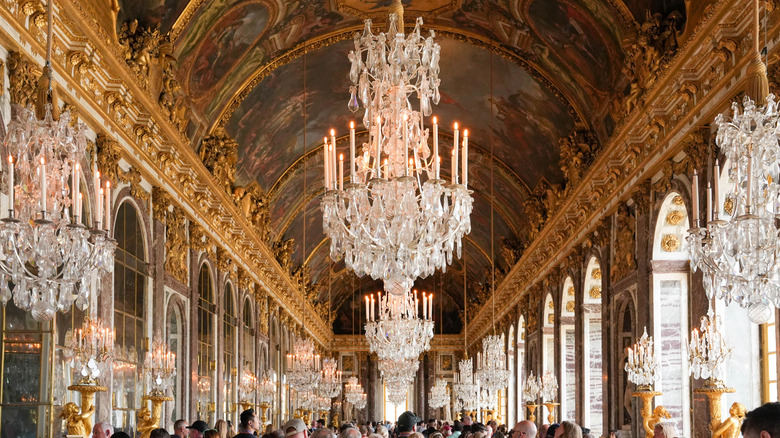
A true feat of architectural engineering and designed in the French Baroque style, the Palace of Versailles covers about 680,000 square feet. As the site of the royal court, Versailles functioned as its own self-enclosed city. According to Rick Steves, the "heart of the palace" is the gilded Hall of Mirrors, an over 230-foot long gallery flanked by 17 wall-size mirrors. From here, Steves says you can "fully appreciate the epic scale of Versailles" as the grand hallway overlooks Versailles' vast manicured gardens. The Hall of Mirrors stretches between the King's State Apartment and the Queen's Apartments. The royal couple's separate apartments were lavish salons adorned with tapestries, paintings, and sparkling chandeliers where the king and queen would entertain guests, play games, and sleep in opulent bedchambers. "The Queen's Bedchamber is a highlight — the silk wall hangings and the 'hidden' door Marie Antoinette used to flee during the Revolution add a chilling layer of history to the luxury," wrote a Tripadvisor reviewer.
Another impressive space is the soaring Royal Chapel, resembling a traditional Gothic cathedral but crowned by one of the most spectacular painted ceilings. Inside the gilded Coronation Room, the focus shifts from the kings to Napoleon, who became the Emperor of the French in 1804. Here, you'll see the large-scale painting of Napoleon's coronation, painted by Jacques-Louis David.
If you want to experience the lifestyle of French royalty, you can even spend the night at Versailles. Airelles Grand Controle du Versailles, which is located inside the gates of the palace, is a boutique retreat with just 14 sumptuous guest rooms and suites. Included in your nightly rate are tours of the palace after it closes to the public and golf carts for exploring the grounds at your leisure.
Exploring the gardens of Versailles
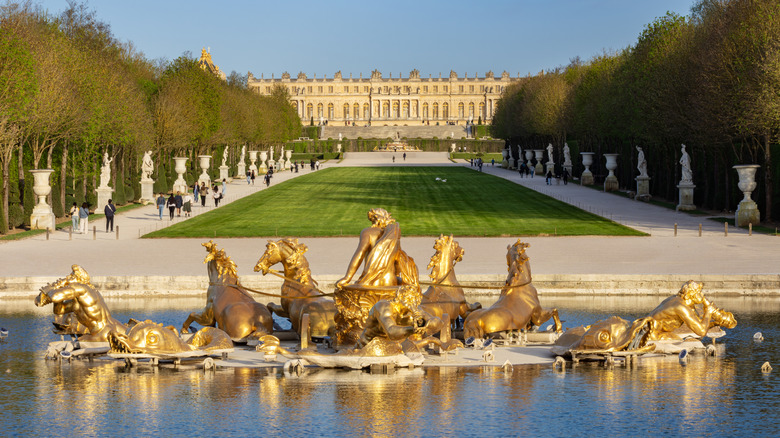
Matching the grandeur of Versailles' interiors are its expansive, 250-acre gardens. The gardens were planned by King Louis XIV to show "that he could control nature," according to Rick Steves. First designed in the mid-17th century, this green heartbeat of the estate is the perfect place for a picturesque stroll at any time of year and offers spectacular views of the palace itself.
Just as the palace is composed of a series of rooms, the gardens are also made up of distinct outdoor spaces. Right beneath the palace is the Orangery, a lush garden carved out in fanciful designs and surrounded by seasonally blooming fruit trees. The gardens' most famous fountain is arguably the Apollo Fountain, a grand water feature including a 17th-century gilded sculpture of Apollo guiding a chariot of horses. Here, Steves says King Louis XIV, who was known as the "Sun King," was associating himself with Apollo, the Greek god of the sun. Another significant fountain is the Neptune Fountain, which revealed an extremely innovative system of nearly 100 water jets in the mid-18th century. A special experience at Versailles is the Musical Fountain Show, a grand spectacle where the gardens' series of fountains are synchronized to classical music. These shows are held between April and November.
Also hidden within Versailles' grounds is a duo of impressive palaces: the Grand Trianon and the Petit Trianon. The Grand Trianon was built in 1670 for King Louis XIV as a romantic escape for him and his mistress, while the Petit Trianon was built in 1768 and later became the private abode of Marie Antoinette. If you want to explore another gorgeous chateau nearby, head about a 40-mile drive east to Vaux-le-Vicomte, which Rick Steves adores above all the rest in Paris.