
Between Atlanta And Augusta Is Georgia's Once-Thriving Village That's Now Ruins Found Through A Forest Hike
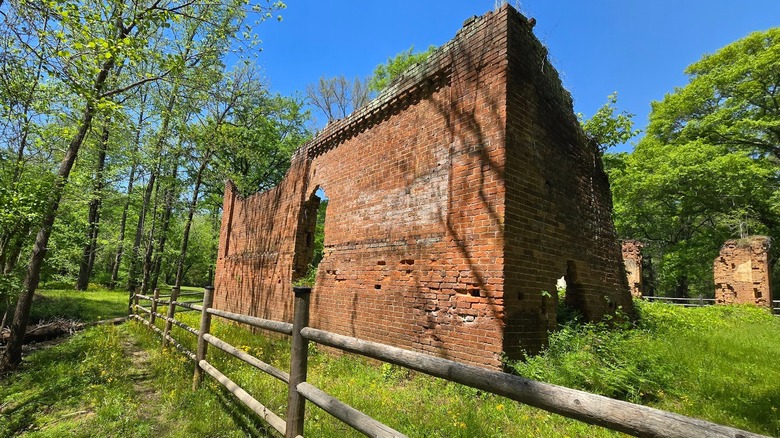
Crumbling brick walls flanked by overgrown plants stand near the shores of the Oconee River, a testament to the ebb and flow of time, nature, and industry in the early decades of Georgia's history. Located halfway between Atlanta and Augusta, Scull Shoals in Greene County, Georgia, isn't hard to find despite being an abandoned site. But it's hard to imagine the ruins of this once-thriving village in a remote part of the Oconee National Forest once housed a booming textile production facility, as well as Georgia's first paper mill built in 1810 (although it stopped being used just five years later in 1815).
European settlers founded the village in 1784. The compound name of "Scull Shoals" derives from the scull of a boat and the Oconee River's shoals, which are also known as sandbanks or sandbars. However, some purport the term "Scull" originated from the unearthing of skeletal remains — namely skulls — in nearby ritual mounds. The shoals made the river difficult to navigate by boat, but ideal for powering mills. By the early 1800s, Scull Shoals had a sawmill, a grist mill, a cotton gin, and the aforementioned paper mill. In the 1850s, Scull Shoals' primary enterprise was cotton production, which was done using slave and prisoner labor alike — although the town did ultimately employ 600 people as yarn and cloth makers once business expanded. By 1854, the cotton milling operation boasted 2,000 spindles and looms and processed $200,000 worth of cotton.
Ultimately, the town's financial success also proved to be its downfall. Cotton farming had removed almost a foot of the land's topsoil, which was deposited into the river and thereby enlarged the shoals, making the area more prone to flooding. Disastrous floods eventually hit the village, and the largest one in 1887 led to its destruction and abandonment by 1900. Now, all that's left are the dilapidated remnants of 19th-century buildings. If you're hoping to see similarly old structures that are a little more intact, you can visit the Georgian ghost town of Auraria, a once-booming gold rush town that's now abandoned, which lies a couple hours northwest of Scull Shoals.
What you'll find in the ruins of Scull Shoals
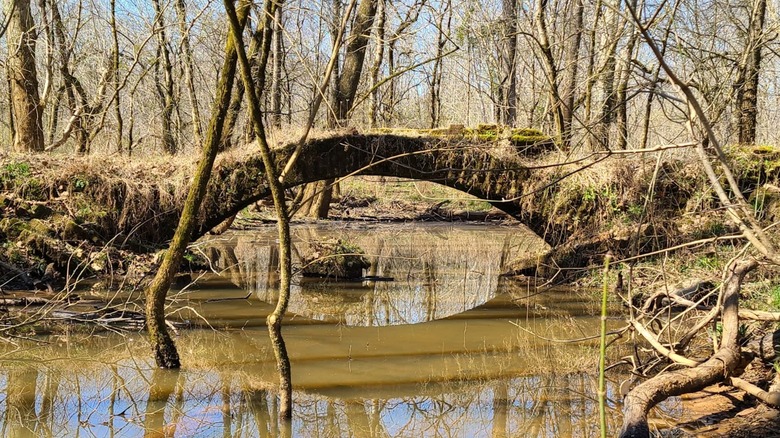
When visiting the ruins of Scull Shoals, what you'll see depends on the temperament of the Oconee river, which still floods to this day. Parts of the ruins, like an arched bridge that workers once used to access the mill, may not be visible when water levels are high. As one Google user put it, Scull Shoals is a "solid lesson on the environmental impact of careless industrialism." Unfortunately, not much is left over from the original worksite; the town's machinery was scrapped for use in the 1940s for World War II, and many of the buildings were also taken apart.
That said, many evocative remnants of this historic village still stand, including a few leftover brick walls from the combination store and warehouse built in 1846. You can also spot scattered stone bits of the old mill's foundation, as well as pieces of an 1809 toll bridge that was destroyed in the massive 1887 flood. You can still see one large granite support beam that originally scaffolded the bridge sitting in the river, though. While an on-site map notes the locations of each building, the ruins themselves aren't marked, so you'll have to use a bit of imagination to figure out what's what.
The site is maintained by the U.S. Forest Service and the non-profit organization Friends of Scull Shoals, which has conducted archaeological research at the site over the past few decades. If you'd like to learn more about the site's history, you could try contacting some of the group's members by email.
What to know before visiting Scull Shoals
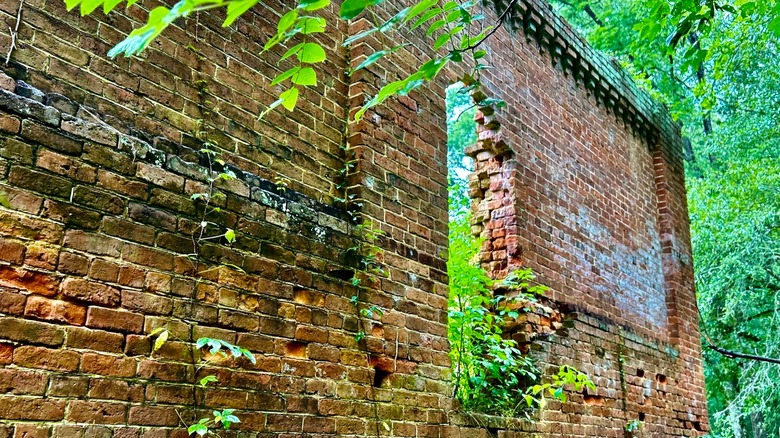
It's just a 0.8-mile out-and-back hike to see the ruins of Scull Shoals, but these days, the trail is just as overgrown as the ruins are. Many have noted that the trail is barely maintained, so it can be hard to find. You can download AllTrails or a similar app to find the path, then download the map for offline access (cell service is purportedly spotty in this area). To protect yourself from ticks and other insect bites, be sure to wear pants and insect repellant. Since it can get muddy along this trek, hiking poles may help you navigate the wilder parts of the trail.
Per one reviewer on Google, coming here is like "stepping into another world," noting that even despite navigation difficulties, the remnants of old trails add "to the magic of the place." There aren't any facilities here besides picnic tables, so consider bringing a snack — and perhaps a book or a pen and paper — for when you take a break, since there isn't much else to do here. Since Native Americans first populated the area roughly 10,000 years ago for hunting and gathering purposes, sitting at this site means you'd be basking in the atmosphere of a place with thousands of years of human history behind it. This destination thus makes for a compelling offbeat adventure suitable for individuals, couples, and families alike, although it may not be of much interest to small children.
To access the path leading to Scull Shoals, you first have to drive down a gravel road for about two miles, which can get bumpy and laden with ruts. The historic site is an hour and 40 minutes east of Atlanta, and it's just over an hour and a half west of Augusta, Georgia's most charming and walkable college town. So, it's a great stop if you're driving between the two major cities. It's also just 45 minutes from the artsy and family-friendly college town of Athens, making Scull Shoals a relatively easy day trip excursion from a variety of Georgia's major cities.