
Halfway Between Baltimore And Philly Is Pennsylvania's Former Mining Site That's Now A Scenic Park With Trails
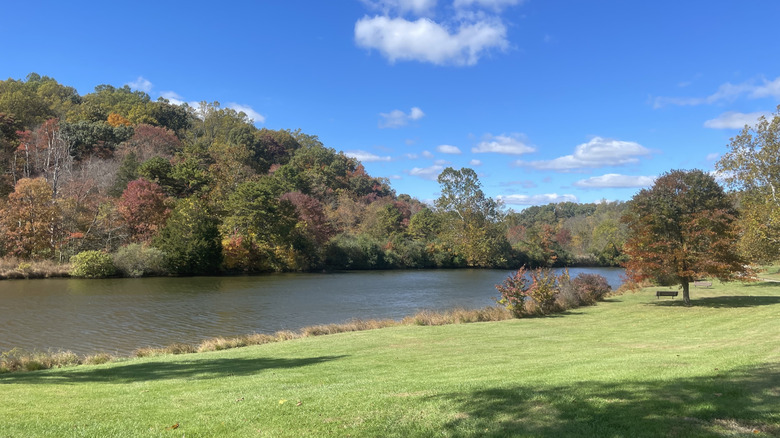
Pennsylvania's rich industrial history is an intrinsic part of America's growth, yet much of that industry is now gone as progress continues. You can see some of its remnants at Nottingham County Park in southeastern Pennsylvania. Mining ruins rest in a beautiful parkland strewn with hiking trails that pass by historical landmarks, offering an intriguing blend of nature and history.
Its 731 acres include a generous selection of amenities, including accessible playgrounds, covered picnic spots, and areas for games and sports, according to Chester County. It has even enjoyed the status of being a National Natural Landmark since 2008. This scenic park is especially vibrant in the fall when its trees exhibit hues of rust and gold.
Small, tree-lined lakes and ponds are tucked away to get some fishing in, although they are only for catch and release of bluegill and bass, according to Chester County Parks and Preservation. Ducks and turtles languidly paddle and laze about in the water, and creeks trickle through the greenery, adding to the calm beauty of the park. Visitors can find it nearly equidistant from Baltimore-Washington International Airport (BWI) and Philadelphia International Airport (PHL), driving just over an hour either way.
The industrial curiosities and history of Nottingham County Park
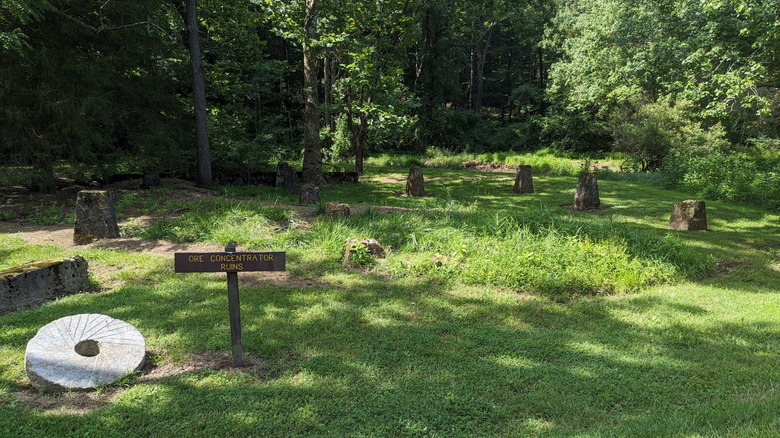
Before its dedication as a park in 1963, the area that is now Nottingham County Park was the site of mining operations that dug up chromite from rare serpentine barrens. The chromite was used to manufacture a colorant and possibly for weaponry. Ruins of ore production facilities can be seen in the park, surrounded by trees, as a stark reminder of the park's Industrial Age use compared to today's increased focus on conservation.
Serpentine was also quarried for use in local construction, according to Friends of the State Line Serpentine Barrens, which notes that some of its use was from quarries near the historic college town of West Chester. It's known for being inhospitable to a great variety of plant life and is often used as an ornamental gemstone and carved into sculptures.
The park's feldspar quarries include an enigmatic, water-filled hole, locally known as the Mystery Hole due to the discovery of a 1920s automobile in its depths, as told by ArcGIS. According to Chadds Ford Live, feldspar had several uses, including toothpaste, pottery, and glass. It was even used in early orthodontics. These days, the noise and pollution of mining have been replaced by peaceful green parkland enjoyed by local families.
Scenic trails meander through the park
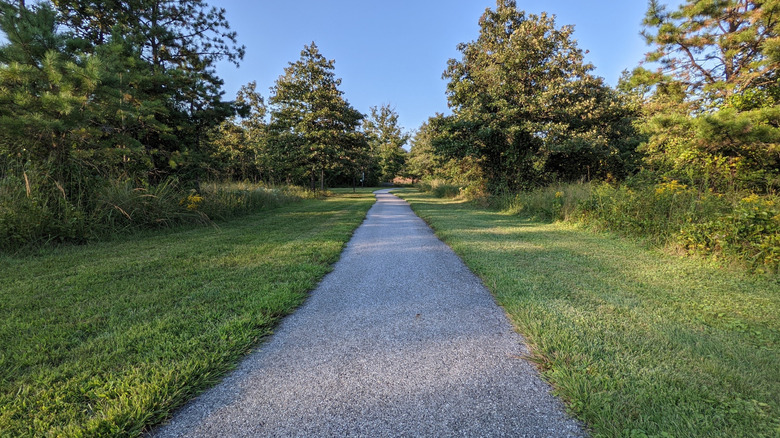
Most of the curious sites in Nottingham County Park can be seen along its beautiful trails. The Feldspar Trail takes you to the feldspar quarries and allows you a glimpse of the Mystery Hole. It is an unchallenging stroll of less than a mile. The tree-lined Nottingham Fitness Trail is dotted with exercise stations and is great for a jog or easy stroll, giving you a scenic break from the gym.
One of the longer routes, at a little over 3 miles, is the Buck Trail, which takes you past former mining sites and swaths of wildflowers. An AllTrails reviewer found the flowers to be a pleasant surprise, saying, "What I didn't expect to see on this visit was the large amount of tiny wildflowers along the edge of the trails. Lots of narrow-leaved blue-eyed grass flowers everywhere, azure bluets and large field chickweed."
Beauty and history are equally spread throughout Pennsylvania, and a satisfying portion of it can be gleaned from a road trip to places like the state's oldest city, Chester, an hour away from the park. You can drive the same amount of time to get a glimpse of America's earliest industrial heritage at the Hopewell Furnace National Historic Site.