
The Largest Green Space In Downtown Seattle Is A Park Packed With Stunning Sculptures And A Scenic Trail
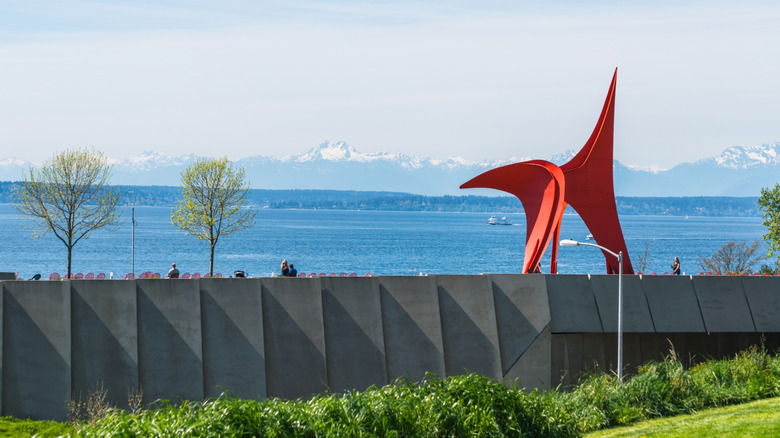
If you're visiting Seattle and feeling split between heading to an art museum or to the waterfront, there's a place where you can experience both: a park that sits just a 20-minute bus ride from downtown Seattle and a 20-minute walk north of the Seattle Aquarium. This park is the Olympic Sculpture Park — according to Visit Seattle, it's the largest green space in the city's downtown area, and it also doubles as an open-air art gallery overlooking Elliott Bay. Here, visitors can explore over 20 sculptures that rise from grassy hillsides and shoreline viewpoints. The 9-acre park's landscape also features ample greenery along a zigzagging path that intersects with the longer Elliott Bay Trail.
Opened in 2007 and operated by the Seattle Art Museum, the Olympic Sculpture Park isn't simply a public space for viewing art — it's also an ecological restoration project. Established on a former petroleum storage facility, the park upended the contaminated industrial site and replaced it with replications of four specific habitat types that are native to the Pacific Northwest. These habitats include an evergreen forest, an aspen grove, grassy meadows, and a shore. The latter shore habitat has even proved to be helpful with the recovery of local salmon populations. Unlike most traditional parks that feature sprawling, uniform lawns, visitors at the Olympic Sculpture Park can pass through shifting landscapes as they admire monuments both big and small.
Take a leisurely stroll and admire the art on view at the Olympic Sculpture Park
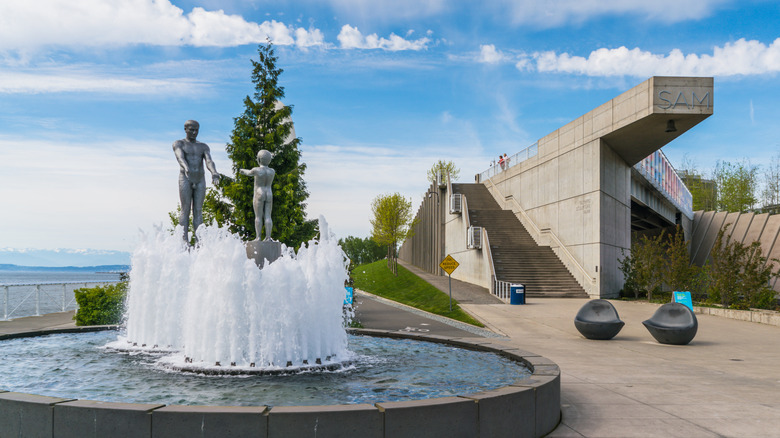
The Olympic Sculpture Park is in the central neighborhood of Belltown, a Seattle neighborhood every visitor should explore (for both fun and food). An entrance lies right off of Western Avenue. The paved 2,200-foot path gradually winds downwards toward the waterfront. Along the way, you'll spot contemporary sculptures standing among the firs, cedars, and ginkgos of the evergreen valley habitat. Where the path turns into a bridge over Elliott Avenue, you'll find one of the park's most prominent sculptures: Alexander Calder's "The Eagle," a massive red arc of steel that's become one of Seattle's notable sights. Beyond "The Eagle" lies the aspen grove, where a snaking path leads to Tony Smith's fortress-like "Stinger."
After you pass another bridge, you'll have reached the waterfront. The walkway meets the Elliott Bay Trail at a corner dotted with Louise Bourgeois's eye-shaped bench sculptures. Following the shoreline will take you to more sculptures, where you'll get a view of the Space Needle in the distance. At the end of the trail is a rocky pocket beach, which supports a tidal garden of kelp, algae, and other plants. Here, you can get close to the water for views of ferries and seals drifting by in Puget Sound, and on clear days, you can even see the Olympic Mountains.
Despite being among the most impressive sculpture parks in America, admission to the Olympic Sculpture Park is completely free. That said, if you're looking for a unique way to experience the park, you might like the idea of reserving a mini golf time slot there for fees ranging between $10 and $15. As of summer 2026, the park hosts a nine-hole mini golf course, with each hole having been designed by a local artist. Visitors can also opt to extend their walk here by continuing along the Elliott Bay Trail, which spans 5 miles and links to other bayside attractions, such as Seattle's redeveloped Waterfront Park.