
The World's Quietest Country Of 2026 Is A Safe Mountainous Paradise With Idyllic Nature To Escape Crowds
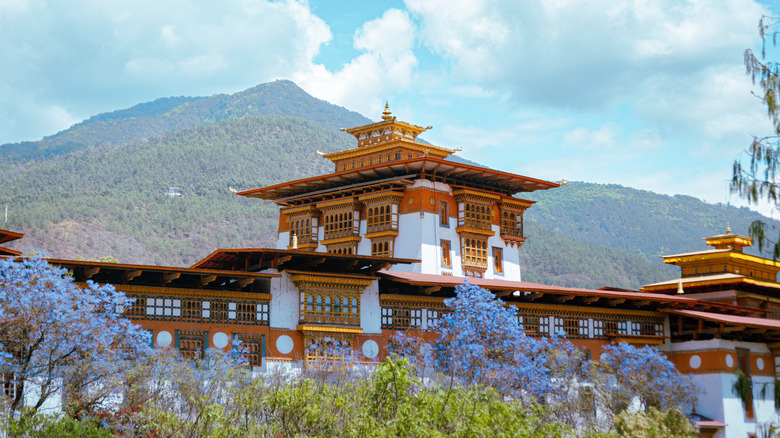
Today, there's a seemingly nonstop influx of sounds from cities, technology, and media that clutter our daily lives. While a vacation can help you escape your own everyday noise, traveling introduces many other overstimulating sounds, from navigating busy airports to being in large crowds of tourists. However, some countries are simply louder than others. In Go2Africa's 2026 study to find "the Quietest Countries in the World," one safe, peaceful nation stands out: Bhutan.
Go2Africa's Noise-Free Nations Index scores each country to reflect its "environmental tranquility," taking into account factors such as population and tourism density, rural and protected lands, and the prevalence of motor vehicles, airports, and trains. Bhutan scored an impressive 89.44, boasting large areas of protected, rural landscapes and highly regulated tourism. Noise pollution is more than just a nuisance; it can impact your sleep, cardiovascular system, and mental health (per the Center for Occupational and Environmental Health). With that in mind, trekking through the South Asian country's peaceful Eastern Himalayan landscape and visiting its Buddhist mountain monasteries can be a truly healing experience.
The rest of the top 10 is made up of African and South American nations with less population density and large expanses of open terrain. When comparing these nations with the loudest country in the world, Singapore (which had a score of 6.78), it's easy to draw a line between noise pollution and human activity and technology. However, there's a reason the top placements are so quiet, as some nations aren't travel-friendly and reject mass tourism. Bhutan's travel industry is quiet in and of itself, preserving the silence and its stunning mountainous environment for locals and inquisitive visitors.
Bhutan's quiet, sustainable tourism

Just looking at Bhutan's official tourism website, you get a sense of its quiet essence of eco-tourism. Here, you won't find any telltale signs that a tourism spot isn't worth the hype simply because crowds of visitors don't exist. Although tourism rates are growing steadily in Bhutan, the country received about 209,376 visitors in 2025, with an all-time high of 315,599 in 2019 (via Best Bhutan Tours). Numbers are so low primarily because traveling to Bhutan isn't ultra accessible. Visitors from most countries must pay a $100-per-day Sustainable Tourism Fee, in addition to a one-off $40 visa fee, with discounted rates for children. While this may seem steep, the government fee goes towards forest conservation, healthcare, education, and infrastructure.
In the past, visitors were required to travel with an accredited tour provider, but tourists can now book their accommodations independently. However, trekking Bhutan's incredible mountains is not allowed without a tour operator or guide (and you'll definitely want to explore its stunning landscapes). Not to mention, having a guide allows for a more authentic experience to discover the country's natural splendors and rich culture.
Plus, you won't have to look for warning signs that your guide isn't trustworthy, as Bhutan is a safe, peaceful country. Per data compiled by World Population Review, Bhutan scores 1.546 on the Global Peace Index, which measures a country's safety, conflict, and militarization. At the time of this writing, the U.S. Department of State lists Bhutan at a Level 1 travel advisory, meaning visitors should "exercise normal precautions." Bhutan's harmonious Buddhist philosophies are also felt throughout the day-to-day culture and traditions.
Exploring Bhutan's mountain landscapes and nature preserves

According to Go2Africa's study, Bhutan surpasses other nations when it comes to the amount of rural and protected areas. Although Bhutan is a small country, the World Wildlife Fund claims that "More than 51% of the country is protected — the largest percentage of any Asian country." With national parks, nature reserves, wildlife sanctuaries, and biological corridors throughout Bhutan, it's no wonder why it is one of the only carbon-negative countries in the world, meaning it emits fewer greenhouse gases than it absorbs (via World Population Review).
Bhutan is also one of the world's most mountainous countries, and its position within the Eastern Himalayas offers pristine treks. In the northern and central parts of the country, you can embark on challenging treks through the Great and Inner Himalayas, while the southern part of the country lies within the foothills. The Jigme Dorji National Park in northwest Bhutan is one of the oldest national parks in the country, home to endangered species like the Bengal tiger and snow leopard. Here, you can gaze upon verdant rice fields tucked between forested hills, trek alongside rugged mountain peaks glistening with snow, and listen to the profound silence found at the Lingzhi Dzong monastery (which houses around 30 monks).
Bhutan's highest peak is Gangkhar Puensum at over 24,800 feet, and it is famously the tallest unclimbed mountain in the world, as mountaineering above 19,600 feet (6,000 meters) is banned in Bhutan for spiritual reasons and lack of high-altitude emergency rescue services. Instead, the Druk Path Trek is a 33-mile route from Bhutan's capital of Thimphu that passes through blue pine forests, alpine lakes, and mountain monasteries. At its highest point, Labana Pass, you can soak in views of Thimphu Valley and Gangkhar Puensum (on a clear day). Although this path is popular, the trails are anything but crowded, leaving plenty of space for the country's trademark silence.