
One Of Japan's Largest Artificial Lakes Is A Serene Gem With Trails, A Floating Bridge, And Mountain Views
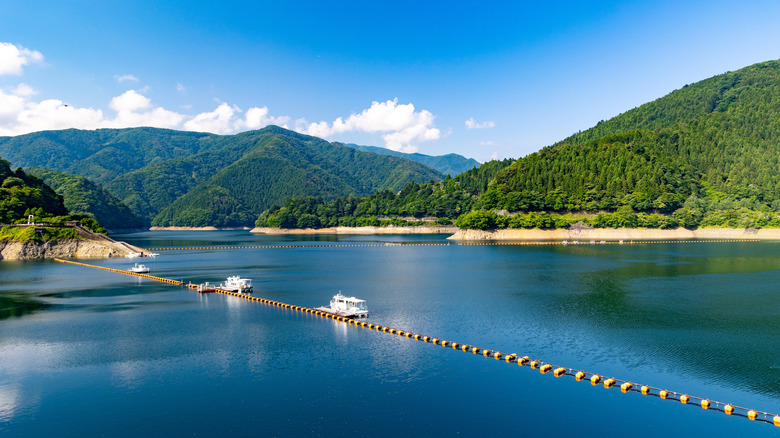
An enormous reservoir stretches through the forested mountains of western Tokyo, with deep-blue water reflecting the surrounding peaks and trails on its shoreline. Lake Okutama, also known as Ogouchi Reservoir, holds about 185 million cubic meters of water (nearly 50 billion gallons), making it Japan's largest reservoir dedicated exclusively to water supply, according to the Tokyo Convention & Visitors Bureau site Go Tokyo. For travelers, though, its appeal is less about the infrastructure than what that infrastructure has created. Visitors can hike the sinuous Lake Okutama Ikoino Michi, take in the reservoir from observation decks, or cross the Mugiyama Floating Bridge as it bobs above the water.
Lake Okutama is a prime example of the range of Tokyo's landscapes, trading skyscrapers for a broad lake picture cradled in mountains. Tokyo's highest point — Mount Kumotori at over 6,600 feet — is one of the peaks near Lake Okutama. Trees crowd the enveloping slopes right down to the water, with minimal disruption around the shores and wooded trails. "The lake has a serene atmosphere which is very soothing after experiencing busy Tokyo," a Google Maps reviewer wrote, and numerous other reviews have attested to the calmness of the setting. You won't find manicured beaches or boating access here. Instead, the reservoir's appeal lies mainly in being a scenic hiking destination, where you might take in the surrounding foliage from the floating bridge or climb up to the Ogouchi Dam Observation Tower to look down over the water.
Explore Lake Okutama's floating bridge and trails
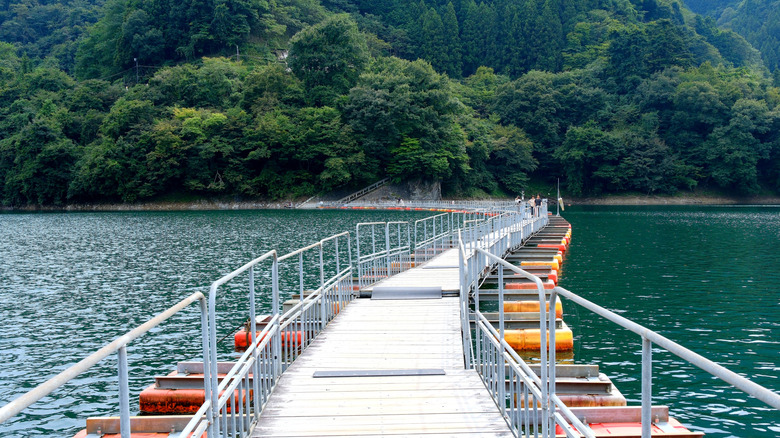
Swimming doesn't have to be the only way to experience lake waters. Lake Okutama offers a unique way to get out on the water: Visitors can walk across it on the Mugiyama Floating Bridge, also called the "Drum Can Bridge." It's supported by drum-shaped resin that floats on the lake, giving the bridge a slightly bouncy, swaying feel as you walk over the water. The bridge is free to pedestrians when open, but it can close for extended periods when the reservoir's water level drops. At the time of writing, the Tokyo Metropolitan Bureau of Waterworks cautions that the bridge is closed due to low water levels, so visitors should check its status before planning a visit. In the meantime, the Mugiyama Floating Bridge can still be viewed from the surrounding shoreline and trails.
Longer hikes make it possible to spend several hours immersed in Lake Okutama's mountain scenery. The Ikoino Michi ("Path of Relaxation") meanders for 12 kilometers, or about 7.5 miles, along the reservoir's southern shore, from Ogouchi Dam to Yamano Furusato, a natural park. Ridgeline Images notes that the trail is mostly gentle, winding through forest, where you might encounter some Japanese macaques. For something with more historical character, the Okutama Mukashi Michi ("Old Okutama Road") passes mountain vistas, shrines, dōsojin (roadside guardian) statues, and deserted rail tracks. It winds for 9 kilometers, or around 5.5 miles, leading from Okutama JR Station to the lake. (On any trail, make sure to pack out your trash, as littering is among the tourist behaviors that rub Tokyo locals the wrong way.)
To get to Lake Okutama from central Tokyo, you can take Japanese Railways, one of the most affordable ways to travel in Japan, from Shinjuku Station to Okutama Station. From there, buses connect the station to the lake, for a journey of slightly over two hours. Once you've had your fill of mountain air and lakeside trails, head back toward the city to reward yourself at one of Tokyo's best ramen shops.